

3D sensor technology
The automated grape harvest
"In vino veritas" is the saying. A very simple truth is that the grape harvest comes before enjoyment. But how? By hand or automatically?

The romantic image of the grape harvest, which is often taken up in films and has certainly inspired one or two Hollywood stars to acquire their own vineyard, does not last long in view of figures such as an annual drinking volume of 20 liters per capita in Germany alone. These figures mean a lot of work in a short space of time for the 80,000 or so winegrowers in Germany, who cultivate and harvest wine on around 102,000 hectares. As a result, many winegrowers use state-of-the-art harvesting machines, so-called grape harvesters, instead of manual labor. A grape harvester can be used variably and can successfully harvest 1 ha in three to five hours. To achieve the same result with a grape harvest 'by hand', around 40 to 60 workers would have to be employed.
Accurate to 3 cm

With 'EasyPilot', Grégoire, manufacturer of tool carriers and fruit fullers, offers a system for automatic line guidance using sensors with a precision of 3 cm without a GPS position signal.
© ifm electronicOne manufacturer of grape harvesters is the French company Grégoire. These vehicles can be optionally equipped with the 'EasyPilot', a system for automatic line guidance. It has an accuracy of 3 cm - without the use of satellite signals. The 3D sensor system 'O3M' from ifm is used to record the vine line. It continuously measures the scenery in front of the harvester 'point by point' using ifm's patented PMD (Time-of-Flight) technology. This digitized environment in front of the machine allows the general condition of the vines to be captured and displayed in abstract form. Errors caused by lateral vines or tall grasses are minimized.
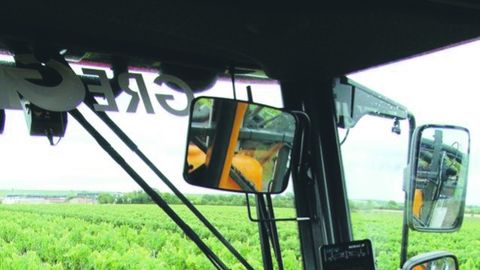
Lean back until the next row of vines: 'EasyPilot' is an automatic line guidance system based on the 'O3M' sensor system from ifm, which largely turns the driver into an observer.
© ifm electronicAs the grape harvester drives over the vines, it forms a tunnel under the driver's cab. This tunnel contains fiberglass rods that generate vibrations. This 'shakes' the row of vines in the tunnel, causing the grapes to fall onto a conveyor belt. This conveys them into a collecting container. A fan blows away unwanted elements such as leaves and branches.
Another sensor is located at the top center of the grape harvester cab. This sensor is aimed at the ground and determines the height and thickness of the grape bunches. A guidance track generated after the signal processing represents the row of vines as a model. The optimum route is calculated on this basis. Once the machine is in the row of vines, the driver starts the 'EasyPilot' via the screen in the driver's cab. Once the system has started, the driver only has to keep an eye on the working speed and monitor the tools - the system takes care of the rest. At the end of the row of vines, a visual and acoustic signal informs the driver that he needs to lend a hand to turn the grape harvester and steer it to the next row of vines.
Author:
Marie-Claire Fink works in Corporate Communications at ifm electronic in Essen.


You might also be interested in
Sensors for good wine
With the help of sensors, winegrowers can obtain information on the ripeness, quality, yield prospects and disease risks of their vines.
 read more...
Hydraulic cylinders become smart
Avoiding sudden machine breakdowns and optimizing maintenance routines - what operator of mobile machinery wouldn't want that? Vehicles can provide the necessary information automatically - for example with the help of position measurement in...
read more...Schaeffler manufactures electric motors
Schaeffler is entering electric motor production with a modular technology platform. Series production is planned from 2021.
read more...Mobile robotics in semiconductor production
Semiconductor production is complex and intricate. Hundreds of production steps are required before the finished product is ready. One challenge here is the transportation and handling of sensitive components from one step to the next.
read more...AGVs and robots - cornerstones of modern intralogistics
Increasing efficiency is a requirement that applies not only to the production process, but also to upstream and downstream warehouses. An example from the beverage industry shows what modern automated guided vehicles (AGVs) can achieve in this...
read more...Micromotors in use with diving robots
Deep-sea diving robots have to function reliably up to 10,000 meters below sea level and withstand enormous pressures - a particular challenge for the drive technology used, among other things.
read more...Thermal images guide autonomous robot 'Anymal'
When autonomous robots such as 'Anymal' help to search for casualties in rough terrain, thermography is almost indispensable.
read more...New drive concept for driverless shuttles
Automated guided vehicles are an essential cornerstone of modern intralogistics concepts. In order to meet the demand for compact systems, innovative design solutions are required - including in terms of drive technology.
read more...Smart support
Mobile devices are inexpensive, constantly online and with their apps, up-to-date information is quickly available at all times. This also opens up potential in the industrial environment, but requires well thought-out integration.
read more...