
Thermography
Thermal images guide autonomous robot 'Anymal'
When autonomous robots such as 'Anymal' help to search for casualties in rough terrain, thermography is almost indispensable.
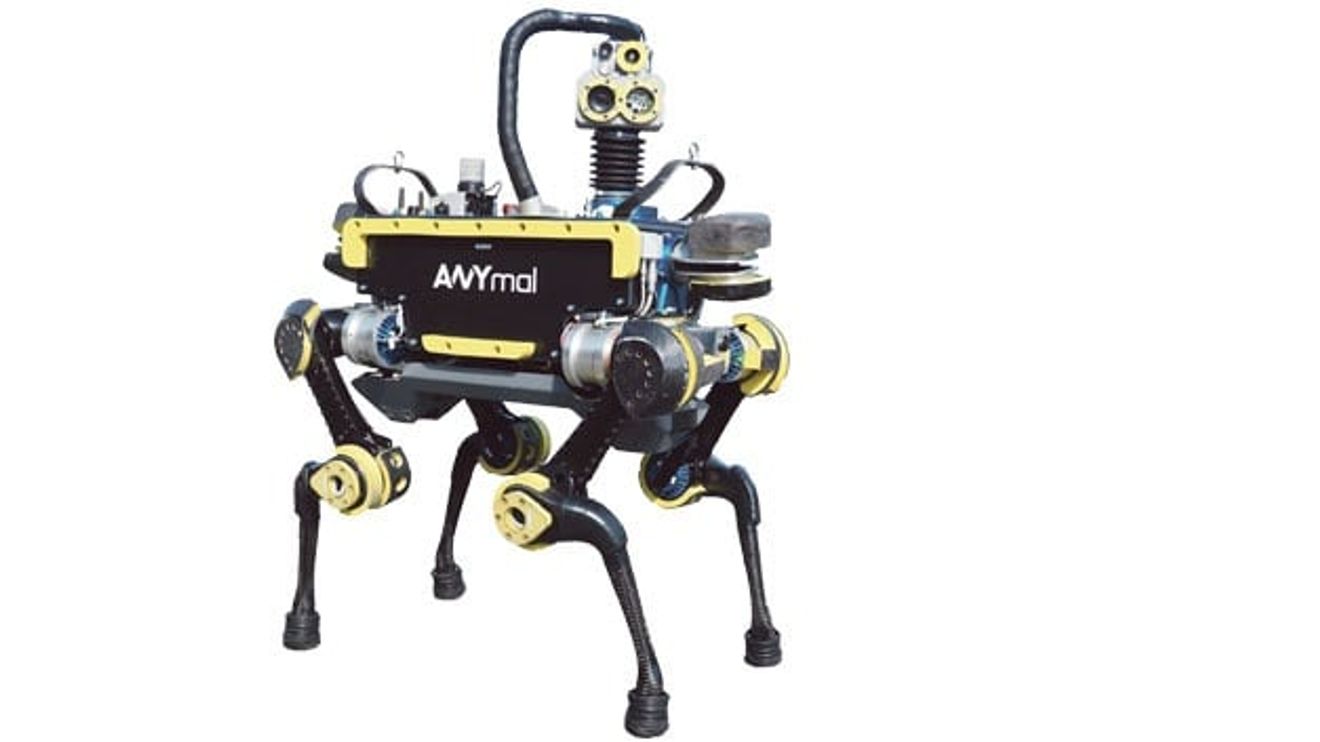
The 'Anymal' robot from Anybotics, whose movements resemble those of an animal, is used to search for people, among other things. The technology is mounted on four flexible legs - for example batteries for two to four hours of operation or sensors that give it autonomy. The four legs and the mobility of its joints, which can be rotated through 360°, enable Anymal to climb, jump, run, crawl or even dance. It is therefore particularly suitable for use in rough terrain: the robot can be used after earthquakes, for example, when scattered rubble makes it difficult to access buried people. A large number of sensors provide the robot with a precise sense of detection so that it can quickly and specifically search for people during mountain rescue, bomb disposal or after earthquakes - especially in places where it is too dangerous to use people for rescue.
Weighing just 30 kg, the Anymal operates completely autonomously. Among other things, it has been fitted with laser sensors to enable it to move around safely; with their help, the robot detects obstacles.
Thermography on board
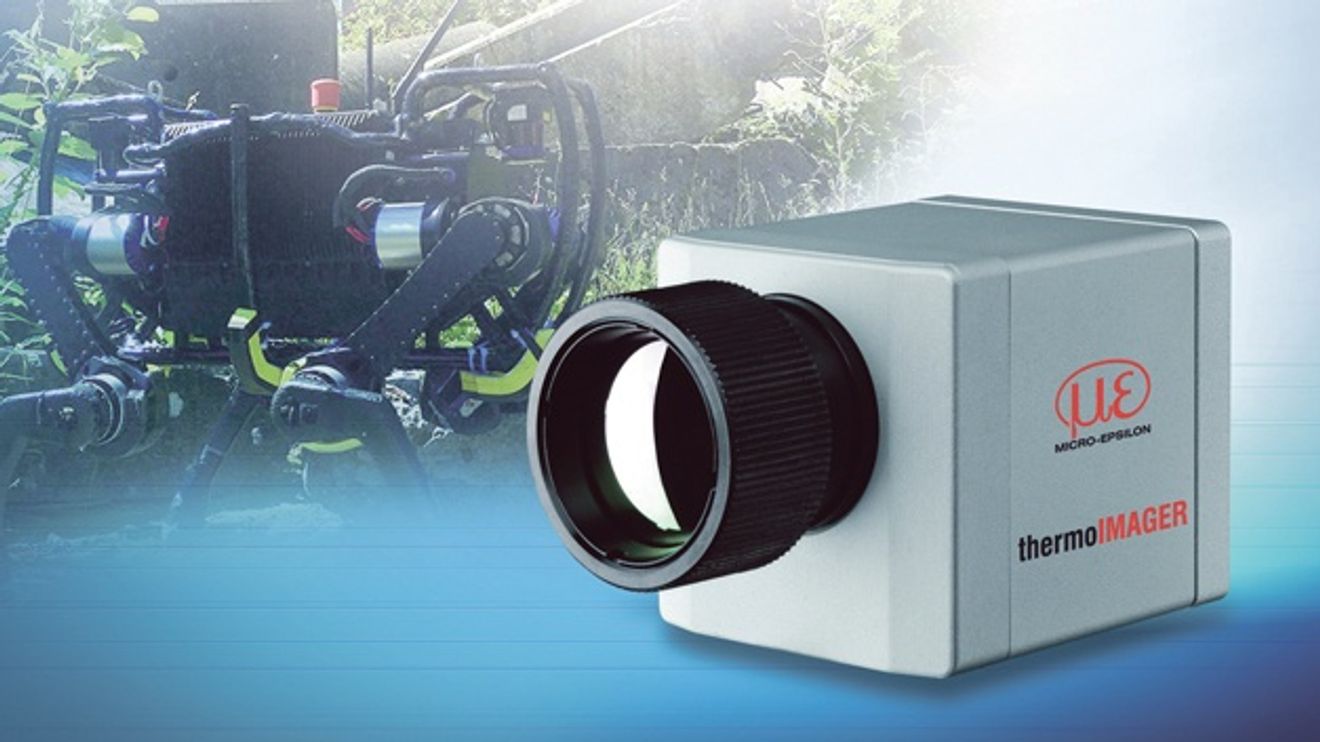
The autonomous robot 'Anymal' is primarily used to search for people who have had accidents. Among other things, it is equipped with a thermal imaging camera with a frame rate of 120 Hz.
© Micro-EpsilonMicro-Epsilon's 'Thermo Imager TIM 160' thermal imaging camera is housed in Anymal's swivel-mounted inspection head; it performs non-contact temperature measurement. The required temperature range that the camera should reliably detect is between -20 and +350 °C with an accuracy of around 2 % of the measured value. In addition to the thermal imaging camera, Anymal's inspection head also houses an RGB zoom camera, microphones and a gas detection sensor. The freedom of movement of the entire system enables the targeted inspection of hard-to-reach areas.
Using 'TIM', the robot scans its surroundings to find unusually hot spots, so-called hotspots, and can therefore issue alarm signals at an early stage. This is necessary for rescue operations, but can also be used in industrial environments to monitor machines and processes: The main areas of application of thermal imaging cameras in industry are the analysis of dynamic thermal processes in product and process development, stationary use for continuous monitoring and control of thermal processes and occasional use as a portable measuring device in the maintenance sector and for detecting heat leaks. They are also used in flight thermography for surfaces that are difficult to see from the ground.


... the 'thermoImager TIM 160' thermal imaging camera from Micro-Epsilon. It is used for non-contact temperature measurement.
© AnyboticsIn contrast to pyrometers, thermal imaging cameras do not detect and measure temperatures at a point, but on a surface. They work like digital cameras and have a field of view (FOV). This can be adapted to the application by selecting a suitable lens. In the infrared range, thermal radiation can only be focused by optics made of germanium or with surface mirrors. Compared to conventional, mass-produced lenses in the visible spectral range, such coated optics are a considerable cost factor for thermal imaging cameras, as they are designed as spherical 3-lens or aspherical 2-lens lenses and must be calibrated for thermometrically correct measurements, especially for cameras with interchangeable lenses, with regard to their influence on each individual pixel.
Infrared radiation is emitted by any body whose temperature is above absolute zero. In a detector, the energy of the infrared radiation is converted into electrical signals, which are then converted into temperature values based on the calibration of the sensor and the set emissivity.
Contactless measurement
Based on this evaluation, the measured temperature can be shown on a display, output as an analog signal or shown on a computer via a digital output. The measurement is contactless, which enables fast and reliable temperature measurements of moving, hot or hard-to-reach objects. While a contact temperature sensor could influence the temperature of a measured object and possibly damage or contaminate it, the non-contact method guarantees precise measured values at all times without contact.
Authors:
Péter Fankhauser is Robotics Software Engineer at Anybotics in Zurich;
Manfred Pfadt is Product Manager Sensors at Micro-Epsilon Messtechnik in Ortenburg.
The beginnings of thermography
The discovery of thermal radiation dates back to 1800, when the astronomer and musician Wilhelm Herschel directed sunlight through a prism. Using a thermometer, he examined the area behind the red end of the visible spectrum. The temperature there rose and he concluded that some kind of invisible energy must prevail. The term 'thermal radiation' was coined, which is still in common use today, but was later replaced by 'infrared'. Over the years, lenses made of rock salt and arrangements of thermopiles were used, which formed the basis of the first thermal cameras.
In 1840, the temperature distribution on surfaces was made visible by Herschel using different evaporation rates of a thin film of oil. Thermal paper, which changed color through direct contact with warm surfaces, was also used for visualization. The breakthrough in non-contact measurement came in 1880 with Samuel Pierpont Langley's invention of the bolometer, which was used to detect icebergs or for rescuing people.


You might also be interested in
Autonomous trucks in everyday operation on the A9
Autonomous trucks from DB subsidiary Schenker are currently on the A9 highway between Munich and Nuremberg with loads. Federal Transport Minister Andreas Scheuer is convinced that this will make transportation safer, more efficient and more...
 read more...
International Federation of Robotics
Industrial robot sales increase by 29% worldwide
Global sales of industrial robots reached a record 380,550 units in 2017. China recorded the highest growth in demand for industrial robots with an increase of 58%. In the USA, sales rose by 6% and in Germany by 8% compared to the previous year.
read more...Probably the fastest goalkeeper in the world
Messi, Neymar and many other soccer greats have tried, but none of them have been able to beat this goalkeeper on the penalty kick. There is no human between the posts, but a robot - the 'RoboKeeper' - and probably the fastest goalkeeper in the...
read more...Hydraulic cylinders become smart
Avoiding sudden machine breakdowns and optimizing maintenance routines - what operator of mobile machinery wouldn't want that? Vehicles can provide the necessary information automatically - for example with the help of position measurement in...
read more...Schaeffler manufactures electric motors
Schaeffler is entering electric motor production with a modular technology platform. Series production is planned from 2021.
read more...Mobile robotics in semiconductor production
Semiconductor production is complex and intricate. Hundreds of production steps are required before the finished product is ready. One challenge here is the transportation and handling of sensitive components from one step to the next.
read more...AGVs and robots - cornerstones of modern intralogistics
Increasing efficiency is a requirement that applies not only to the production process, but also to upstream and downstream warehouses. An example from the beverage industry shows what modern automated guided vehicles (AGVs) can achieve in this...
read more...Micromotors in use with diving robots
Deep-sea diving robots have to function reliably up to 10,000 meters below sea level and withstand enormous pressures - a particular challenge for the drive technology used, among other things.
read more...New drive concept for driverless shuttles
Automated guided vehicles are an essential cornerstone of modern intralogistics concepts. In order to meet the demand for compact systems, innovative design solutions are required - including in terms of drive technology.
read more...