
Agricultural technology
Sensors for good wine
With the help of sensors, winegrowers can obtain information on the ripeness, quality, yield prospects and disease risks of their vines.
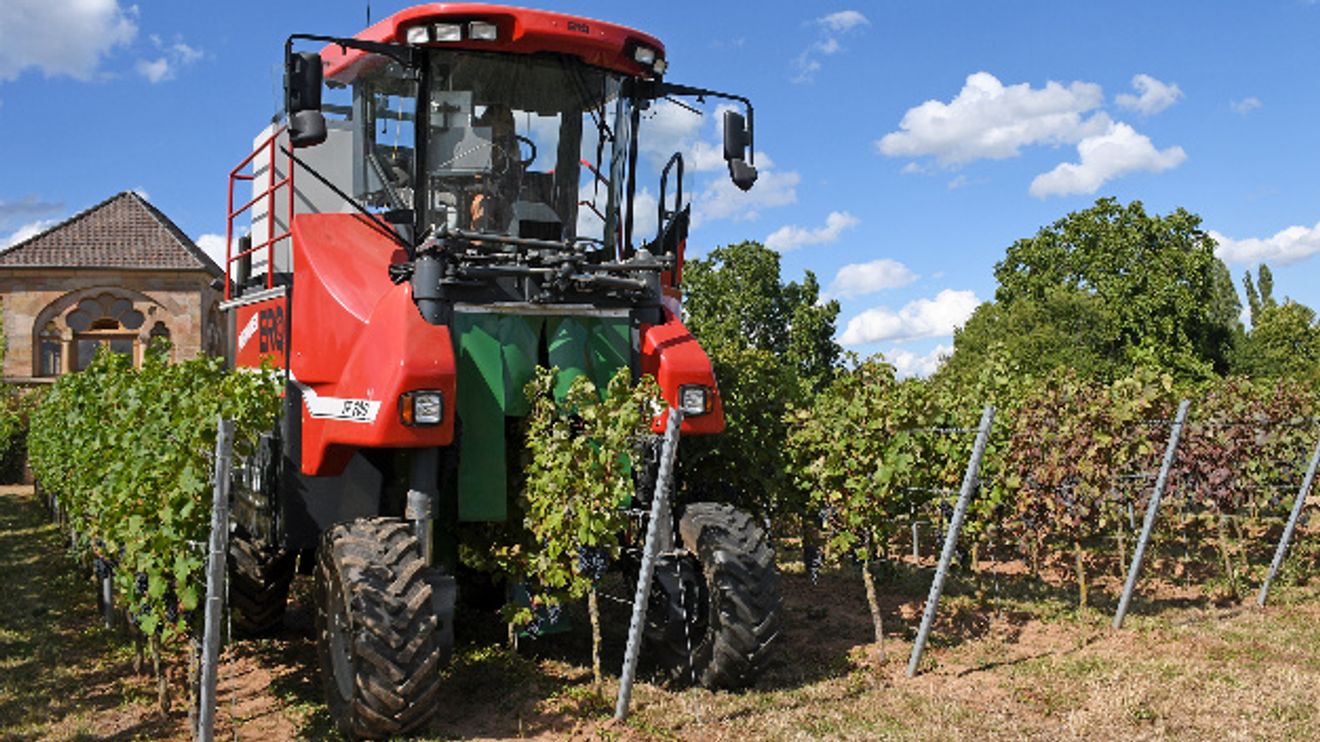
At the Julius Kühn Institute for Grapevine Breeding at the Geilweilerhof in Siebeldingen (Südliche Weinstraße district), agricultural biologist Anna Kicherer is testing the 'Phenoliner': here, the devices of a grape harvester have been replaced by optical devices and a geo-information system. Hardly any daylight penetrates the tunnel inside the vehicle. Artificial light sources ensure that the difficulties caused by changing light conditions and changing backgrounds outside can be avoided during measurement. In addition to the broadband light sources, various sensors (RGB, NIR camera system, GPS and position sensors) are housed in the vehicle so that the 'Phenoliner' can record high-quality data with precise location information under standard conditions without external interference. This allows a lot of information on the phenotype of the grapes to be collected without having to test them destructively in the laboratory.
Until now, phenotyping has been very time-consuming and labor-intensive. People simply estimated the phenotypic data visually, a process that is subjective and prone to error. Today's sensors make it possible to record plant characteristics in a non-destructive way and to make reliable and objective measurements.
"We see the 'Phenoliner' as a test platform with the long-term vision that winemakers will also be able to use it," says Kicherer. The assessment of grapes as small, large or medium could become much more objective with this image-based technology. In grapevine breeding, such information is of crucial importance in order to be able to assess the special features of new varieties. "When it comes to developing genetic markers, you have to bring phenotype and genotype together," says Kicherer. This means that the external appearance must be traced back to the respective genetic make-up.
The 'phenoliner' is just one of several examples of possible efficiency increases through digital technologies in viticulture, says Ernst Büscher from the German Wine Institute: "Already today, only the healthy grape berries can be sorted out after the harvest using optical systems." In the near future, it will also be possible to use drones to protect plants on steep slopes that are difficult to access.


You might also be interested in
The automated grape harvest
"In vino veritas" is the saying. A very simple truth is that the grape harvest comes before enjoyment. But how? By hand or automatically?
 read more...
Sogar der Wein wird smart
Das IoT findet in allen Applikationen seinen Einstieg, neuestes Beispiel ist der Weinbau. MyOmega hat mit TracoVino ein System entwickelt, das einen umweltschonenden und effizienten Weinanbau ermöglichen soll.
read more...Roboter für 'Farming Intelligence'
Serviceroboter in der Agrarwirtschaft säen, entfernen Unkräuter, düngen und versorgen Tiere zunehmend autonom. Eindrucksvoll: 2012 waren über ein Drittel der verkauften Serviceroboter Feldroboter.
read more...From sensor to intelligent system
Sensors, measurement technology and artificial intelligence are merging to form intelligent systems. From June 9 to 11, 2026, Sensor+Test in Nuremberg will showcase the most important trends in a changing industry.
read more...Changes to the Endress+Hauser Executive Board
Three new people will strengthen the top management level of Endress+Hauser in the future: The Board of Directors has appointed Dr. Mirko Lehmann, Prof. Dr. Katja Windt and Helena Svensson to the Group's Executive Board.
read more...Sensors and measurement technology
Application start for AMA Innovation Award 2026
The AMA Association for Sensors and Measurement (AMA) is inviting scientists and developers from industry and research to apply for the AMA Innovation Award 2026. We are looking for research and development results in sensor and measurement...
read more...Industrial AI at SPS | Endress+Hauser
"AI will become a natural functional component"
Industrial AI is also becoming increasingly relevant in process automation: although field devices themselves still make little use of it, it is already proving helpful in evaluation and peripheral devices as well as control systems. Christian...
read more...Slight decline in incoming orders
The sensor and measurement technology sector recorded no change in turnover in the third quarter of 2024 compared to the previous quarter. However, turnover fell by 10% compared to the third quarter of 2023. Incoming orders were 2% below the level...
read more...Chip start-up founded
The start-up milli IC from Karlsruhe specializes in the development of ASICs - and Vega Grieshaber is 'on board' to ultimately develop radar measuring devices with radar frequencies of more than 100 GHz.
read more...