
Gas sensors
The artificial nose
Until now, measuring and evaluating gases has been the task of multiple sensor systems. Now, a type of 'artificial nose' should make it possible to selectively detect a large number of organic and inorganic compounds with just one conventional metal oxide sensor.

Alongside solid and liquid, gaseous is one of the three classic states of aggregation. Well-known gases are oxygen, helium, hydrogen and propane - to name just a few. However, there are also complex gas mixtures such as cigarette smoke, alcohol vapors or various gases that are produced in fires. In the event of danger, each gas requires a special reaction in order to limit the damage: In the event of a fire, for example, windows must be closed tightly to prevent oxygen from providing additional fuel for the fire. Gas escaping from gas pipes, on the other hand, requires all windows to be opened as wide as possible as an immediate measure in order to neutralize the escaping gas.
Gas sensors are used to measure and evaluate the respective gases. On the one hand, these are powerful components that perform their tasks quickly and reliably. At the same time, however, they are extremely complex components that often only achieve their true performance potential through more complex circuitry. Well-known concepts use so-called sensor arrays, for example, which are used simultaneously for measurements. Each sensor generates an individual measured value for all gases - as a result, these different measured values generate a characteristic gas imprint for the respective gas type. This creates unique patterns that can be stored in a library, similar to a fingerprint file, and compared for matches as required.
The disadvantage of this physical array technology is that the individual sensors react differently to changes in humidity, temperature and gas concentration as well as their long-term drift behavior. This sometimes results in distortions, meaning that sensor arrays often have to be recalibrated. The maintenance effort and costs involved are high. Added to this is the considerable power consumption of these multiple sensor systems.
Fingerprint for every gas
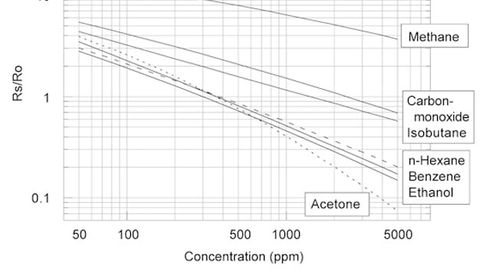
Relationship between sensor signal and gas concentration in a double-logarithmic diagram.
© Figaro EngineeringThe development team at Unitronic has come up with a more modern alternative to the conventional method: The 'virtual multifunctional gas sensor array' (VGSA) uses just a single miniature gas sensor based on an oxide semiconductor, which can differentiate between the various gases by means of a special evaluation. The sensor determines the type of gas based on the gas-induced distortion of periodic temperature jumps: semiconductor sensors have the property of reacting with varying degrees of sensitivity to gases in the event of temperature fluctuations. To increase the measuring accuracy, the 'USM-VGSA' uses intelligent temperature control. There is an optimum temperature environment for each gas, which provides optimum measurement results. In addition to temperature modulation, the module evaluates the conductivity (impedance) of the sensor that a gas causes. Until now, signal processing has generally only involved evaluating the ohmic resistance of a sensor.
By using the Unitronic solution, the calculated signals are free from the effects of humidity, drift of the absolute value and the memory effect. The module uses a special, highly sensitive evaluation process with innovative algorithms and techniques. The technology uses a single semiconductor sensor to generate several individual sensor signals and thus corresponds to a virtual sensor array. The sensor parameters obtained contain complex gas-typical and long-term stable patterns that represent a kind of fingerprint for each gas.
Virtual sensor array

Qualitative statements about the type of gas are made schematically by analyzing the USM-VGSA. The virtual sensor array represents a kind of third dimension, which usually consists of 48 values.
© UnitronicDue to the combined complex evaluation and temperature modulation, the use of the sensor creates a new form of evaluation graphs: Normally, the simple relationship between sensor signal and gas concentration can be displayed in a double-logarithmic diagram. However, this does not allow any qualitative statements to be made about the type of gas. This is different with the analysis of the USM-VGSA, where this is done schematically. The virtual sensor array represents a kind of third dimension, which usually consists of 48 values, whereby more or fewer virtual sensors can also be used. The values determined are variable on the Z-axis as absolute values, but stable in relation to each other.

Gas analysis: A metal oxide sensor detects various inorganic and organic gaseous compounds. The result is a virtual multifunctional gas sensor array.
© UnitronicThe function of the 'artificial nose' is ultimately based on certain aspects, each of which has a different effect on the sensor element due to its chemical composition. The penetration of the gases into the sensitive active layer of the sensor is different for each gas.
To determine relevant results, the sensor 48 evaluates different sensor influence variables and extracts them from the sensor layer. This creates a virtual 48-sensor array. The 48 measured values are gas-specific, creating a kind of 'fingerprint' for each gas. The typical data of the respective gases are not influenced by cross-influences such as humidity, temperature and gas concentration. Values determined by the sensor are stored in a file and are available for comparison at any time during a measurement. If the system is presented with an unknown gas or gas mixture during an analysis procedure, it compares the characteristics with the data in the stored files. If the gas in question is present in the stored file, it is easily identified. If necessary, the system can readjust itself independently at any time, eliminating the need for costly manual zero air recalibration.
Author:
Eduard Schäfer is Head of the Sensors Department at Unitronic in Düsseldorf.
Fields of application for intelligent gas sensors
- Fire detection systems for early fire detection. The analysis process recognizes which material is currently burning and supports the individual detection of different types of fire.
- Gas alarm detectors, which can be used to explicitly identify and record exactly which gas is present in an environment. Different gases have different explosion limits - concentrations that are considered uncritical for one gas can cause the formation of an explosive mixture in the same concentration for another gas. With conventional measuring methods, cleaning agents such as alcohol or solvents can also trigger a false alarm if they are used in the same room. A more accurate gas analysis can prevent such false alarms.
- Analysis to prevent major damage to industrial systems. Here, sensors can be used to specifically search for certain substances that are emitted before an immediate total crash.
- In the 'white goods' sector, gas sensors are used to detect air quality. Difficulties often arise here with regard to cross-sensitivities to humidity and temperature. The Unitronic analysis method counteracts this problem without the need for additional expensive sensors to compensate for it.
- Manufacturers of industrial filter systems can benefit from this by specifically analyzing the gases behind the filter in order to detect filter breakthrough in good time.


You might also be interested in
Interface diversity
Unitronic has added the TRB 245 and TRB 255 industrial gateways from Teltonika Networks to its in-house 'Sensor2Cloud' portfolio. The TRB 245 is a small industrial LTE Cat 4 gateway with a variety of input/output, serial and Ethernet connections
 read more...
Security-relevant applications in mobile communications
Unitronic presents the RUT955 dual SIM 4G/LTE and WiFi mobile router from Teltonika Networks.
read more...News from the industrial computer sector
What's new on the market for industrial PCs and operating systems? Our picture gallery shows you the latest products from these areas.
read more...Cooling system manufacturers under pressure to act
An EU regulation is intended to help reduce harmful emissions in the industrial sector by 2030. However, the requirement to replace fluorinated greenhouse gases and carry out leakage checks is putting cooling system manufacturers under pressure. Gas...
read more...Useful peripheral functions included
The Mangoh Red hardware platform is now part of Unitronic's Sensor2Cloud portfolio.
read more...New products at embedded world 2018
From February 27 to March 1, 2018, the Nuremberg exhibition halls made room for everything to do with embedded systems technology. Computer&AUTOMATION presents a selection of new products that were on show at the stands of the 16th embedded...
read more...News from the field of big data
As part of the big data trend, many new products are coming onto the market - from boards, gateways and data loggers to software and security solutions.
read more...LPWAN - an alternative for the industry?
LPWAN technologies such as LoRaWAN, Sigfox or NarrowBand IoT have specific advantages and disadvantages compared to other data transmission technologies. But which ones? And to what extent are they really suitable for industrial applications? Five...
read more...News from measurement technology
What innovations are there for industrial users on the measurement technology market? Computer&AUTOMATION has summarized a selection of new products in a series of pictures.
read more...