
Low Power Wide Area Networks
LPWAN - an alternative for the industry?
LPWAN technologies such as LoRaWAN, Sigfox or NarrowBand IoT have specific advantages and disadvantages compared to other data transmission technologies. But which ones? And to what extent are they really suitable for industrial applications? Five experts from the industry give their views.
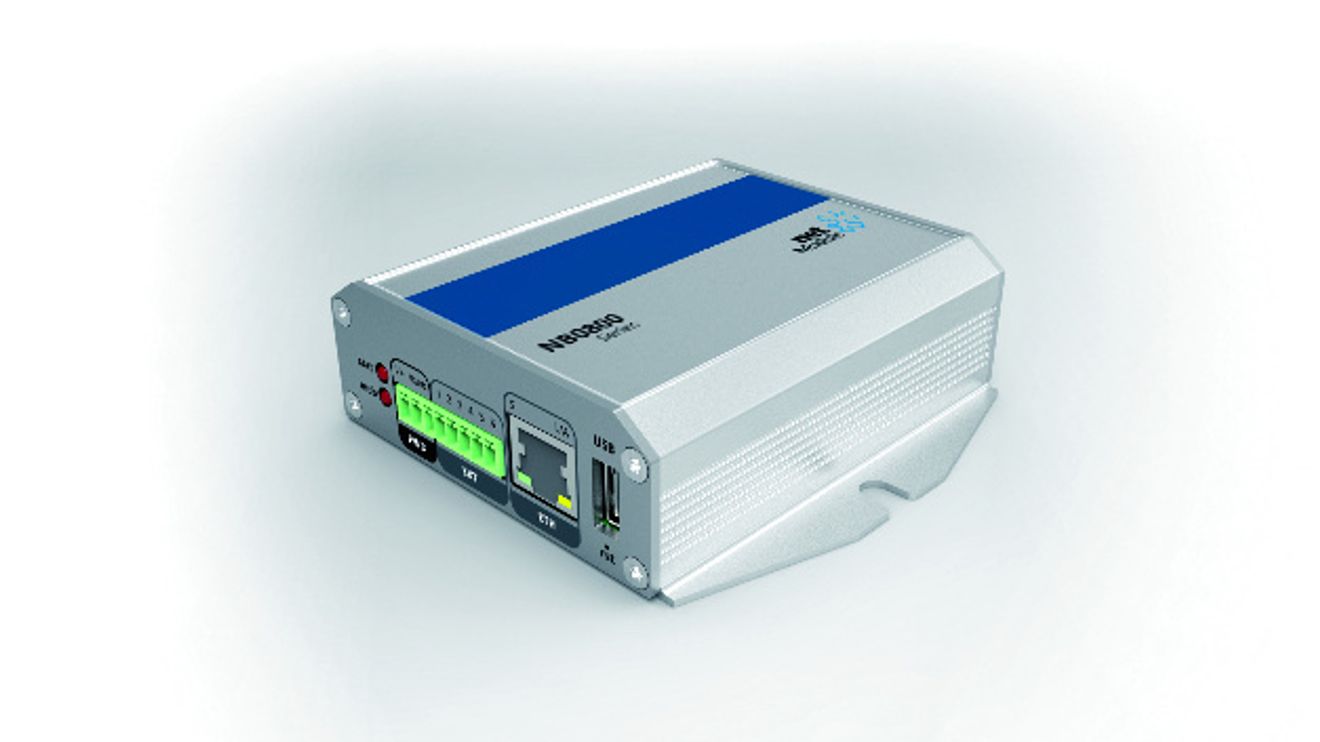
The industrial wireless routers of the "NB800 EcoRouter" series from NetModule support LoRa, Sigfox and 6LoWPAN on request.
© NetModule
Stefan Zimmermann, comtac: "LPWAN is inexpensive, reliable and economical - both in terms of installation and operation."
© comtacCondition monitoring and predictive maintenance - LPWAN (Low Power Wide Area Network) is predestined for these applications. But why? Stefan Zimmermann, Managing Director of comtac, explains.
Is LPWAN even suitable for industrial applications?
Stefan Zimmermann: LPWAN is generally suitable for applications that require long ranges or reliable reception under difficult conditions, but that manage with low data volumes and are not extremely time-critical - also and especially in industry.
For which industrial applications is LPWAN suitable?
The specific properties of LPWAN define the area of application. From comtac's point of view, LPWAN is particularly suitable for applications that have to do with condition monitoring or predictive maintenance in the broadest sense. Because comtac can in principle make any sensor and actuator with a digital interface LPWAN-capable, the number of possible applications is ultimately limitless.
Is LPWAN an alternative only to wireless or also to wired communication technologies?
The answer depends on the suitability profile. Where the requirements for data rates and response times are not too high, LPWAN impresses with its low power consumption and good radio range as an alternative to wired standards as well as to WLAN or mobile radio.
What are the advantages and disadvantages of LPWAN in certain industrial applications compared to other wireless and wired communication technologies that could also be considered for these applications?
LPWAN is inexpensive, reliable and economical - both in terms of installation and operation. Wherever the limits of the technology (maximum data rate, response time) do not play a role and no existing cabling can be used, LPWAN can be the first choice as a solution.
What are the advantages and disadvantages of the various LPWAN protocols for industrial applications?
We take a pragmatic approach and specialize in LPWAN-based solutions, which we currently offer for LoRa and Sigfox. These two standards have one major advantage: they are available here and now. LoRa is available in Switzerland as a public network and is also well suited in Germany (and ultimately the rest of the world) for companies that want to operate a private network. Sigfox has the advantage of already being available as a public network in large parts of the world - including Germany and other EU countries. As soon as other LPWAN protocols are widely available and in demand in markets relevant to us, we will adapt our solutions accordingly.
Does it make sense for industrial companies to set up an LPWAN network infrastructure themselves or should they use the services of an infrastructure provider?
This question can only be answered on the basis of an individual situation and requirements analysis. An existing public LPWAN network is certainly often the most obvious solution. However, there are also good reasons for operating your own networks - maximum data security, ensuring reception under difficult conditions (indoors, unfavorable topography) or the desire to be able to offer an LPWAN-based solution worldwide.
m2m Germany: Small data volume plus long range equals LPWAN

Dr. Erik Lins, m2m Germany: "LPWAN is suitable for applications with a long range and low data volumes."
© m2m GermanyWhen small amounts of data need to be transmitted over relatively long distances, for example in monitoring and logistics, LPWAN is the ideal solution. Dr. Erik Lins, Technical Director at m2m Germany, explains the background.
To what extent is LPWAN suitable for industrial applications?
Dr. Erik Lins: That depends on the specific application. In general, LPWAN is suitable for applications with a long range and low data volumes. Because there is hardly any cabling involved, it is ideal for retrofitting. It is less or not at all suitable for real control functions.
In which industrial applications can LPWAN demonstrate its advantages?
For monitoring functions, for example, where only a small amount of data needs to be transmitted. Thanks to its range, LPWAN reduces cabling costs and/or can create redundancy for existing monitoring functions. Examples include room air monitoring or fire and water detectors.
Other applications include logistics functions such as localizing, locating and identifying load carriers and controlling them within a production chain. Using active tags, things such as load carriers can send information about themselves, which is received by gateways (even over a certain distance) and made available to a central process control system.
As soon as an application no longer concentrates on just one building, LPWAN (e.g. LoRa) is an alternative. Mobile radio 2G/3G/4G/NarrowBand IoT beyond this; goods can also be monitored during transportation.
To which wired and wireless communication technologies in industry is LPWAN an alternative?
LPWAN is an alternative to simple wired bus systems such as RS-232 or RS-485 with low data volumes, but even then only to a very limited extent. Under no circumstances is LPWAN an alternative to real field buses such as Profibus.
Sometimes LPWAN is an alternative to WiFi/WLAN and has the advantage of a greater range. With WiFi, up to 500 m is possible, and with LoRa, several kilometers can be bridged.
In which cases does it make sense for industrial companies to set up an LPWAN network infrastructure themselves, and in which cases is it advisable to use the services of an LPWAN infrastructure provider?
It is not the size of the company that is decisive, but rather the application itself and the sensitivity of the data. Whenever the data should not leave your own company, if no running costs are to be incurred for data transmission and if the company's IT department can take over and ensure operation, it makes sense to think about your own LPWAN network infrastructure.
NetModule: Cost-effective operation of sensor networks with LPWAN technology
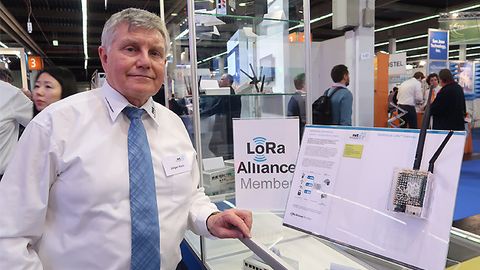
Jürgen Kern, NetModule: "LPWAN is mainly suitable for sensor networks in open spaces with line of sight, which extend over long distances and where the sensors occasionally send small amounts of information to the base station."
© WEKA SPECIALIZED MEDIALarge wireless sensor networks are a domain of LPWAN: Because ISM bands can be used without licenses, hundreds of sensors can be operated in LPWANs without radio costs. Jürgen Kern, CEO of NetModule, provides more detailed information.
What do you see as the purpose of LPWAN technology?
Jürgen Kern: LPWAN stands for "low power wide area networking". LPWAN technology was developed to connect LPWAN endpoints - e.g. many sensors - to a base station of the LPWAN network in a cost-effective and energy-saving way. This creates star-shaped network structures in which a base station on the network connects to many end points (sensors). Distances of several kilometers are bridged in this way (quite possibly 20 or more). Ideally, license-free radio frequencies (in the ISM band) are used for communication.
Which industrial applications is LPWAN suitable for?
Mainly for sensor networks in open spaces with line of sight, which extend over long distances and where the sensors occasionally send small amounts of information to the base station.
What are the advantages and disadvantages of LPWAN in certain industrial applications compared to other communication technologies that could also be considered for these applications?
The costs and energy consumption of LPWAN are low. The sensors can be equipped with batteries, which makes the applications cost-effective. Typical applications for LPWAN are location services ("where are my systems/devices/vehicles"). The disadvantages are the low bandwidth and the lack of infrastructure in most cases.
How does LPWAN differ technically and functionally from 4G mobile communications?
The difference lies firstly in the low energy consumption of LPWAN technology, secondly in the ability to use ISM bands without licenses and thus be independent of providers, and thirdly in the fact that the use of license-free bands means that hundreds of sensors can be operated without radio costs.
How widespread are the various LPWAN protocols in industrial applications at the moment?
A number of pilot projects have been and are being launched with great hope. However, there still seems to be little concrete development for productive operation.
How quickly is the development of LPWAN network infrastructure currently progressing among providers? Are there already profitable business models with LPWAN for infrastructure providers?
It is likely to be difficult for infrastructure providers to create profitable business models because data connections with low data volumes based on 3G and 4G are now available at low cost and therefore compete with the costs of LPWAN. In Switzerland, Swisscom does operate a LoRaWAN, but it is doubtful that it will earn any money with it. In Germany, providers are concentrating on narrow-band mobile radio technologies.
SSV Software Systems: Transferring monitoring data from the sensor to the cloud via LPWAN

Klaus-Dieter Walter, SSV Software Systems: "Personally, I wouldn't describe the development of LPWAN network infrastructure as 'fast', at least in German-speaking countries."
© Market&TechnologyLPWAN is also suitable for transferring monitoring data between sensors and the cloud in the IIoT - with its own network infrastructure or that of a service provider. Klaus-Dieter Walter, Managing Director of SSV Software Systems, has the details.
What types of industrial applications is LPWAN predestined for?
Klaus-Dieter Walter: Primarily for the elementary sensor-to-cloud task that we find or will find in every IoT application - and I include Industrial IoT including Industry 4.0 and Smart Factory in this. Such applications always have a monitoring component, for which LPWAN is particularly suitable if the sensor plus the associated electronics have to be supplied with a battery that cannot be replaced every few months. But LPWAN is also an option if a power supply unit provides the supply voltage.
Which wired and wireless communication technologies in industry can LPWAN be an alternative to?
Firstly, there are still numerous galvanically isolated RS-485 and M-Bus connections for linking decentralized data points to a higher-level IT system via sometimes very long cable connections. Then there are still countless GSM and GPRS mobile phone connections that sporadically transport small amounts of data and cause relatively high operating costs due to SIM card fees. I see LPWAN as a sensible alternative for these examples.
What are the advantages and disadvantages of LPWAN in certain industrial applications compared to other wireless communication technologies that could also be considered for these applications?
The advantages of LPWAN are the long range to the nearest base station, the relatively good penetration of masonry and the low power consumption per data packet and the associated suitability for battery operation. Important disadvantages are the low bandwidth, the need for a special infrastructure and - not to be underestimated - the difficult-to-understand range of competing LPWAN technologies, not all of which will certainly be successful on the market. The relatively low level of LPWAN engineering knowledge is another problem.
When does it make sense for industrial companies to set up an LPWAN network infrastructure themselves, and when is it advisable to use the services of an infrastructure provider for LPWAN?
I think that makes sense in any case. For me, however, this is not a question of company size, but a question of application. If, for example, you want to connect sensors in parking garages or parking meters in city centres to a cloud via LPWAN, the Telekom network infrastructure that will soon be available will be an option. However, if you want to optimize intralogistics or energy efficiency with the help of a few sensors on your extensive premises far outside urban boundaries, you can also set up your own LoRa network as a medium-sized company or have it set up by a partner.
Unitronic: LPWAN networks with own or public infrastructure?

Werner Niehaus, BU Manager Electronics at Unitronic: "The focus of LPWAN is on the three Cs: Coverage, Consumption, Costs."
© UnitronicCompanies that want to use LPWAN technology can do so with their own or public network infrastructure - depending on their situation and applications. Werner Niehaus, BU Manager Electronics at Unitronic, provides information.
To what extent is LPWAN suitable for industrial applications?
Werner Niehaus: Do you need to have data available in real time? Then forget about LPWAN. The focus of LPWAN is on the three Cs: Coverage, Consumption, Costs. If these three criteria fit the requirements profile of your application, you should take a closer look at LPWAN.
For which industrial applications is LPWAN suitable?
You only need a low data transfer rate and your application is battery-powered? This may be the case for monitoring the operating status of machines used in all branches of industry or in greenhouses where the temperature and irrigation need to be monitored and controlled. Do you want to monitor cold chains, such as the transportation route from production to the consumer's cold store? Then you should definitely consider LPWAN.
LPWAN should be seriously considered wherever penetration is not sufficient today, where battery operation is required but power consumption does not permit this, or where the costs are currently too high because they are overspecified.
How widespread are the various LPWAN protocols in industrial applications at the moment?
We are still at the beginning of what we hope will be a successful path for this relatively new technology. But it can be expected that the number of applications will increase by leaps and bounds with the availability of LPWAN, as this will remove major hurdles: Coverage (penetration), power consumption and cost.
For which companies does it make sense to set up an LPWAN network infrastructure themselves, and for which is it advisable to use the services of an LPWAN infrastructure provider?
Here too, the user's situation must be taken into account. At Unitronic, we support both approaches through our partner network. There are companies that prefer to have their own infrastructure operated under their control and for whom this is economically feasible. Other companies want to become active quickly, concentrate fully on the application and therefore prefer a public infrastructure. Of course, the issue of data security against possible hacker attacks also plays an important role in these considerations.


You might also be interested in
Safety in sensor technology
What do sensor manufacturers currently offer in terms of safety? At SPS IPC Drives, there were a number of clever concepts on show - including from Sick, Pepperl+Fuchs and Leuze electronic.
 read more...
Video flashback of the three days of the fair
New hall, new topics and a new name in 2019 - the SPS IPC Drives 2018 in seven minutes.
read more...The review in the movie
New hall, new topics and a new name - that was SPS IPC Drives 2018 in seven minutes.
read more...OPC UA and TSN - a major trade fair topic
The OPC UA and TSN communication standards are major topics of discussion in the industry. This could not be overlooked at SPS IPC Drives 2018.
read more...Smart transport - three approaches in the video
How can material and product transport in machines and systems be reorganized in the age of Industry 4.0? Beckhoff, B&R and Bosch Rexroth presented interesting approaches in this regard at SPS IPC Drives 2018.
read more...'Software & IT' in focus
Last year, SPS IPC Drives bundled the topic of 'Software & IT in manufacturing' in Hall 6. In response to high demand, this concept was extended to Hall 5 in 2018.
read more...The 'Automation Hackathon'
At the 'Automation Hackathon' at SPS IPC Drives 2018, seven start-ups had the chance to develop new business models for selected companies in the automation industry in 48 hours. Winner: the start-up Othermo in collaboration with Wago.
read more...Entering the Machine Building Business
Known as a technology supplier to robot manufacturers, Synapticon now plans to offer targeted solutions for machine builders. The kick-off was given at the SPS IPC Drives with the ‚Actilink‘ drive systems and a quick-start package for the production...
read more...The winding does it!
With the market launch of the new brushless DC motor family BXT, Faulhaber is setting new standards in the field of external rotor high-performance drives. The winding plays a central role in this.
read more...