
Gas sensors
Cooling system manufacturers under pressure to act
An EU regulation is intended to help reduce harmful emissions in the industrial sector by 2030. However, the requirement to replace fluorinated greenhouse gases and carry out leakage checks is putting cooling system manufacturers under pressure. Gas sensors can help.

Air conditioning systems in data centers, industrial cooling systems and heat pumps mainly work with greenhouse gases that are harmful to the climate. The EU wants to put a stop to this with the F-Gas Regulation and reduce emissions in the industrial sector by more than 70 % by 2030 compared to 1990. With the so-called 'phase down', a gradual restriction on the use of fluorinated greenhouse gases with a high global warming potential (GWP) has been in place since 2015. In the transition period from 2016 to 2030, the GWP values of refrigerants are to be reduced from the current level of around 2300 (100%) to <500 (21%). During the 'phase down' process, however, some exceptions will remain permitted: certain companies may still use recycled F-gases during this period, for example; all other manufacturers must switch to alternative gases.
Growing number of air conditioning systems
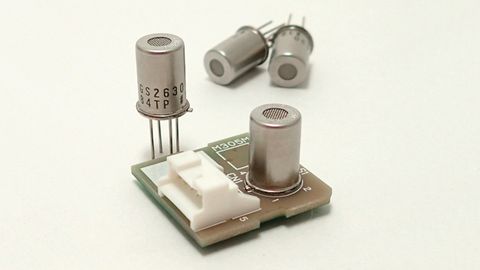
The 'TGS 2630' sensor for the detection of environmentally harmful gases acts as the basis for the pre-calibrated 'FCM 2630' module, which already contains temperature compensation.
© UnitronicThe European Union's provision is a major challenge for all concerned, as the number of air conditioning systems in buildings is continuously increasing worldwide. And cooling is also used in other areas: hardly a car rolls off the production line without an air conditioning system, and the cooling systems in industrial plants and data centers would come to a standstill without cooling. In Germany, there is also an increasing trend towards heat pump heating systems, as they are more efficient than fossil heating systems that use gas or oil. As with cooling systems, the actual working principle here is the refrigeration cycle - with heat pumps, the process is simply reversed: heat is extracted from the environment by expanding refrigerant gas and raised to the higher temperature level using a compressor - the heat pump. This is then the heat source for heating systems. Regardless of which process is used, the environmentally harmful F-gases are always used.
Leak test of the systems
In systems that work with cooling gases, there is always the possibility that certain areas of the system will leak and the harmful environmental gases will escape. As a rule, these are non-toxic and therefore harmless to humans. However, the damage to the environment can be very high, especially in large systems. For this reason, their operators are obliged to carry out regular safety checks. The systems must be checked at specified intervals in order to detect possible weak points from which gas can escape and harm the environment. Sensors that can be used to 'sniff out' leaks help with these measurement processes.
The EU regulation on F-gases is intended to encourage manufacturers to use gases with low GWP values in future. However, these gases also have a catch: many of them are either flammable or toxic. The hazard potential is correspondingly high, which is why system manufacturers are required to take the necessary safety measures when manufacturing their products. The systems must be designed and constructed in accordance with the applicable regulations. Continuous and careful inspections are also mandatory here. Even the smallest weak point can lead to the gases igniting or people being poisoned.
Simplified control through gas sensors
Gas sensors are ideal for monitoring these less environmentally harmful gases. Unitronic, for example, sells solutions developed by the Japanese company Figaro Engineering for this application scenario. The basic model TGS 2630, for example, reacts extremely sensitively to highly flammable refrigerant gases such as R32 and R1234yf as well as to R-404a and R-410a, which are often used in conventional air conditioning and refrigeration systems. The sensor allows customers to equip each sensor themselves with individual signal processing and the corresponding electronics. Customers can also configure the sensor for the desired application and calibrate it themselves, allowing them to flexibly determine the sensor's field of application.
The TGS 2630 semiconductor gas sensor element is also the basis for the pre-calibrated FCM 2630 module, which already includes temperature compensation and is delivered to the customer with the necessary electronics. It can be implemented and used immediately. The pre-configured values are compatible with many applications, but can also be individually configured and adapted if required.
Author:
Eduard Schäfer is Head of Sensor Department at Unitronic in Düsseldorf.


You might also be interested in
Interface diversity
Unitronic has added the TRB 245 and TRB 255 industrial gateways from Teltonika Networks to its in-house 'Sensor2Cloud' portfolio. The TRB 245 is a small industrial LTE Cat 4 gateway with a variety of input/output, serial and Ethernet connections
 read more...
Security-relevant applications in mobile communications
Unitronic presents the RUT955 dual SIM 4G/LTE and WiFi mobile router from Teltonika Networks.
read more...News from the industrial computer sector
What's new on the market for industrial PCs and operating systems? Our picture gallery shows you the latest products from these areas.
read more...Useful peripheral functions included
The Mangoh Red hardware platform is now part of Unitronic's Sensor2Cloud portfolio.
read more...New products at embedded world 2018
From February 27 to March 1, 2018, the Nuremberg exhibition halls made room for everything to do with embedded systems technology. Computer&AUTOMATION presents a selection of new products that were on show at the stands of the 16th embedded...
read more...News from the field of big data
As part of the big data trend, many new products are coming onto the market - from boards, gateways and data loggers to software and security solutions.
read more...LPWAN - an alternative for the industry?
LPWAN technologies such as LoRaWAN, Sigfox or NarrowBand IoT have specific advantages and disadvantages compared to other data transmission technologies. But which ones? And to what extent are they really suitable for industrial applications? Five...
read more...The artificial nose
Until now, measuring and evaluating gases has been the task of multiple sensor systems. Now, a type of 'artificial nose' should make it possible to selectively detect a large number of organic and inorganic compounds with just a single conventional...
read more...News from measurement technology
What innovations are there for industrial users on the measurement technology market? Computer&AUTOMATION has summarized a selection of new products in a series of pictures.
read more...