
Reichelt Electronics
Quantum minimalists
How do you turn a highly complex physical laboratory setup into a marketable product? The art lies in reduction, as the start-up Quantum Technologies shows.
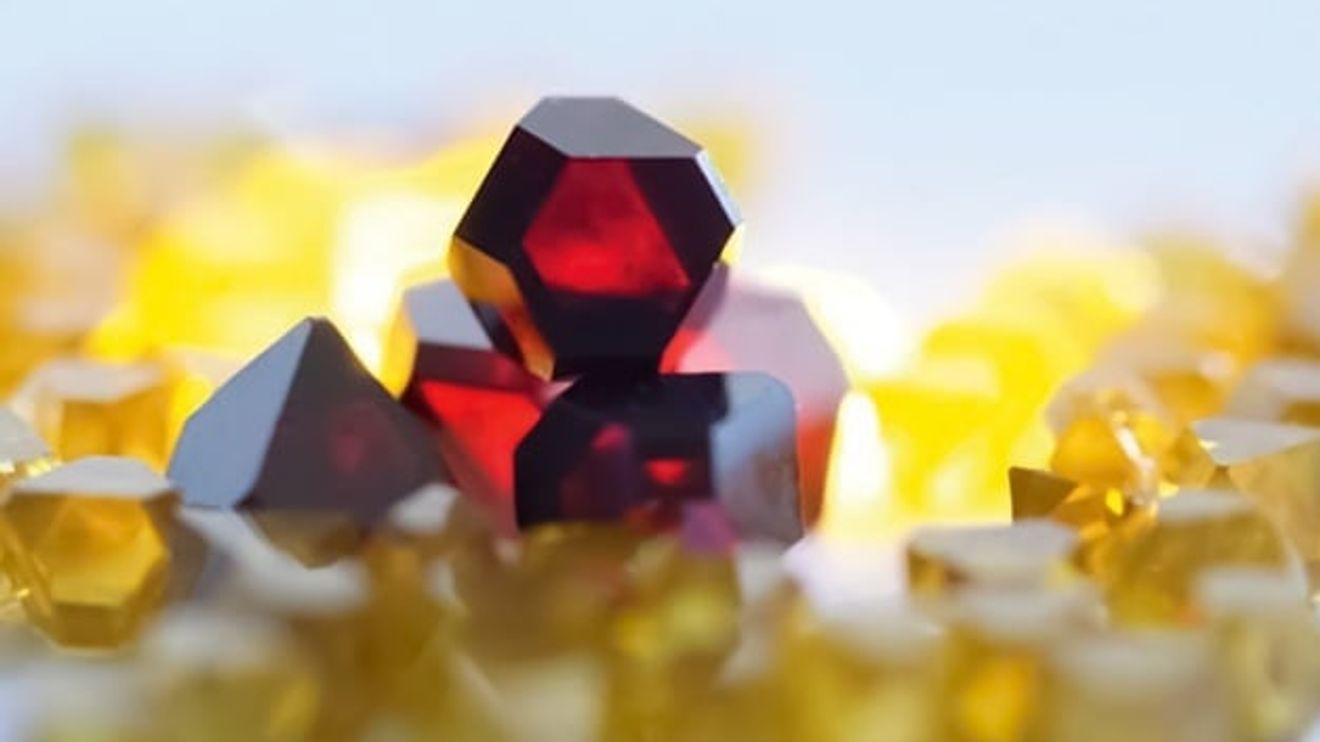
Measuring tasks in factory and process automation, as well as in automotive and medical technology, are constantly presenting sensors with new challenges. There is a demand for precise, reproducible and scalable methods that can be integrated advantageously into applications under adverse operating conditions - at extreme temperatures, in electromagnetic fields or with limited installation space. In the field of magnetometry, or magnetic field measurement, quantum sensors, which achieve a high level of sensitivity and accuracy compared to conventional sensors, have been the focus of attention for several years. Unlike Hall effect or magnetoresistive sensors, for example, they react robustly to temperature fluctuations and measure without hysteresis. This is based on quantum physical interactions on the subatomic scale, which can be generated and controlled in diamond crystals.
Using diamonds and lasers to measure magnetic fields
Quantum Technologies, a spin-off from Leipzig University, has been developing in the field of quantum magnetometers since 2020. The target applications include highly sensitive angle encoders, robust sensors for current sensors and the monitoring of electric motors - all of which are problematic areas of application, even for quantum sensors. This is because either the necessary cooling is disadvantageous when integrating the measuring methods or microwave radiation is required, which in turn can generate heat. It is often difficult to galvanically isolate the sensor and the measuring environment.
Dr. Robert Staacke, co-founder and CEO of Quantum Technologies, was already researching magnetic field sensors that use quantum effects as a doctoral student. The scientists typically focus on so-called color centers in diamond crystals, in particular nitrogen-vacancy centers (NV). They are suitable for optically measuring magnetic fields and their changes. NV centers are formed when one of the carbon atoms in the crystal lattice of the diamond - a modification of the element carbon - is replaced by nitrogen, while an adjacent carbon atom is missing. This defect pair of nitrogen atom (N) and lattice vacancy (V) is characterized by the fact that it has a spin of 1. External magnetic fields influence the energy levels of the spin states of the center, which in turn results in a change in fluorescence. Light can be used to excite the NV center energetically. If the resulting fluorescence is monitored, this allows conclusions to be drawn about the strength of the magnetic field in question.
Microwaves banned from the sensor
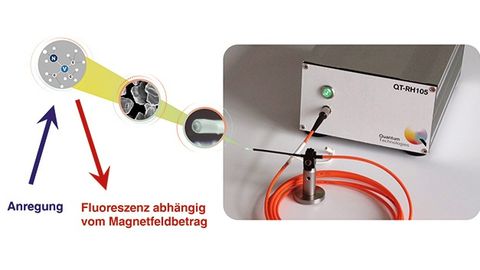
The measuring principle of the magnetic field sensors from Quantum Technologies.
© Quantum technologyIn contrast to squids (Superconducting Quantum Interference Devices), NV magnetometers can record further measuring ranges and work up to room temperature and beyond. However, it is typically necessary to align the NV centers spatially to the magnetic field and to use microwave radiation. Although NV sensors do not require the complex cooling equipment needed for squids, microwaves also require special setups - for example antennas close to the diamond or shielding enclosures to increase the sensitivity of the measurement.
Quantum Technologies is therefore pursuing a technology approach that works independently of the direction of the magnetic field and without microwave radiation: Instead of an extended and homogeneous diamond crystal, diamond nanoparticles are used on the tip of an optical fiber. The statistically distributed orientation of the particles eliminates the unavoidable directional dependence (anisotropy) of the material properties in crystals. The magnetic field measurement becomes isotropic.
This technology has two advantages: Firstly, the sensors work purely optically. They can be easily positioned at the end of an optical fiber without any electrically conductive or magnetic material. This allows the measurement to be galvanically decoupled and unaffected by electromagnetic interference sources. Secondly, the measurement setup is very small, simple and can also be integrated into applications that are difficult to access, such as electric motors.
This was not always the case. The typical picture of a laboratory for research at NV centers shows complicated test setups, huge optical tables, littered with components and devices. The Quantum Technologies team's approach was rather atypical for science, because the aim was not to measure even more precisely with even more complexity in order to uncover one more physical effect, but rather to ask how the complexity could be reduced and the system simplified?
What emerged as the minimum equipment looks like this: Diamond nanoparticles, a light source and a detector are required. The red fluorescence is then evaluated. Although the result is not the most sensitive sensor that can be achieved with NV centers, galvanic isolation is achieved. The diamond nanoparticles create an isotropic measuring possibility and a tiny measuring point, which opens up new application possibilities for the sensors.
Measuring without being a quantum physicist
| Market-ready sensor technology |
|---|
| The quantum magnetic field sensor 'QT DMFS-C2' from Quantum Technologies is currently available from the Reichelt Elektronik sales program. Equipped with a multimode glass fiber and specified for operating temperatures of 15 to 25 °C and an excitation power of 5 mW, the robust and compact sensor is suitable for the completely optical, galvanically isolated and isotropic measurement of the magnetic field strength in the range from 0 to 75 mT. All that is required is an excitation light source for generating and a photodetector for observing the fluorescence, but no microwave radiation. In addition to the photodiode, suitable filters are required in the detector to suppress the excitation wavelength. |
The directional and interference-decoupled measurement as well as the small footprint of the sensor are key to the applications that Quantum Technologies wants to develop: directly in the air gap of an electric motor, for example, or within an electric vehicle battery, in high-voltage energy systems, in invasive medical technology and radiology or in non-destructive inline material testing for the metal industry.
According to Dr. Staacke, it is important in practice that the red fluorescence of varying intensity provides an output signal that is easy to interpret: Although the physical relationships behind the measurement are really complicated, changes in brightness can be easily understood by anyone, even without being a quantum physicist.
A single measuring point is one of the simpler application scenarios. Scanning processes, for example with a moving sensor in material characterization, are also relatively easy to implement. The idea of a quantum magnetic field camera is somewhat more complex, but demonstrators have already been set up for this too. For this, a large surface was covered with diamond nanoparticles, these were excited using an LED and the red fluorescence was then observed using a CCD camera.

The author: Tobias Wölk is Product Manager Automation Technology & Active Components at Reichelt Elektronik.
© Reichelt ElectronicsDemonstrators for position and frequency measurement on rotating magnets, electric motor monitoring and the megapixel magnetic field camera are intended to show Quantum Technologies' customers the practical benefits and variety of potential applications. To accelerate the market entry process, the company entered into a partnership with Reichelt Elektronik in 2023.


You might also be interested in
Increased revenue and expanded production capacity
The Fraba Group, a manufacturer of sensors for industrial motion control, looks back on a successful 2025, during which both revenue and the number of employees increased.
 read more...
Self-learning sensor systems monitor industrial manufacturing processes
In the 'GenSATIOn-Edge' project, the Fraunhofer Institute for Microelectronic Circuits and Systems IMS is working with partners to develop intelligent sensor systems for the continuous monitoring of industrial processes. AI models run directly on...
read more...Sales growth in a turbulent market environment
Thanks to innovations and a focus on strategic industrial markets, Sick was able to moderately increase its sales in the 2025 financial year. In a turbulent market environment, the company was able to maintain its position and gain market share with...
read more...Human-like sense of touch for robots
The sense of touch is one of robots' greatest weaknesses. Researchers have now developed a miniaturized tactile sensor that could give robots something much closer to the human sense of touch.
read more...Non-contact differentiation between air, foam and liquid
With the 'QCRC' series, EBE sensors + motion presents a new solution for process monitoring that is particularly suitable for sensitive production environments. The sensors in the series work through closed vessel and hose walls and enable clear...
read more...RS expands automation portfolio with Leuze products
RS has expanded its automation range to include products from Leuze electronic Germany. The company specializes in sensor solutions for industrial applications.
read more...Precisely recognize fluid properties
With the QCRC sensor generation, EBE sensors + motion is expanding the 'Cortec' product family with a compact solution for the non-contact detection of fluid properties for OEM and process applications.
read more...Takeover of force sensor specialist
The sensor supplier Baumer is expanding its position in force and strain measurement and acquiring the Swiss company X-Sensors.
read more...Sebastian Müller becomes sole member of the Management Board
Jürgen Uebbing has resigned from the Executive Board of NCTE by mutual agreement with effect from June 2, 2025 and is leaving the company. Until further notice, CEO Sebastian Müller will assume the role of sole CEO and will be responsible for the...
read more...