
Rotary encoder
One cable is enough
One cable for the motor power supply and the sensor supply with communication - technologically, the associated challenges on the cable and in the connection technology have already been solved. Now the motor feedback market has to follow suit.
The single-cable technology offers many advantages in the application due to the higher level of integration in the cable and connection technology: smaller cable diameters with lower masses can be installed in smaller drag chains. Instead of the previous two connections, only one plug connection is required. The number of storage and assembly components is reduced. Growing power spectrum and higher power densities enable smaller overall solutions in motor feedback and therefore also lower masses to be moved for higher dynamics and lower power consumption. And with single-cable technology, an additional increase in efficiency is possible.
Cable and connector manufacturers have already broadened their portfolio for this application and have been providing solutions for around six years. The status quo is mature solutions for different performance levels from various manufacturers. Challenges such as interference coupling due to the joint use of a cable for motor power supply and sensor supply with communication have been minimized. In addition, the critical transfer points - the cable ends, the connectors and the assembly itself - have been optimized to minimize interference coupling. The technological challenges of single-cable technology on the cable and in the connection technology have therefore already been solved. Now it is up to the motor feedback and sensor market to follow suit.
Limitation due to proprietary protocols
In summary, the aim of single-cable technology can be described as increased production output in a smaller size with greater dynamics and higher efficiency. The systems are becoming more compact and dynamic with smaller designs and the same or higher performance. Modern control systems enable greater dynamics thanks to lower masses and higher control cycles. On the drive side, the number of manufacturers using single-cable technology has already increased significantly. However, the available solutions use proprietary protocols, which limit the variety of available solutions and the range of different manufacturers on the sensor side.

BiSS Line offers high-precision digital transmission and sensor-side generation of the time of detection.
© iC HouseThe range of sensor manufacturers and protocols is only growing very slowly - partly due to existing patent protection and a lack of market dominance. A similar situation already existed 14 years ago with regard to serial encoder interfaces in classic two-cable systems.
The BiSS interface was defined as an open standard across all manufacturers in 2002. With currently 415 BiSS device manufacturers and a large number of BiSS users, the interface has established itself as an open, standardized sensor interface worldwide.
Since 2014, the international 'BiSS User Community' has been working on its own open single-cable technology. Their credo: A globally open and standardized one-cable technology is necessary. Implementation should be simple and modular on the basis of BiSS. This one-cable technology should be available to all BiSS users as an open standard.
It is important that the various sensor technologies, such as optical, magnetic, inductive and capacitive, can still be integrated. Scalable solutions must be possible for a wide variety of products with different resolutions and adapted performance for different markets. The transmission technology used should be simple, established and available. And: Existing cable and connection technology, including the physical layer for baseband transmission, should be usable as a complete, proven single-cable infrastructure.
The 'BiSS Line' protocol

The 'BiSS Line' protocol was presented at SPS IPC Drives 2016 as an open interface for single-cable technology.
The underlying BiSS protocol offers fast and digital transmission of sensor data. Motor feedback applications can securely transmit position data and status information with this protocol, and bidirectional communication is available without affecting the control data transmission. The BiSS control data contains the position data, a simple status consisting of error and warning bits as well as a sufficient CRC check number. In addition, register communication in an in-band protocol provides independently secured information transfers.
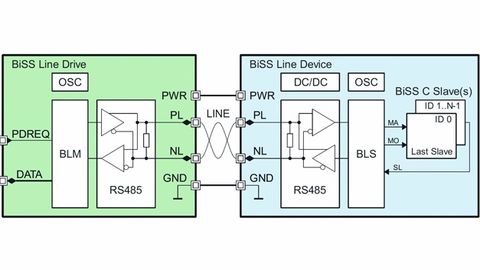
BiSS Line uses a 100% compatible protocol conversion from BiSS C to BiSS Line. All contents of the basic protocol are fully retained during the BiSS Line transfer. This compatibility means that existing definitions such as the electronic data sheet (EDS), user data memory (Userdata), profile definition and identification, serial numbers and diagnostic descriptions are also retained in the single-cable solution.
Safety-critical systems can be implemented with 'BiSS Safety' content via the BiSS protocol. This safe protocol variant uses black channel transmission. Thanks to the modular approach and the preservation of all protocol content with the same
sensor basis, safety solutions can also be implemented directly in the single-cable variant. This means that manufacturers can easily transfer existing BiSS safety systems to BiSS Line, and associated sensors and drives can be easily certified with the extension to BiSS Line. In addition, nothing stands in the way of condition monitoring as a prerequisite for detailed system monitoring and efficient maintenance. The BiSS protocol enables additional sensors to be used in parallel with the motor feedback. This means that additional measured values, status and diagnostic information can be transmitted as sensor data without interference and in a scalable manner.
Physical layer and protocol
The BiSS Line protocol uses asynchronous half-duplex baseband transmission with RS485 as the physical layer. The transmission can be used with both a 2-wire and a 4-wire solution without any difference. With the 2-wire solution, the sensor is supplied with an additional DC voltage via the wire pair. The permissible voltage range is defined as compatible with existing single-cable systems (7 V to 12 V) and has been extended to include the standard industrial voltage (24 V) as a permissible supply.

Despite asynchronous half-duplex transmission (position request, green), the sensor-side reconstruction of the time of detection (magenta) is highly accurate and with minimal jitter.
© iC HouseThe BiSS Line protocol offers a high proportion of user data thanks to clock recovery based on 8B10 coding. The defined transmission symbols offer a maximum Hamming distance. The communication channel is constantly in motion with an IDLE symbol and prevents DC voltage components and synchronization losses.
The communication principle is master-slave based: at the request of the master, one or more sensors are queried via the protocol converter and the responses are transferred to the master. The protocol conversion from BiSS to BiSS Line retains all previous content, including its own check digits. The complete preservation of the secure data to be transmitted is guaranteed for black channel monitoring. The retrieval takes place completely or in partial quantities. A repeated query for redundancy or after loss is also possible with BiSS Line. It is also possible to reduce the bandwidth of less relevant data (e.g. temperature values).
The time of position detection is particularly important for high-resolution and highly dynamic systems. Even slight deviations in the time of detection affect the accuracy of the position to be detected. With BiSS Line, the position detection time is not transmitted in analog form or as an edge, but is digitally coded into the position request.
Higher controller rates and more frequent commutations, new drive driver stages, high power densities and broad dynamics cause a higher level of interference. More correction options in the protocol allow for more errors during transmission. For this reason, the optional 'Forward Error Correction' (FEC) creates additional interference margins during transmission through reconstruction options after the reception of disturbed bit sequences. This coding enables a robust, error-correctable reconstruction of the transmitted data. The generation, transmission and evaluation of an FEC is implemented with current infrastructure on both sides.
The practical implementation
The RS485 interface is often already present in drive systems; the protocol conversions of reconfigurable hardware are usually found in FPGAs. Currently, powerful processors are also used for direct protocol processing in software. In both cases, protocols are implemented by means of a firmware extension. This means that a hardware change is not necessary - and would hardly be feasible due to a lack of user acceptance. By means of a firmware extension, the drive system also becomes BiSS-Line-capable in this way. The BiSS-Line-Master-IP is made available to users free of charge as VHDL IP, for example.
Existing BiSS sensor systems can be converted to BiSS Line with little effort: With any single-cable sensor system, a power supply unit for the power supply and communication via the physical layer are required in any case. BiSS Line does not require any new developments on the sensor side and uses established components. It can be integrated into the housing of an existing sensor, and can also be implemented in the existing connection technology in a plug connector or in an intermediate adapter. Integration into the cabling system itself is also possible.
Author:
Marko Hepp is responsible for the support of BiSS Interface, BiSS Line and BiSS Safety at iC-Haus in Bodenheim.


You might also be interested in
The lubricant problem in food production
Lubricants for components used in food production machinery must be safe for human consumption. However, as these are very expensive, alternatives are in demand - for example in drive chains.
 read more...
IO-Link for the vacuum
To make electric vacuum generators, grippers or compact ejectors visible for the smart factory, they must supply digital energy and process data in real time. This works using interfaces such as IO-Link, Ethernet or NFC in the vacuum components.
read more...Integrated microchips
Whether medical devices, product tracking, vehicle systems or 5G communication - the demands on safety, performance, documentation and user-friendliness are increasing. What is the significance of microchips integrated into connectors or cable...
read more...RJ45 - fit for the IIoT
Industrial-grade RJ45 connectors are a good solution for applications without increased protection against dust, dirt or splash water. What must the data interface look like so that the 'dinosaur of data transmission' can serve industrial...
read more...Engineering with a digital twin
There is simply not enough time for time-consuming activities such as drawing up parts lists based on circuit diagrams in control cabinet construction. How can the process - from planning to installation to operation - be optimized?
read more...The effects of the F-Gas Regulation
Can refrigeration units and chillers still be used when the F-Gas Regulation on climate protection comes into force on January 1, 2020? What do the bans on the use of refrigeration and air conditioning systems and new regulations for their...
read more...Choosing the right heat sink
In order to equip a data center with high-speed modules for optical interfaces, AFCI was looking for a suitable solution for cooling the high-performance servers. Pin heat sinks were the solution.
read more...(Ethernet) cables put to the test
The dynamic requirements for cables and the associated energy chains are high. How must (Ethernet) cables be designed so that they can be safely routed in energy chains even under the highest bending stress?
read more...Predictive maintenance of cables subject to wear
A sophisticated concept is needed to be able to maintain cables subject to wear and tear in a predictive manner. Lapp is currently developing one for Ethernet cables that uses machine learning approaches, among other things.
read more...