
ifm electronic
Not just clean, but pure
Water as it comes out of the tap does not pose any major challenges for process sensors. The situation is different when treating ultrapure water: The sensors used in such a process have to perform and withstand a lot more.
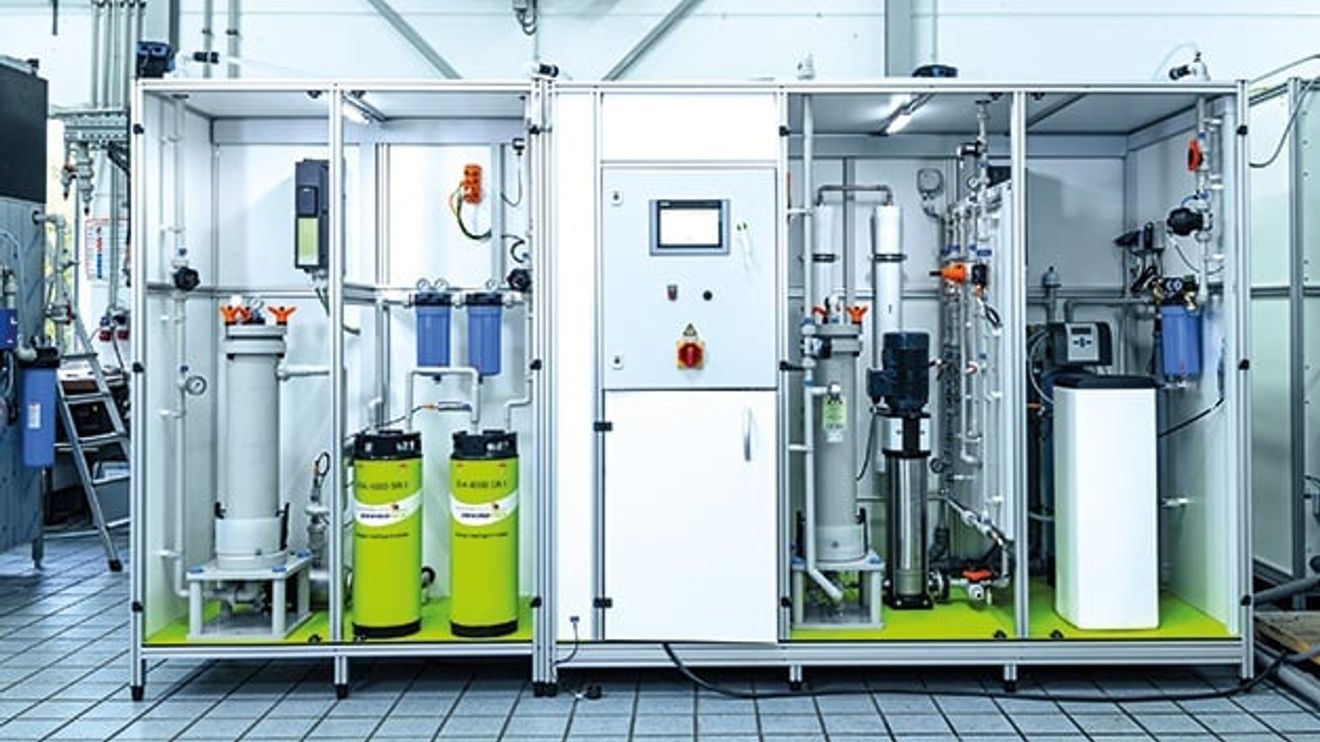
Cleaning with tap water often leaves unsightly stains on surfaces. This can have a serious impact on product quality in industrial processes - for example, when treated water is used in the rinsing process of parts cleaning to remove oils and cooling lubricants from machined metals in order to prepare them for the subsequent process, such as coating or electroplating. The optical industry and medical technology also require water for rinsing processes that leaves no residue after drying. The solution is pure water that is free from dissolved minerals, salts and bacteria. Depending on the degree of treatment, this is referred to as pure or ultrapure water.
Systems for ultrapure water extraction
EnviroFalk is a manufacturer of ultrapure water treatment systems. The company develops concepts using a wide range of water treatment technologies: Reverse osmosis systems, ultrafiltration, nanofiltration or ion exchange systems. There is often a combination of different technologies in one system. Normal tap water is fed into such a process water treatment system and softened in a first step. All solids are filtered out of this 'soft water' using reverse osmosis. In the next purification step, the water passes through an ion exchanger cartridge filled with a special granulate or mixed bed resin that removes all minerals from the water. This fully demineralized water is tested using conductivity sensors. This process value can also be used to detect an increase in conductivity as soon as the cartridge is exhausted and needs to be replaced. The pure water is pumped into a tank for temporary storage and sometimes heated so that the user can use it for various applications at any time. To ensure a high degree of purity, this desalinated water is also irradiated with UV light to keep it germ-free.
Sensors and requirements
To ensure the quality of the ultrapure water in the long term, sensors from ifm monitor the treatment process, as even the smallest impurities or remineralization could reduce the water quality. EnviroFalk uses flush-mounted sensors in the pipes and tanks. As a result, there are no dead spaces in which the water does not circulate sufficiently and could therefore become enriched again unintentionally.
Demineralized water constantly tries to compensate for the unnatural desalinated state by dissolving minerals from the surrounding materials. With conventional stainless steel walls, the water would succeed in doing this and lead to pitting over time. This is why either plastic pipes or particularly high-quality stainless steel are the material of choice. The same applies to the sensors that come into contact with the media. ifm offers sensors specifically for ultrapure water applications, which have particularly high-quality stainless steel or other materials at the points where the sensor surface comes into contact with the medium, from which the ultrapure water cannot extract any molecules.
Conductivity as the central measured value
EnviroFalk uses the IO-Link conductivity sensor 'LDL101'. The conductivity value is the reciprocal of the electrical resistance value of water. The purer the water, the higher its resistance and the lower the conductivity value. The conductivity indicates the concentration of ions in the water. The smaller the number of free ions, the lower the conductivity. With the conductivity sensor and its measuring range of 0.04 to 1000 µS/cm, all water levels of the EviroFalk systems - from normal 'city water' at the inlet to ultrapure water at the outlet - can be covered in terms of measurement technology. The sensor is connected using standard M12 connection technology and requires neither a data cable nor an external evaluation unit in the cabinet. The digital transmission of the measured values via IO-Link enables a permanently precise analysis of the water quality. If the conductivity value increases during the ultrapure water production process, this indicates components in need of maintenance, for example.
Precise pressure measurement
The pressure in the pipes needs to be monitored at many points in the system. The 'PL15' pressure sensor is used for several tasks in a complex treatment plant, for example to control the pumps. The sensor offers a resolution over the entire pressure range from 0 to 10 bar. The measured values can be read out directly digitally and without conversion losses via IO-Link. Another area of application for the pressure sensor is the tank. Here it monitors the fill level. Its front flush design prevents dead spaces in which the water does not circulate sufficiently and can then accumulate again unintentionally. The sensor also outputs the medium temperature as an additional process value.
Flow measurement for ultrapure water
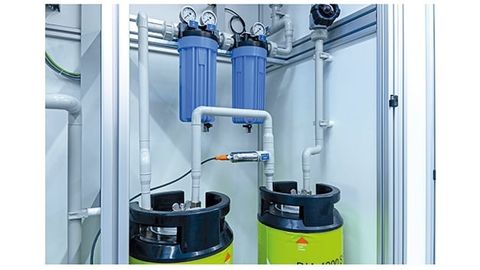
The LDL101 conductivity sensor from ifm uses conductivity measurement to monitor the purity of the water and signals in good time when the ion exchanger cartridges need to be replaced.
© ifmA relevant parameter for users is the amount of pure water available at the end of the treatment process. This is because reverse osmosis produces both pure water, also known as permeate, and concentrate, which contains particles, from the city water supplied. By comparing the two quantities, the system operator can determine whether filters are in need of maintenance or whether the city water supplied is too heavily contaminated with foreign matter from the outset. To determine an exact result, a flow measurement is required at various points in the system.
For this purpose, ifm offers the 'SU' ultrasonic flow sensor developed for ultrapure water applications, which measures flow rates of up to 1,000 l/min. Thanks to ultrasonic technology, this also applies to ultrapure water with low conductivity, such as that produced in EnviroFalk systems. In combination with the conductivity sensors, reliable quality and quantity control can be established in the filtration process. The measuring tube of the flow sensor is made of high-quality stainless steel and is free of measuring elements, seals and moving parts. This means that errors caused by deposits, damage, leaks or blockages, which can occur in mechanical systems such as impellers or turbines, are ruled out from the outset, as is the pressure drop associated with other measuring methods. Thanks to the pure stainless steel tube, no material compatibility tests of the electrodes or seals are required, and easy cleaning is possible at any time without leaving any gaps or residues. The LED, which can symbolize the signal strength, serves as an additional visual indicator for a stable process. If the signal strength drops, this may be an indication of particles, air bubbles or deposits on the inner wall of the pipe.
Non-contact radar measurement on the tank
The IO-Link-capable radar level sensor 'LW2120' is suitable for non-contact level monitoring in tanks. It can detect fill levels up to 10 m high without blind zones with a resolution accurate to the millimeter. The 80 GHz frequency used ensures stable and precise measurement results. With the antenna extension available as an accessory, the sensor can also be used outside closed metal tanks, for example on open tubs or plastic containers.
In certain applications, EnviroFalk also uses the radar sensor instead of hydrostatic level measurement. For example, this is also desired by the end customer in the ultrapure sector, as every screw connection and every measuring point represents a source of danger for contamination. With radar level measurement, the sensor is mounted outside the tank cap and does not come into contact with the medium. It can be parameterized and read out remotely via IO-Link. An intelligent algorithm in the device simplifies parameterization via IO-Link, so that only the reference level needs to be set once.
Added value with IO-Link
IO-Link enables EnviroFalk to provide transparency down to every sensor via the HMI and control system. In the event of unusual behavior, the problem can be quickly localized and rectified using the diagnostic data of each sensor. Integrating the sensor data into the control system is also simple: the measured values are supplied directly as a numerical value via the cyclical data query. Data such as serial numbers or calibration data can also be queried and digitized. IO-Link can also be used to transfer several measured values from one sensor. Examples of this are the conductivity sensor and the pressure sensors on the tanks and the pump: on the one hand, the pressure is measured to determine the fill level in the tank and, at the same time, the temperature value supplied by the sensor is read out to find out the media temperature in the tank. This eliminates the need for additional temperature sensors and the associated screw connections in the tank. The flow sensor also supplies several measured values via one data line: in addition to the flow rate and the sensor status, the total flow rate and the temperature are also available via IO-Link.

Thanks to the data storage function, IO-Link also enables EnviroFalk and the end customer to immediately notice if an incorrect sensor has been used or if there are errors in the wiring. Thanks to this function and the wiring of pre-assembled M12 connection cables on both the master and the device, a qualified electrician is not necessarily required to replace a sensor, for example.


You might also be interested in
Hygienic flow measurement in the food industry
For the hygienic flow measurement of media such as beer, milk or fruit juice, which flow through the pipe in various quantities, ifm offers a solution for the high standards of the food industry with the magnetic-inductive flow sensor 'SM Foodmag'.
 read more...
ifm electronic at the Logimat 2024
Communication via IO-Link
With the 'O2I' multicode reader, ifm shows how IO-Link can be used in modern vision systems. Applications can be found primarily in logistics.
read more...Safety solutions for the smart factory
Schmersal is launching IO-Link safety products on the market with the solenoid interlock 'AZM42' and the safety sensor 'RSS362'.
read more...Growth course continued
The Hima Group, a provider of safety-related automation solutions, grew significantly in the 2024 financial year, driven in part by international expansion and an increasing focus on digital solutions.
read more...Sensor for detecting hydrogen leaks
Honeywell has introduced a new sensor for Hydrogen Leak Detection (HLD) that can detect the smallest leaks from 50 ppm in real time using Thermal Conductivity Detection technology.
read more...Solenoid interlock functionally extended
Schmersal has equipped the electronic solenoid interlock 'AZM40' with new accessories and new features.
read more...Security technology for today and tomorrow
Tailored to the needs of customers from various industries, EUCHNER develops and produces solutions that safeguard guards on machines. This minimizes hazards, protects people and makes processes more efficient at the same time.
read more...Germany is top 3 target for ransomware attacks
A recent report by the Var Group sheds light on the cyber security situation in Europe. The so-called Y-Report shows a significant increase in security incidents; the manufacturing industry is particularly affected.
read more...Four adjustable sensor zones
With 'OndoSense reach WA' (Wide Angle), Ondosense has developed a compact radar sensor for collision avoidance, vehicle detection and object positioning.
read more...