
Q.ANT at the Hannover Messe
Controlling prostheses, exoskeletons and avatars with nerve signals
With the magnetic field sensor from Stuttgart-based quantum technology company Q.ANT, the finest electrical currents can be measured more easily and precisely than ever before via their magnetic field. This enables native and intuitive access to biosignals for the first time.
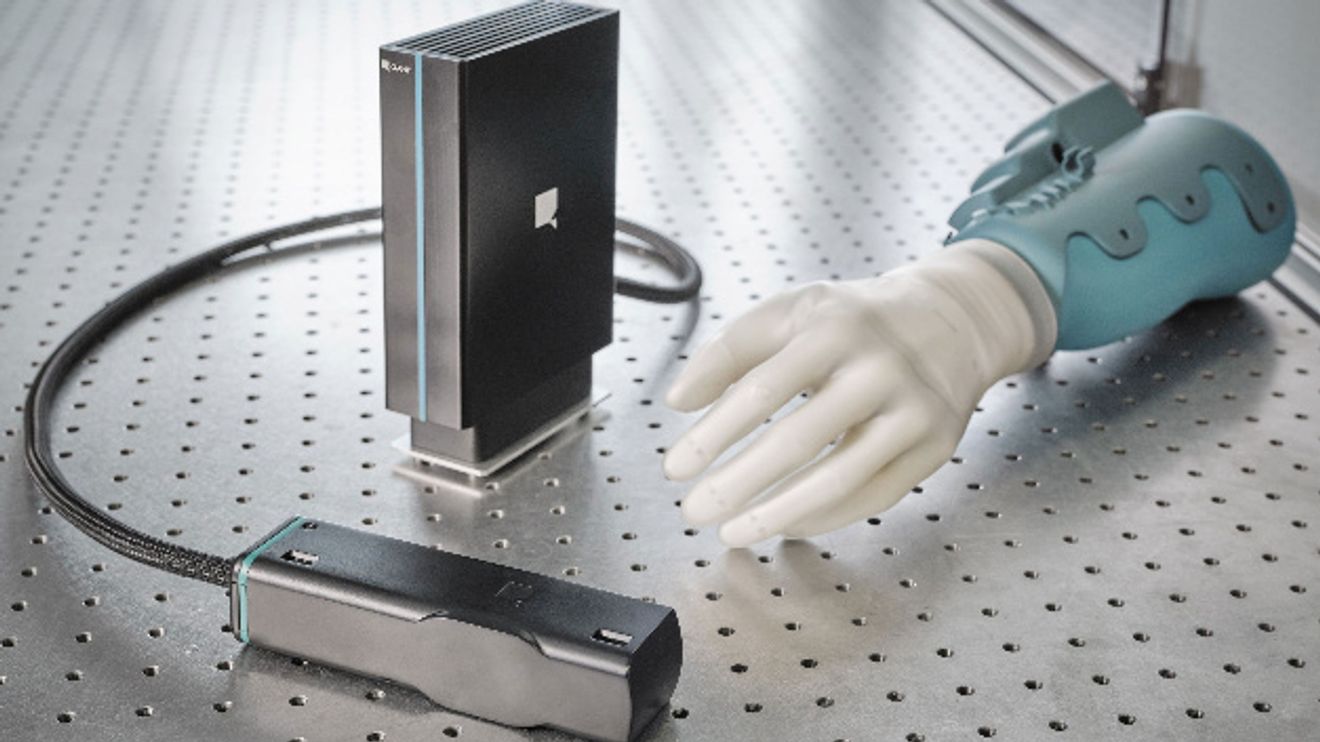
The miniature sensor, which is suitable for everyday use, can now control prostheses via muscle signals, for example, and take sensor technology in medical technology to a new level. At the Hannover Messe, Q.ANT will be demonstrating what else it can do and which industrial applications can benefit from it.
Alongside quantum computing, quantum sensor technology is regarded as a catalyst for industrial progress. One example is the magnetic field sensor from Q.ANT. "Quantum sensor technology is a game changer for industry. Our sensor can be used in numerous areas of application, whether in medical technology, electronics or the automotive industry. It can be used to measure the finest electrical currents and the resulting magnetic fields. We are creating something completely new here and this will lead to a rethink in many industries. The applications range from the quality assurance of hard disks to the identification of fault currents in power chips or batteries; even machines and devices should be able to be controlled by thought at some point," says Dr. Michael Förtsch, CEO of Q.ANT.
The magnetic field sensor makes it possible to measure the smallest magnetic fields in the picotesla range, which corresponds to one millionth of the earth's magnetic field - under everyday conditions. According to the supplier, other technical solutions only achieve a comparable sensitivity range in special laboratory environments and by cooling the sensors down to absolute zero (-273 °C) or by heating them up to +150 °C. The magnetic field sensor from Q.ANT, on the other hand, is sensitive enough to even detect human muscle signals in nerve pathways. Q.ANT will be demonstrating this at the Hannover Messe: The company is using a setup with a hand prosthesis to demonstrate how the magnetic field sensor detects the signals from human muscles and transmits them to the prosthesis, which then closes into a fist within milliseconds.
The combination of sensitivity, minimal size and operation at room temperature without direct body contact already makes the sensor ready for everyday use. In prosthesis control, magnetic signals work more precisely and reliably than electrical signals, which can be disturbed by sweat or hair on the skin, for example. The sensor can also be used in rehabilitation for muscle training control or in the diagnosis of muscle dysfunctions. For example, it could be used to detect neuronal disorders or improve the diagnosis of paraplegia. Exoskeletons can also be controlled intuitively and contribute to occupational safety. In telemedicine, it could even be used to control avatars in the metaverse in the future.
Q.ANT is a high-tech start-up founded in 2018 as a spin-off from Trumpf that promotes and industrializes photonic quantum technologies, thereby pushing the boundaries to new fields of application and processes. The company is working on technologies for data generation and data processing. To this end, Q.ANT develops quantum sensors and photonic processors. With its four product lines Photonic Computing, Particle Metrology, Atomic Gyroscopes and Magnetic Sensing, Q.ANT is a partner for a wide variety of industries and fields of application, ranging from medical technology and autonomous driving to aerospace, mechanical engineering and process technology. Q.ANT employs around 100 people at its Stuttgart site.
Hannover Messe: Hall 2, Stand A31


You might also be interested in
DLR QCI awards two contracts
The German Aerospace Center (DLR) has commissioned the development of a special mini quantum computer for training courses. The aim: a quantum computer that future users, students and companies can touch and try out.
 read more...
European pilot infrastructure for quantum technologies
European industry is facing the challenge of translating innovations in the field of quantum technology into scalable processes and products. The 'Qu-Pilot' project aims to help here by using the existing pilot manufacturing infrastructure.
read more...Bosch, Trumpf and DLR develop quantum sensor
Bosch, Trumpf and the German Aerospace Center (DLR) want to develop a quantum sensor that will be able to precisely align mini-satellites in the future and thus enable very fast data transmission.
read more...Increased revenue and expanded production capacity
The Fraba Group, a manufacturer of sensors for industrial motion control, looks back on a successful 2025, during which both revenue and the number of employees increased.
read more...Self-learning sensor systems monitor industrial manufacturing processes
In the 'GenSATIOn-Edge' project, the Fraunhofer Institute for Microelectronic Circuits and Systems IMS is working with partners to develop intelligent sensor systems for the continuous monitoring of industrial processes. AI models run directly on...
read more...Sales growth in a turbulent market environment
Thanks to innovations and a focus on strategic industrial markets, Sick was able to moderately increase its sales in the 2025 financial year. In a turbulent market environment, the company was able to maintain its position and gain market share with...
read more...Human-like sense of touch for robots
The sense of touch is one of robots' greatest weaknesses. Researchers have now developed a miniaturized tactile sensor that could give robots something much closer to the human sense of touch.
read more...Non-contact differentiation between air, foam and liquid
With the 'QCRC' series, EBE sensors + motion presents a new solution for process monitoring that is particularly suitable for sensitive production environments. The sensors in the series work through closed vessel and hose walls and enable clear...
read more...RS expands automation portfolio with Leuze products
RS has expanded its automation range to include products from Leuze electronic Germany. The company specializes in sensor solutions for industrial applications.
read more...