

Balluff
Condition monitoring in the sensor
Whether conveyor belt, industrial robot, hydraulic unit, motor or pump - the failure of individual components can cause the entire system to come to a standstill. This makes condition monitoring all the more important - for example using a condition monitoring sensor.
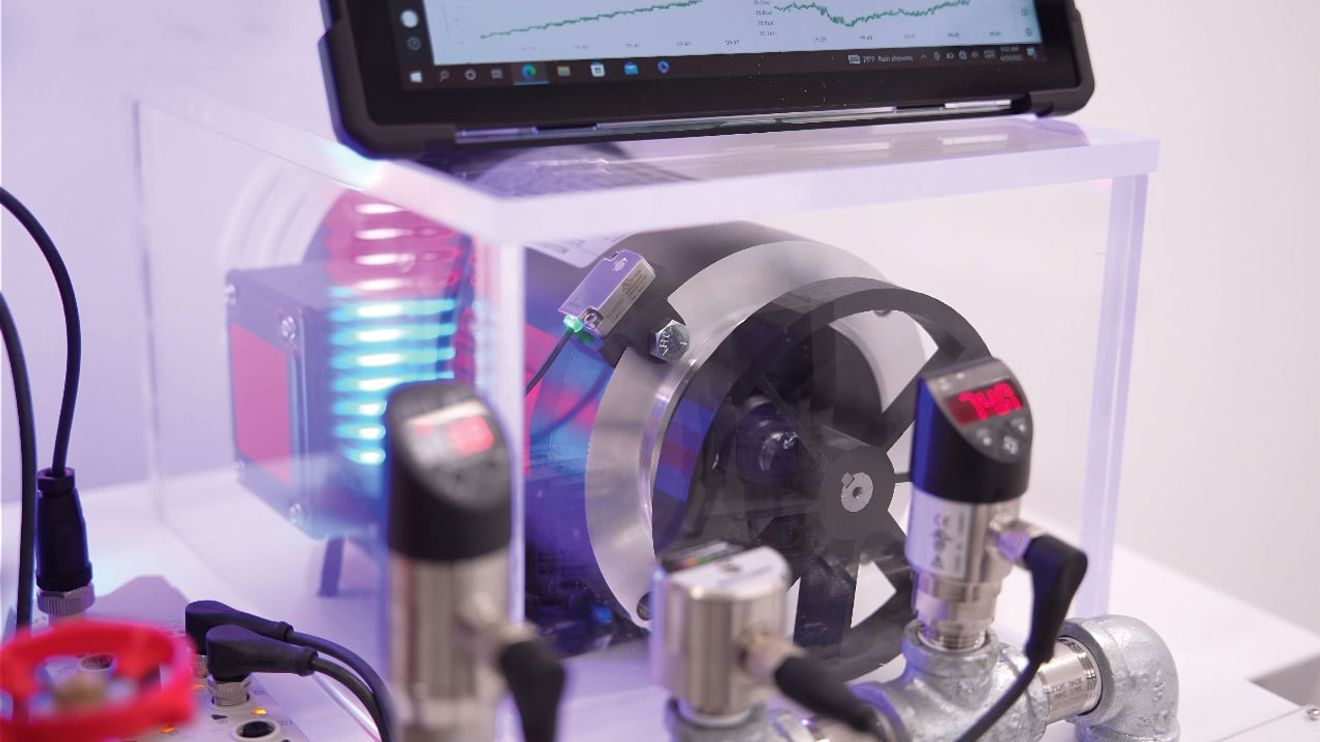
Condition monitoring systems and their components contribute to the efficient and trouble-free operation of industrial machines and systems. Monitoring devices such as vibration, temperature, pressure and level sensors provide meaningful data on the condition of the system and thus provide valuable information for machine maintenance. With such condition monitoring systems, changes such as the wear of individual components can be detected more quickly and maintenance work can be better coordinated. Ultimately, the failure of individual components in complex applications - whether conveyor belts, industrial robots, hydraulic units, motors, pumps or air systems - can bring the entire system to a standstill. It therefore makes sense to use various indicators to monitor the condition of each component.
Vibration monitoring, for example, is essential for rotating machines, systems and individual parts, as vibrations are a typical sign of increasing wear and tear, which ultimately leads to damage and failure. An important indicator for checking proper machine functions is temperature: sensors are therefore attached to the relevant points to measure the contact temperature of critical components such as spindles, bearings or motors, as well as the temperatures of liquids. One such sensor is the 'BCM' condition monitoring sensor from Balluff, which records and processes physical variables such as vibration, temperature, humidity and ambient pressure and transmits the data to a higher-level system via IO-Link. It can also recognize and communicate its own status. This sensor is now available in its second generation.
From the first to the second generation
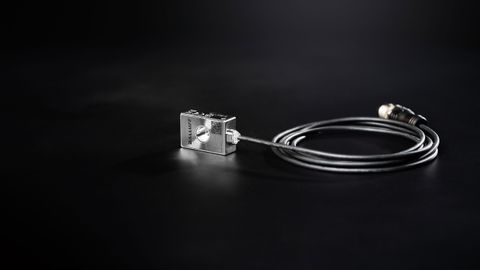
The second generation is not so much an update as an upgrade: externally, the rectangular design of the first generation, the cable with M12 connector and communication via I/O link have been retained. What is new is the central fastening screw, which enables the sensor to be attached to practically any metallic surface using an adapter. The inner workings consist of a new acceleration sensor, a temperature sensor and further developed electronics and software. The measuring range of the internal vibration sensor has been extended from 2.5 to up to 6 kHz and the sensitivity has been improved. The machine vibrations are recorded simultaneously in three axes, with the axis directions corresponding to the edges of the sensor housing. The extended measuring range now makes it possible to monitor higher-frequency phenomena - for example rolling over of pittings in roller bearing raceways and on gear teeth.
Toolkit for easy handling
The condition monitoring of rolling bearings and gears requires complex calculation operations, which Balluff supplies directly on the sensor. The amplitude spectra are calculated there using the fast Fourier transformation as well as the envelope curve spectra. The 'Condition Monitoring Toolkit CMTK' is available to determine the relevant damage frequencies to be monitored. This toolkit mainly consists of a base unit to which a maximum of four I/O-Link sensors can be connected, including for example 'BCM Gen 2' sensors, and the 'BCM Config Assistant'. The base unit can be extended by an IO-Link master with eight ports, so that a total of twelve sensors can be integrated. This provides users with an easy-to-use plug-and-play solution that allows them to configure the 'BCM Gen 2' sensor for their drive or set up their own condition monitoring system if required. IT knowledge is not required for this. For installation, the sensors are mounted on the base unit and connected to the network via Ethernet LAN cable. The user interface or the 'BCM Config Assistant' for the sensor then simply needs to be called up using the IP address.
This wizard enables users to intuitively implement professional condition monitoring for standard drives without having to be an expert in the field of vibration analysis. The most common applications - electric motor, pump, fan or compressor - have already been created. The typical monitoring functions can be selected for each component of these drives or units, for example bearing damage and temperature for a pump or monitoring in accordance with the ISO standard.
Condition monitoring of rolling bearings
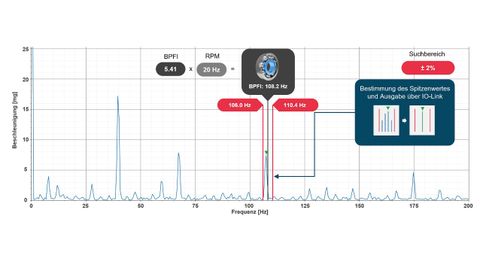
Bearing monitoring has been newly implemented, for which a database for standardized rolling bearings with around 160,000 bearing types from different manufacturers has been integrated. In most cases, this eliminates the need to manually enter geometric bearing data or the tedious search for bearing frequencies with the respective manufacturers. However, this is also possible - although it should mainly be used for special and drawing bearings.
Once the rolling bearing has been selected, the calculated frequency bands for the inner ring, outer ring and rolling element within which the damage will occur are displayed. During operation, the 'BCM Gen 2' sensor calculates the frequency spectrum from the acceleration signals and then filters out the peak values within the monitored frequency bands. An alarm is triggered as soon as the amplitude has exceeded the values for a pre-alarm and the (main) alarm. Damage can thus be detected accurately and at an early stage, long before the damage has progressed to the point where the machine is audibly and noticeably damaged. Signal pre-processing and analysis on the sensor reduces the amount of data transmitted: 20 Gbytes of raw data per sensor per day are reduced to just a few Mbytes of data. A monitoring function is defined in the configurator for each component and each potential damage pattern; the parameter set generated from this is then transferred to the sensor.
Speed as an important signal
The bearing frequencies depend directly on the current speed. The condition monitoring sensor must know the current speed in order to calculate the frequency bands correctly and thus be able to shift the bands dynamically with the speed. In the configurator, Balluff offers three options for transmitting the speed to the sensor:
Constant speed
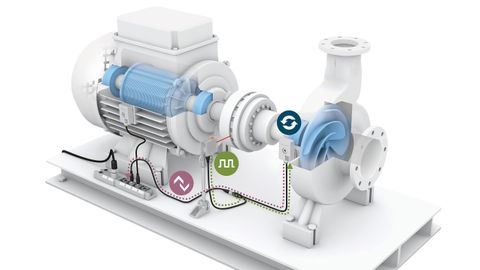
- The variable speed signal, which is already present in the machine controller (e.g. from a rotary encoder), is transmitted via the fieldbus to an IO-Link master, which then transfers this signal to the sensor via cyclic IO-Link communication.
- Variable speed signal from a second, applied sensor. This second inductive or optoelectronic sensor picks up a signal corresponding to the speed to be monitored, for example at the claw coupling, a toothed belt pulley, a gear wheel or a toothed shaft or pulley. The binary signal is transmitted directly to the condition monitoring sensor via a Y-connector. To enable the sensor to calculate the corresponding speed, the transducer pulses per revolution must first be specified in the configurator. This solution is particularly suitable for end customers who do not want to interfere with the existing control system of a running system.
The adapter solution
If there is no M5 thread at the desired measuring point to attach the condition monitoring sensor directly, the following options are available:
- A magnetic holder for temporary attachment, for example to collect data and experience.
- A screw-in adapter from M5 to M6, 8, 10 and 12.
- An adhesive adapter that has the M5 thread for the sensor on one side, while the adapter on the opposite side is fixed with two-component adhesive. If the monitored component is defective, only the adapter is lost, but not the sensor.
- A cooling fin adapter for mounting between cooling fins. It is important that the tip of the adapter makes metallic contact with the housing. The remaining gap is filled with adhesive and the adapter is fixed in place. This variant is used when neither a suitable surface nor a thread is available.
Users with a self-developed automation and condition monitoring solution can therefore use the 'BCM Gen 2' as a sensor with data pre-processing and incorporate their domain expertise into the overall solution. Companies that are looking for a condition monitoring system as a stand-alone solution and do not want to intervene in the existing automation can use the toolkit with sensor and use it to save and visualize the data.



You might also be interested in
Sales growth in a turbulent market environment
Thanks to innovations and a focus on strategic industrial markets, Sick was able to moderately increase its sales in the 2025 financial year. In a turbulent market environment, the company was able to maintain its position and gain market share with...
 read more...
2D Machine Vision brands bundled under one roof
From January 2026, the image processing brands Allied Vision, Chromasens, Mikrotron, NET and SVS-Vistek will be merged under the Allied Vision brand. The companies, which are part of TKH Group NV, will combine their technological know-how,...
read more...Double focus
With the 'DCR 1048i OCV', Leuze is expanding its Simple Vision portfolio with a further functionality: The sensor can both read 1D/2D codes within an application and check the quality of a print using the OCV method.
read more...Combination of line scan camera, intelligent image processing and AI
Imago Technologies launches the 'Vision Cam XM2 Line Scan', an intelligent embedded line scan camera system that combines line scan camera technology, intelligent image processing and AI vision in one compact device.
read more...Record figures for Vision 2024
Vision, the world's leading trade fair for machine vision, will kick off with a record number of exhibitors on October 8, 2024. Around 500 exhibiting companies - more than ever before - will showcase their new developments and innovations to an...
read more...Award for sustainability management
Sick has received a platinum medal in the EcoVadis sustainability ranking. This puts the provider of sensor-based automation solutions in the top 1 percent of more than 130,000 companies worldwide that have been assessed over the past twelve months.
read more...AT - Automation Technology becomes AT Sensors
AT - Automation Technology becomes AT Sensors. The rebranding is intended to reflect the strategic decision to withdraw from the systems business.
read more...Better packaging with AI-supported sensor solutions
At Fachpack, the European trade fair for packaging, technology and processes in Nuremberg from September 24 - 26, 2024, Sick will be presenting sensor solutions for process and quality control as well as machine safety.
read more...Vision Optrix / Teledyne Dalsa
Crease-free adhesive tapes for medical applications
The US system integrator Vision Optronix has developed an image processing system that checks the quality of self-adhesive cohesive material during production. Line scan cameras form the basis of the system, which ensures significantly less waste.
read more...