

AI.country
With robots, AI and photovoltaics
The semi-mobile agricultural robot called 'Davegi', developed by the start-up AI.Land in Kempen, which enables energy self-sufficient and resource-saving vegetable production using photovoltaics, is an exciting example of modern agricultural technology.
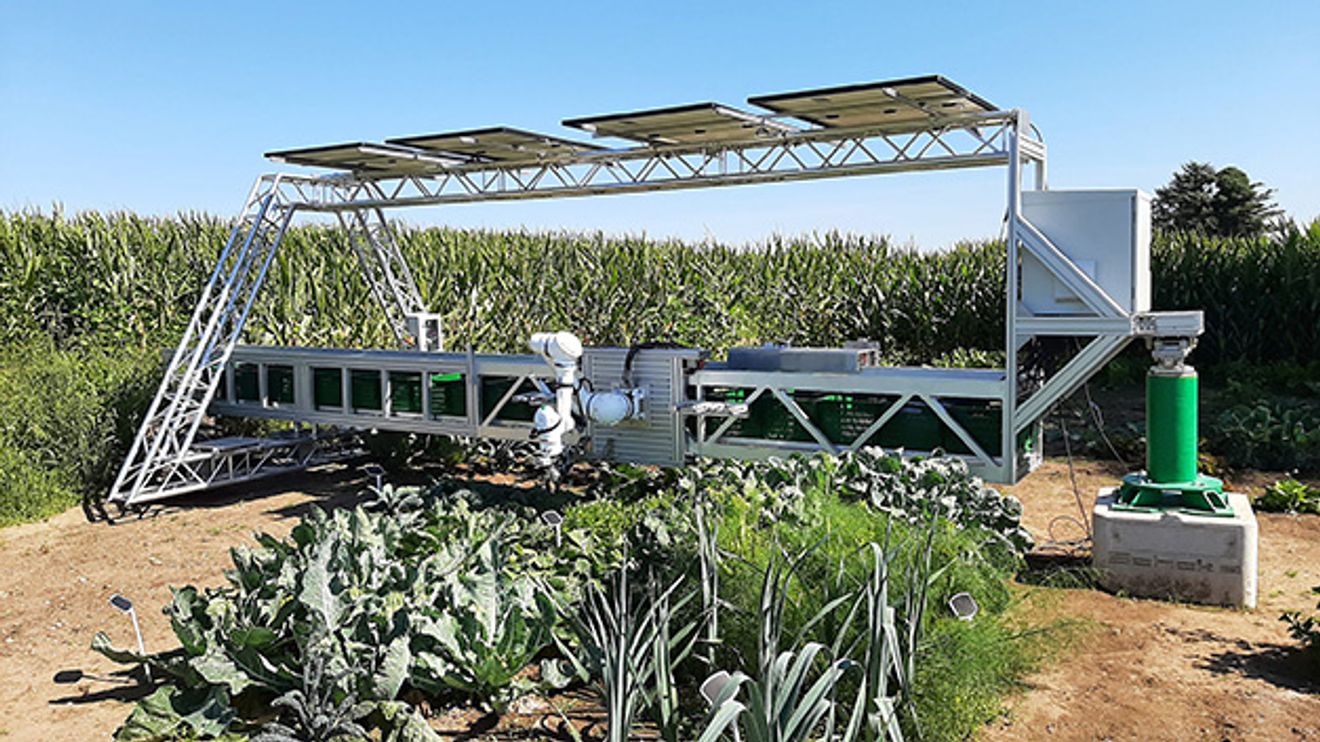
Vegetable production with photovoltaics: the agricultural robot "Davegi" in action.
© AI.countryThe agricultural robot circles a vegetable field with its eight solar modules. Unlike conventional, permanently installed photovoltaic systems, it can rotate 360°, allowing the crops to receive sufficient sunlight while generating solar energy at the same time. According to Josef Franko - founder of AI.Land and developer of the prototype - the device is 50% more efficient in its use of parallel energy and vegetable production compared to immobile shade-casting agrivoltaic systems. The German Advisory Council on Global Change (WBGU) describes this kind of dual use as a sustainable strategy for generating more profit. "There is only a limited amount of land available," says Alexander Bonde, Secretary General of the German Federal Environmental Foundation (DBU). "We therefore need a sustainable approach to land - for climate protection, biodiversity conservation and food security at the same time." Digitalization and AI are "promising instruments for the multiple use of land" and the project is a good example of this.
Farming, sowing, watering, fertilizing and harvesting
Company vision: The semi-mobile agricultural robot 'Davegi' developed by the start-up AI.Land is designed to load 60 vegetable crates per day.
© AI.countryAccording to the startup, the 'Davegi' will be an agricultural all-rounder and will be able to till, sow, water, fertilize and harvest in the future. "With our prototype, all plant cultivation processes - from soil cultivation to harvesting - can be carried out precisely, depending on the needs of the individual plants," says Franko, who is focusing on organic farming with the system. According to him, the individual treatment saves on fertilizers, pesticides and water. The plants should also be harvested when they have reached the appropriate maturity, which reduces food waste. The company's vision is for Davegi to autonomously and energy self-sufficiently fill 60 crates per day with a total of 600 harvested vegetables in ten different varieties on 2,500 square meters, about a third of a soccer pitch. "We want to sell the vegetables regionally," says Franko. A test field is being planned. Short distances save fuel and therefore energy. In addition to self-sufficient operation with solar energy, this also improves the greenhouse gas balance in vegetable cultivation.
Modern Agriculture Innovation Award
For Franko, the semi-mobile agricultural robot is an important intermediate step towards fully automated agriculture. "With the prototype, we are demonstrating in a first step that photovoltaic-powered, energy self-sufficient and fully automated vegetable production, including field logistics, is possible," says the start-up founder.
AI.Land will launch the 'RoboFeld' pilot project at the end of 2024. In a second step, families from Kempen and the surrounding area will receive fresh vegetables directly from the field. AI.Land received the 'Innovation Prize for Modern Agriculture', endowed with 5,000 euros, for its invention at the International Green Week 2024 in Berlin. AI.Land was founded in November 2020 by the Institute for Mobile Autonomous Systems and Cognitive Robotics at Aachen University of Applied Sciences and currently employs 15 people.


You might also be interested in
Mobile plastic robots for SMEs
Conventional mobile robotic systems on the market start at around 25,000 euros, with an integrated robotic arm they are around 70,000 euros. Due to the high prices, widespread use is often unaffordable for small and medium-sized companies. Igus...
 read more...
'Robot kitchen' opens
The CeTI Cluster of Excellence at TU Dresden has opened a 'robot kitchen' as a research laboratory for human-machine interaction. Among other things, it is intended to demonstrate the capabilities of modern cobots.
read more...SensoPart and Cambrian Robotics
Partnership for 3D-Guided Robotics
Cambrian Robotics and SensoPart are jointly developing an AI-powered solution for 3D-guided robotic applications. The combination of vision sensors and AI is designed to simplify gripping and positioning processes.
read more...IFR Elects Jane Heffner as President
Jane Heffner is the new president of the International Federation of Robotics. Adrien Brouillard has been appointed vice president of the global federation.
read more...Production and Distribution Capacities
Yaskawa Opens Robotics Center in Slovenia
Yaskawa has opened a new robotics distribution center and an assembly hall in Kočevje. The 32-million-euro investment strengthens production and logistics for the EMEA region.
read more...Alibaba Expands 'Qwen' for Robotics
Alibaba is expanding its Qwen model family with a robotics suite for Physical AI. The three models support manipulation, navigation, and simulation for autonomous robotic systems
read more...International Federation of Robotics
U.S. Robotics Industry Sees Double-Digit Growth
In the U.S., sales of industrial robots rose by 11% compared to the previous year: 38,000 units were newly installed in 2025. This significant recovery is driven by robust growth in the food industry and other non-manufacturing sectors. However, the...
read more...Development Collaboration for Humanoid Robotic Hands Launched
Schunk is entering into a new development partnership with Robert Bosch Robotics. Their shared goal is to develop an industrial-grade robotic hand that can be integrated into various humanoid robot systems.
read more...International Federation of Robotics
The 2026 IERA Award was presented
The 2026 “Award for Innovation and Entrepreneurship in Robotics & Automation” (IERA) goes to the Swiss deep-tech company Verity for its fully autonomous indoor drone system. The flying robots support the logistics and retail sectors by...
read more...