
Humans and robots work together
The topic of HRC at Automatica 2016
From June 21 to 24, Munich was all about the latest developments and trends in robotics - above all the topic of human-robot cooperation and collaboration (HRC).

The ongoing digitalization and automation of production is changing the world of work. In the future, human and machine skills will be combined more intelligently than ever before. Smart assistance systems, for example, will make manual workstations in multi-variant assembly more ergonomic and error-free. In short: with human-robot collaboration (HRC), the robot becomes the worker's assistant.
"While simple, repetitive and physically demanding tasks are increasingly being automated, humans with their special judgment, flexibility and creativity will continue to play the central role in the future," Patrick Schwarzkopf, Managing Director of the VDMA Robotics + Automation Association, which is also the technical sponsor of Automatica, is firmly convinced. The combination of human skills and robotics is a recipe for success and is reflected, for example, in German car manufacturers: between 2010 and 2015, the number of robots in the German automotive industry rose by 17%, while the number of employees increased by 13%.
On the following subpages, you can read an excerpt of what the exhibitors at Automatica 2016 had to show in terms of HRC:
Motoman HC10 robotic arm from Yaskawa
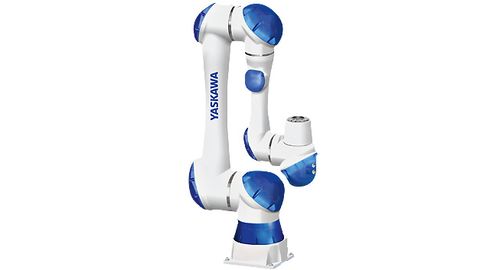
The new Motoman HC10 robot arm from Yaskawa has been designed so that there are no pinch zones. It therefore requires no additional protective measures, such as a protective housing.
© YaskawaWith the Motoman HC10, for example, Yaskawa presented a collaborative robot for the first time outside of Japan. According to Yaskawa, the prototype on show in Munich with a reach of 1.2 m and a handling weight of 10 kg has already been approved in accordance with the ISO TS15066 technical specification. The HC10 ensures the required safety in direct contact with the operator by means of a force-torque sensor system in all axes, which enables flexible interaction between the robot arm and its environment. Programming can be carried out as 'easy teaching' with the Smart-Hub function via manual guidance. Speaking of programming: Motoman robots from Yaskawa can be programmed and controlled via the PLC in the standard IEC 61131 environment using MotoLogix. Following the Ethernet/IP and Powerlink platforms, this is now also possible with Profinet for Siemens environments.
New generation of six-arm robots from Stäubli

The new generation of six-axis robots from Stäubli comprises the three model series TX2-40, TX2-60 and TX2-90 in the payload range from 2 to 15 kg with reaches from 515 to 1450 mm.
© Stäubli RoboticsHRC was also a major topic at Stäubli. The new generation of the TX2 series was on show here for the first time. The special feature of these six-axis robots lies in the special safety functions of the CS9 safety controller, which all meet the requirements of the SIL3/PLe safety category. The TX2 robots also have their own digital safety encoder per axis and an integrated safety board. To ensure maximum safety, every movement of the robot is monitored by sensors. All of the robot's coordinates, speed and acceleration are recorded in real time.
When asked why Stäubli uses its standard machines for human-robot collaboration and does not build typical assistance robots, Managing Director Germany Gerald Vogt replies: "We didn't want to develop expensive special kinematics for pure HRC applications. Such robots are usually too limited in terms of payload and dynamics. That's why we have qualified our standard robots for collaboration with humans while retaining their full performance capabilities." Vogt sees the decisive advantage of this strategy in the flexibility of the robots. The TX2 six-axis robots can be used to enable different levels of human-robot interaction, while at the same time their performance in terms of precision, availability and speed make them the first choice for all kinds of industrial applications with the toughest cycle time criteria. And according to Vogt, these make up the majority of applications in industrial practice.
Concept study KR Agilus CC from Kuka
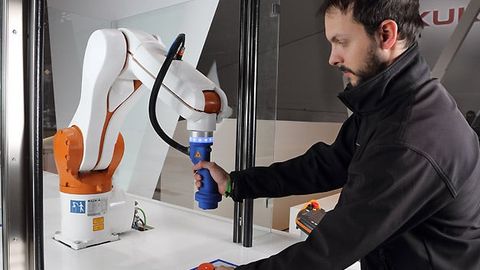
Thanks to its free manual guidance, the robot is ideal for teach-in processes, among other things. This is made possible by the position- and load-dependent calculation of the motor currents that keep the robot hovering.
© Kuka robotsKuka, on the other hand, is pursuing a two-pronged strategy when it comes to HRC. At Automatica 2014, the Augsburg-based company had already focused on the LBR iiwa - a sensitive and intelligent lightweight robot that was specially developed for human-robot collaboration. Although this robot also dominated the Kuka stand at this year's industry show, the Augsburg-based company also presented an HRC implementation in the industrial robot portfolio using the KR Agilus Cobotics Concept (CC) as an example. As part of a concept study, Kuka has equipped the KR Agilus series with a force torque sensor in the robot base. This enables the industrial robot to detect collisions with humans and perform sensitive tasks.
Two-armed YuMi from ABB

ABB is convinced that collaborative robots such as the two-armed YuMi will permanently change assembly processes, among other things.
© ABBWhether or how quickly collaborative concepts become established in industry will ultimately depend on whether productivity does not suffer as a result. ABB had set itself the goal of allaying this fear among trade fair visitors with two exhibits. On the one hand, the Swiss-Swedish company simulated a collaborative assembly line from ABB's Finnish low-voltage electronics plant at its stand, where workers and YuMi robots are already successfully working hand in hand. On the other hand, ABB, together with YuMi, presented a further development of its safety-certified software solution for monitoring and controlling cooperating robots. The software, called SafeMove2, has numerous functions - including safe speed limits, safe standstill monitoring and safe axis ranges as well as position and orientation monitoring - and is intended to enable even closer cooperation between humans and robots in the future by limiting robot movements to exactly what is required for a specific application.
Last but not least, ABB announced at Automatica that it will introduce a connected services platform for robots that will help to reduce malfunctions by up to 25% and shorten response times and problem-solving processes by up to 60%. These services will be available as part of ABB Robot Care service contracts and will utilize all relevant data from the entire installed base of ABB robots to increase availability. Dr. Hui Zhang, Head of Product Management at ABB Robotics, said: "Until now, robots were often only serviced when they needed repair or when the number of operating hours demanded it. Now we can perform maintenance based on the actual condition of a robot and prioritize activities that keep key processes efficient and available."
ZDT tool from Fanuc
Zero Down Time, or ZDT for short: Fanuc is now also introducing a new system for preventive maintenance under this abbreviation. Fanuc wants to address two basic requirements: monitoring the 'life functions' of robots practically in real time and taking over preventive maintenance of the robots. The ZDT tool includes all axes and additional axes that are implemented in the Fanuc controller and that are controlled from the controller. ZDT therefore not only monitors robot axes, but also servo drives in the periphery, drives of servo welding guns or positioning tables. Fanuc and Cisco have launched a collaboration to implement ZDT; a ZDT pilot project is already underway at an automotive manufacturer in the USA.
'Universal Robots+' ecosystem from Universal Robots
Finally, Universal Robots presented the Universal Robots+ ecosystem for developers, sales partners and end customers for the first time at the trade fair. The most important components of the ecosystem are a free developer platform (+You) and a showroom (Universal Robots+). With their help, all conceivable applications relating to the UR3, UR5 and UR10 family of collaborative robot arms can be developed and presented in the future. The aim is to create so-called URCaps in this way - i.e. customized hardware components, software plug-ins or a combination of both - which should ultimately ensure reduced integration times for applications, increased ease of use and reduced costs for everyone involved. Participants in the developer program will receive free support from Universal Robots in the development of URCaps.
Co-act Grippler JL1 from Schunk
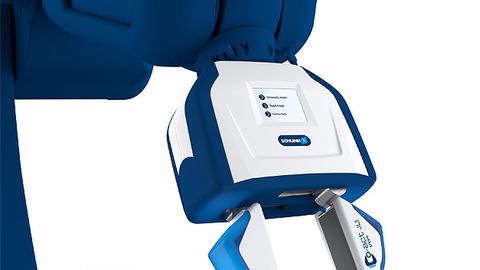
The gripper concept of the future from Schunk: Key features include a flexible outer skin, integrated protection against workpiece loss and an LED panel as a communication interface to the human operator.
© SchunkInevitably, robots always need the right gripper. Schunk demonstrated what developments can be expected in this sector with the 'tame' Co-act Gripper JL1. According to the Lauffen-based manufacturer of clamping technology and gripping systems, this technology carrier is the world's first collaborative gripper that interacts and communicates directly with humans.
Even at the basic level, the Co-act Gripper JL1 fulfills the central requirements of safe human-robot collaboration: if the process is interrupted in the event of an emergency stop, for example, it is always guaranteed that the gripped part is reliably held. The gripper uses an environment sensor system to continuously monitor its surroundings and processes the data using integrated software. If unwanted contact with a person occurs, the gripping force is automatically limited.
In addition, Schunk turns the gripper into a means of communication between the system control and the operator. LED lights and a corresponding color system indicate whether the system is ready for operation and whether the correct workpiece has been gripped. And the plans go even further: in future, Co-act Grippers will enable complex interaction between different sensors and safety mechanisms. This includes force measuring jaws and visual monitoring as well as skins made of tactile and capacitive sensors or current-based force control. The collaborative grippers will also be able to communicate with the robot and the higher-level system control via OPC UA interfaces.


You might also be interested in
International Federation of Robotics
Robotics continues to gain ground
Good news from the robotics industry: The International Federation of Robotics (IFR) announced new record figures for the 2015 financial year at Automatica: 248,000 units sold represent an increase of 12% compared to the previous year.
 read more...
Follow-up with Matthias Krinke
The robot as a temporary worker?
Robozän, a temporary employment agency for robots, was founded in Berlin in November last year. Managing Director Matthias Krinke explains the idea behind it.
read more...German robotics and automation
VDMA announces details of record sales
Last year, the German robotics and automation industry posted record sales - this was announced by the VDMA at the beginning of June 2016. The association has now broken down its figures further at Automatica 2016.
read more...New products at Automatica 2016
Automatica, the biennial 'Trade Fair for Automation and Mechatronics', will exceed the number of exhibitors from 2014 this year. Computer&AUTOMATION shows a selection of the new products presented by the 825 or so exhibitors in Munich in a...
read more...Division for software and digital business established
Kuka has founded a new business division. With 'Kuka Digital', the Augsburg-based company known for its orange industrial robots and automation solutions is expanding its software and digital business.
read more...Finalists for the Innovation Award 2025 have been announced
The motto of the Kuka Innovation Award 2025 is 'Medical Robotics Challenge 2.0'. Five international teams have made it to the final with their robotics ideas for the future of medicine. The winner will receive 20,000 euros in prize money.
read more...Great career opportunities for women in robotics
The IFR supports the career advancement of women in the robotics industry because, according to a World Bank forecast, the gross domestic product per capita would increase by almost 20 percent worldwide if the employment of women reached the same...
read more...Cobot assistant for SMEs
A user-friendly cobot application for small and medium-sized companies that can be used without programming - a team of researchers from Belgium received the Kuka Innovation Award 2024 for this concept.
read more...Handles handling and spot welding
The 'KR Fortec' from Kuka is an energy-efficient and dynamic heavy-duty robot that can be used in particular for tasks such as handling and spot welding.
read more...