
Robotics
RobMoSys for more software quality
With the involvement of the robotics community, the RobMoSys project aims to establish an open and agile software ecosystem for a wide range of applications, thereby increasing the scalability and quality of software development in robotics.
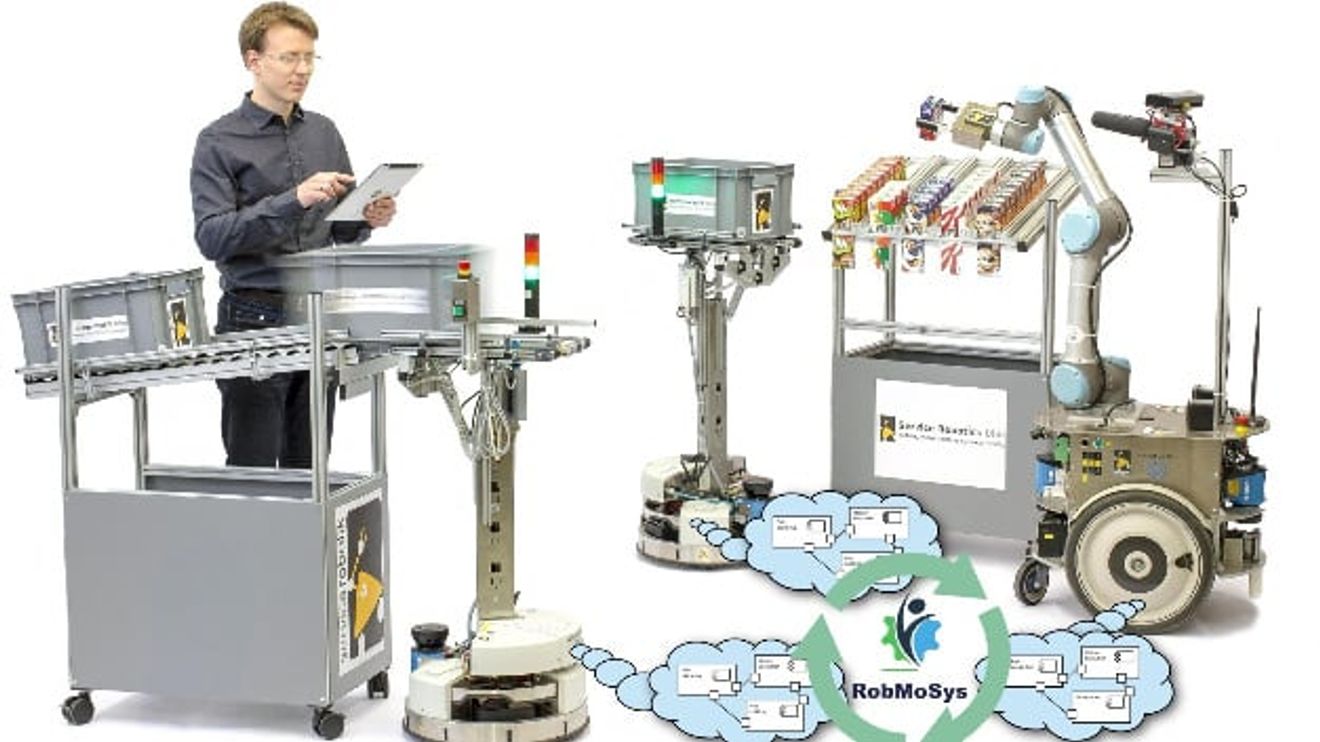
Specifically, RobMoSys (Composable Models and Software for Robotics) aims to use model-driven methods and tools and apply them to existing technologies to ensure the large-scale integration of different robotics platforms and improve tools that have already been developed for further use. The project is establishing a methodology that focuses on the composability of building blocks. The aim is to ensure modularity and the management of defined system properties at model level independently of the existing robotics platforms and existing implementations.
RobMoSys involves external partners from the robotics community via two open calls for proposals in a multi-stage funding process and thus passes on 50% of the project budget to the robotics community. At the first public RobMoSys workshop, which will take place on March 22 at the European Robotics Forum in Edinburgh, all stakeholders and potential end users will have the opportunity to find out more about the project and how they can get involved. Prof. Christian Schlegel from Ulm University of Applied Sciences and Prof. Herman Bruyninckx from the University of Leuven (Belgium) will explain the aims of the project and answer open questions. Further workshops are planned in the course of the project in order to take up and consider the ideas, recommendations and requirements of all stakeholders.
The RobMoSys project is coordinated by the Commissariat à l'énergie atomique et aux énergies alternatives (CEA, France). Other partners are Comau (Italy), Eclipse Foundation Europe (Germany), EUnited AISBL (Belgium), Ulm University of Applied Sciences (Germany), KU Leuven (Belgium), PAL Robotics (Spain), Siemens (Germany) and the Technical University of Munich (Germany).


You might also be interested in
Festo at the Hannover Messe 2017
New bionic approaches for robotics
The engineers from Festo's Bionic Learning Network are presenting new concepts for robotics at the Hannover Messe 2017. Models from nature served as inspiration: the elephant's trunk and octopus tentacles.
 read more...
EU project ROSIN launched
Creating a digital industrial platform for robotics with open source software: this is the aim of the EU research project ROSIN, which was launched at the beginning of January with a four-year term.
read more...Fraunhofer experts explore the world's oceans
Fraunhofer IOSB is the only team from Germany to have qualified for the semi-finals of the Shell Ocean Discovery XPrize. This highly remunerated international competition recognizes innovations for research into the seas and oceans.
read more...Drone use in the business environment
Intel and Deutsche Messe want to demonstrate the wide range of applications for drones in companies at Cebit 2017: In the 'Intel Cebit Drone Park', visitors will be able to experience the digital value chain surrounding unmanned aerial vehicles.
read more...5G for intelligent manufacturing
Ericsson and robot manufacturer Comau have signed a cooperation agreement. Together, they want to explore the potential of 5G technologies in the context of Industry 4.0 and smart manufacturing.
read more...Hand in hand with the robot
With 'Mixed Reality Production 4.0', DFKI researchers and the BMBF will be presenting new, cross-location forms of human-robot collaboration (HRC) for cross-location production at this year's Cebit.
read more...TUD opens "incubator" for start-ups
The Technical University of Dresden (TUD) and the Technical University of Munich (TUM) have opened the new "launchhub42 ComSpace". In addition to cutting-edge research for future 6G communication networks, it also focuses on visionary ideas from the...
read more...The foundations must be laid now!
A major project is starting at the Technical University of Munich that aims to lay the most important foundations for the 6G standard. Project manager Prof. Wolfgang Kellerer explains in an interview what is important in the development of the next...
read more...Hyperloop Pod Competition from SpaceX
The fastest pod comes from Munich
The pod of the WARR Hyperloop Team of the Technical University of Munich almost reached the speed of sound at the final of the Hyperloop Pod Competition in Los Angeles.
read more...