

Kuka researches
Psychosocial aspects of human-robot collaboration
How can robots be used outside of production? Kuka is researching this in collaboration with the BMBF, the German Sport University and RWTH Aachen University. The RoboGym shows what it can look like in reality.
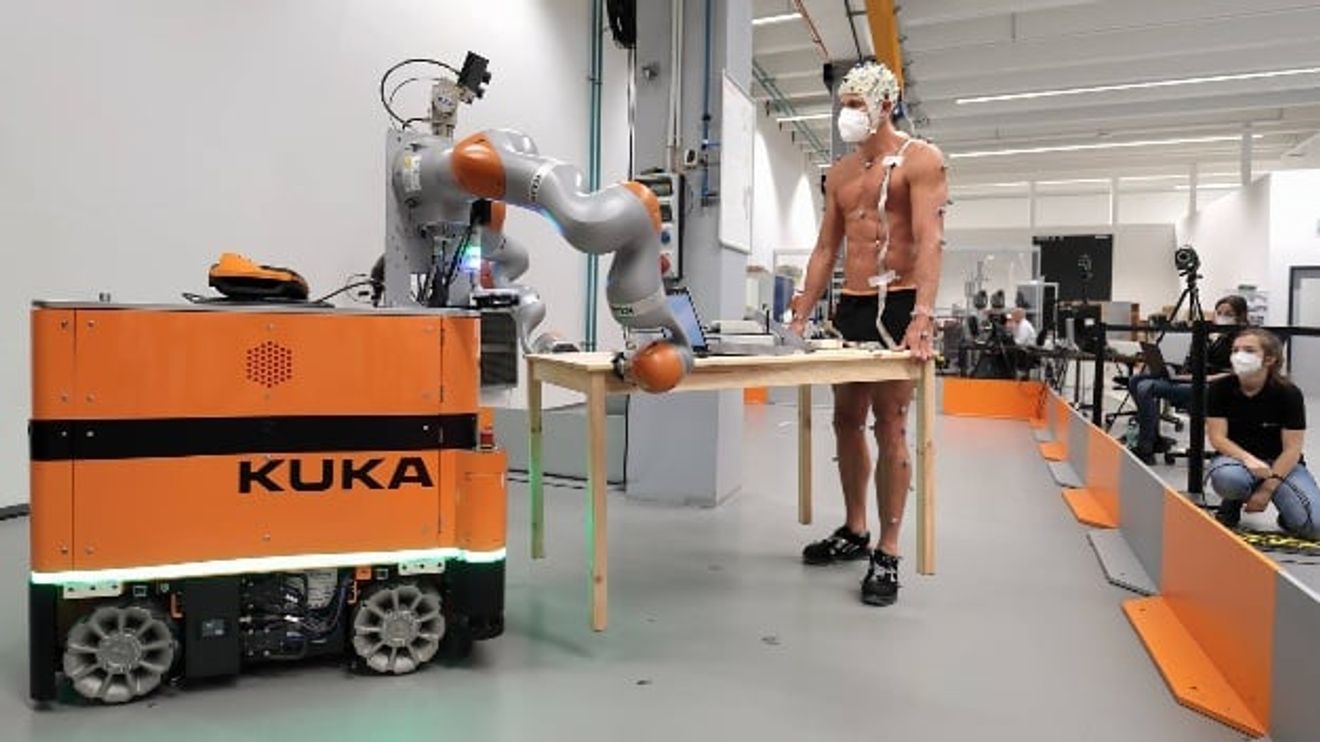
RoSylerNT is the name of the research project in which Kuka has been involved since 2017 together with the German Sport University Cologne and RWTH Aachen University. As part of the project, a robot-based system for neuromuscular training is being tested. While the German Sport University focuses primarily on physical parameters in this project, which is supported by the Federal Ministry of Education and Research, the robot specialist from Augsburg is investigating the psychosocial aspects. These include fear and trust as well as acceptance of technology.
The project is exciting because it is also investigating the benefits of robots outside of the production plant, focusing primarily on the social acceptance of the mechanical helpers. Nadine Bender, Senior Analyst Social Impacts of Robotics in Group Research at Kuka, sums it up: "We are changing the world of work with our products, so we have to look at the effects of this change on people. We are aware of this social responsibility."
Three systems, three applications, different tests
As part of the research project, various devices were developed as executable test systems, the effects of which are now being examined on test subjects. These include a robotic leg press, an automated walking and running trainer, for example for patients who have suffered a stroke, and a robot-based carrying aid that provides support when handling heavy objects.
The latter was developed by Kuka and consists of a mobile autonomous platform and two LBR iiwa. It was tested in Augsburg. 15 test subjects between the ages of 18 and 49 completed various tasks with the HRC system and answered questions. One of these tasks was to carry a table - sometimes with a human, sometimes with a robot. "When carrying with the robot, it was clear that the human was in control and the robot only did what it was supposed to do. This avoided communication difficulties," said one of the test subjects after his assignment. "Overall, the communication was clear. The tablet in particular gave us clear instructions."
Direct human-robot interaction
In addition to sensors and a Roboception camera, the system is also equipped with a tablet that provides visual feedback. "The test subjects have no robot-specific training. The tablet makes communication more pleasant and we create trust in the interaction," says Nadine Bender from Kuka, explaining the technical equipment.
The system also contains maps of the surroundings to control navigation and a photo database. Thanks to the integrated face recognition, the robot greets its counterpart personally. All three systems, including the leg press and the walking trainer, are able to perceive the posture, movement and load of the person and thus adapt to them and the respective situation. In this way, the robots ensure that users and patients are not overloaded or even endangered. One test subject explained: "After a short familiarization phase, I quickly noticed how the robot reacted to me, what it did and what it didn't do. For example, I knew relatively quickly that it didn't tend to make hectic movements."
Focus on basic research
Kuka is conducting basic research in a network with the Sport University in Cologne and the BMBF. Although there are already isolated studies on human-robot interaction, the psychosocial aspects also come into play in the experiments. These findings are then to be transferred to other products. "Collaboration with robots is becoming increasingly important, especially in the care sector. But people and intelligent machines are also increasingly working together in close proximity in industry," emphasizes Nadine Bender.
The research project, in which the results of the test week in Augsburg are now being evaluated, will run until January 31, 2021. The two other systems in Cologne will also be evaluated to the same extent in the fall. Project manager Dr. Uwe Zimmermann says: "At the moment, in addition to psychosocial research, we are also focusing on the development of innovative new technologies that can also be incorporated into other products. Ultimately, we want to develop a learning robot system that actively applies force and thus becomes an interactive helper for people."
Robots are already acting as interactive helpers in RoboGym. Here, questions such as "What does the future of training look like?", "Can robots be used for strength training and thus possibly achieve increased progress?" or "How far is the acceptance of technology among the population and athletes?" are answered.
RoboGym - Training for top athletes
Kuka has been dealing with questions relating to sport and robotics for a long time. At the end of 2014, the robotics specialist called in its system partner BEC to answer these questions, who presented the first prototype, the RoboGym, at the beginning of 2015. The RoSylerNT project described above was then created in 2017.
The so-called 'RoboGym' should be ready for the market as soon as possible and represents an improvement on conventional training methods in many respects. What was originally planned exclusively for elite sport could permanently change the way we train in the future.
New movement geometries
While conventional strength training equipment only allows a linear load with constant weight, the RoboGym based on a KR 160 nano can enable completely new movement geometries and a focus on individual muscle groups thanks to stored biomechanical skeletal models. The test subjects report improved performance and an absolute feeling of safety. Thanks to the built-in sensors for force measurement and built-in safety features such as safety spaces and speed monitoring, the maximum load and the range of movement of the individual parts can be controlled in such a way that subsequent injuries are avoided and the athlete can return to their usual level more quickly, especially in the area of rehabilitation, for example after a cruciate ligament rupture.
Three types of training are supported
So far, the RoboGym supports three different types of training: In addition to the leg press, there is the option of knee extension, as well as a rowing exercise for the upper body. The data is displayed on the screen in real time and stored on a cloud. By activating the device, the data can be called up directly from anywhere in the world and the device adjusts itself individually to your height and desired training weight. By recording the data, a much more precise screening is possible, in which the actual force applied and the movements during each part of the exercise can be viewed even more accurately. This means that training can be adapted to individual requirements. Martin Gerlich, CFO at BEC, summarizes the commitment: "Our dream would be for the RoboGym to become the standard in professional sport and rehabilitation in a few years' time and to be found in every Olympic training centre."


You might also be interested in
Combining technology and art
An industrial robot is one of the main actors in a play at the Staatstheater Augsburg, which audiences can watch from home as a 360-degree production using virtual reality goggles. Man and machine dance together on the virtual ballet stage.
 read more...
***** ENG ***** Belgian research team wins Innovation Award
Artificial intelligence to automate two-handed demanding tasks - with this idea, a team of researchers from Leuven, Belgium, won the innovation competition worth 20,000 euros.
read more...Belgian research team wins Innovation Award
Artificial intelligence to automate demanding two-handed tasks - with this idea, a team of researchers from Leuven, Belgium, won the innovation competition with prize money of 20,000 euros.
read more...Kuka relies on ecosystem
Intuitive, fast and powerful - this is how Kuka describes its future operating system iiQKA.OS. It is intended to greatly simplify the use of robots and serve as the basis for an entire ecosystem.
read more...followed up! - with Helmut Schmid, DRV
Securing Germany as a business location with robots
At the beginning of the year, Helmut Schmid co-founded the German Robotics Association. We asked him why a new association is needed and how the DRV is fighting the prejudice that robot automation is expensive and complicated.
read more...Sharp decline in sales, incoming orders and EBIT
Like the market as a whole, Kuka also felt the massive impact of the coronavirus pandemic. Although there were slight signs of recovery in the third quarter of 2020, these were unable to compensate for the slumps in the first half of the year and...
read more...Cobots automate cleanroom
At Infineon's semiconductor production facility in Villach, 17 sensitive lightweight robots from Kuka work safely together with humans and machines to ensure greater efficiency and safety in the manufacture of highly fragile wafers.
read more...Market-ready gesture control for robots
The Fraunhofer IWU reports: Industrial gesture control for robots is now ready for the market. It complies with the applicable guidelines on machine safety and data protection.
read more...Steven Wyatt appointed Chairman
Steven Wyatt will support Kawasaki Robotics' growth plans in the EMEA region. Previously, Wyatt was President of the International Federation of Robotics (IFR) and held a senior position at ABB.
read more...