

Reply
More intelligent in a swarm
Why do fish swim in shoals, birds fly in flocks or bees in swarms? Because they are more intelligent and efficient together. This also applies to swarm robotics - decentralized, self-organizing systems.

The members of a swarm interact locally with each other and with their environment. These interactions lead to adaptive search behaviour and ultimately to the global optimization of the swarm. This nature-inspired optimization approach has developed rapidly in recent years and is inspiring new developments in numerous industries. But what mechanisms underlie swarm robotics, what features characterize intelligent swarm algorithms and what models and applications are currently available?
Algorithms in swarm robotics
The model of an intelligent swarm is based on a cooperative algorithm as a key component that controls behavior and interactions. Robot swarms are based on a wide variety of algorithms that can control basic functions such as the simple distribution of objects or robots in space or functions for complex cooperation such as the formation of a chain.
The basic goals of swarm robotics are often aimed at miniaturization of hardware or cost efficiency. Four of the most important characteristics of swarm intelligence are coordination, group formation, optimization and path planning. Typical characteristics of swarm algorithms are
- Low complexity: Individual robots follow simple rules.
- Scalability: The system is designed for any number of robots.
- Decentralization: Swarm robots are autonomous and do not follow external commands.
- Local interactions: The robots exhibit collective behavior through local information exchange.
Overview of existing models
Many different swarm algorithms have been developed over the years. The most commonly used models are Artificial Bee Colony (ABC), Boids (Bird-oid object) and Ant Colony Optimization (ACO).
ABC - Artificial Bee Colony
ABC was developed in 2005. The algorithm is inspired by the behavior of honey bees in their search for food sources (nectar) and the subsequent exchange of information about these food sources with other bees in the hive. The ABC algorithm consists of three phases: the Employed Bee Phase, the Onlooker Bee Phase (start phase) and the Scout Phase (search phase). Each Employed Bee selects a known food source and determines the nearest location. She estimates the amount of nectar available there and passes the information on to the other bees by dancing around the hive. The onlooker bee observes the worker's dance, selects one of the food sources on the basis of this information and goes there to view the available nectar. Old food sources are replaced by the new food sources discovered by the onlooker bee. The best food source and the position associated with it are thus preserved.
The position of a food source represents the 'target'. The amount of nectar found in this area corresponds to the 'quality/quantity', also called fitness or 'associated solution'. The number of workers thus corresponds to the number of 'associated solutions' within the swarm.
An illustrative example of an ABC algorithm can be found in agriculture. Swarm robotics is particularly suitable for precision farming, for example in large-scale agricultural operations where drones are used for topographical and thermographic purposes.
In agriculture, thermography provides important information about environmental conditions that is difficult to obtain by other means. If a drone is equipped with a thermal camera, the temperature in the area under investigation can be measured with astonishing precision. Different temperature values represent different characteristics of plant development. The use of drones in precision farming leads to high product efficiency and enables the use of minimal resources and thus savings.
Boids - Bird-oid Objects
Boids stands for a simulation of artificial life that was developed by Craig W. Reynolds in 1986. It is an optimization algorithm inspired by the natural behaviour of flocking birds. Boids is a simple algorithm with three rules that enable complex behavior in swarm robotics: Cohesion, Alignment and Separation.

With the ACO algorithm, the optimization problem is solved by searching for the shortest path in a weighted graph.
© Johann DréoCohesion: This behavior causes agents to seek out the middle position (the center of mass) within the neighboring agents. In this way, the boids always move within a certain range.
Alignment: This behavior causes a particular agent to align its position relative to other agents in the environment and steer in the same direction as its neighbors. A formula is used to define its own speed from the speeds of its neighbors in the environment.
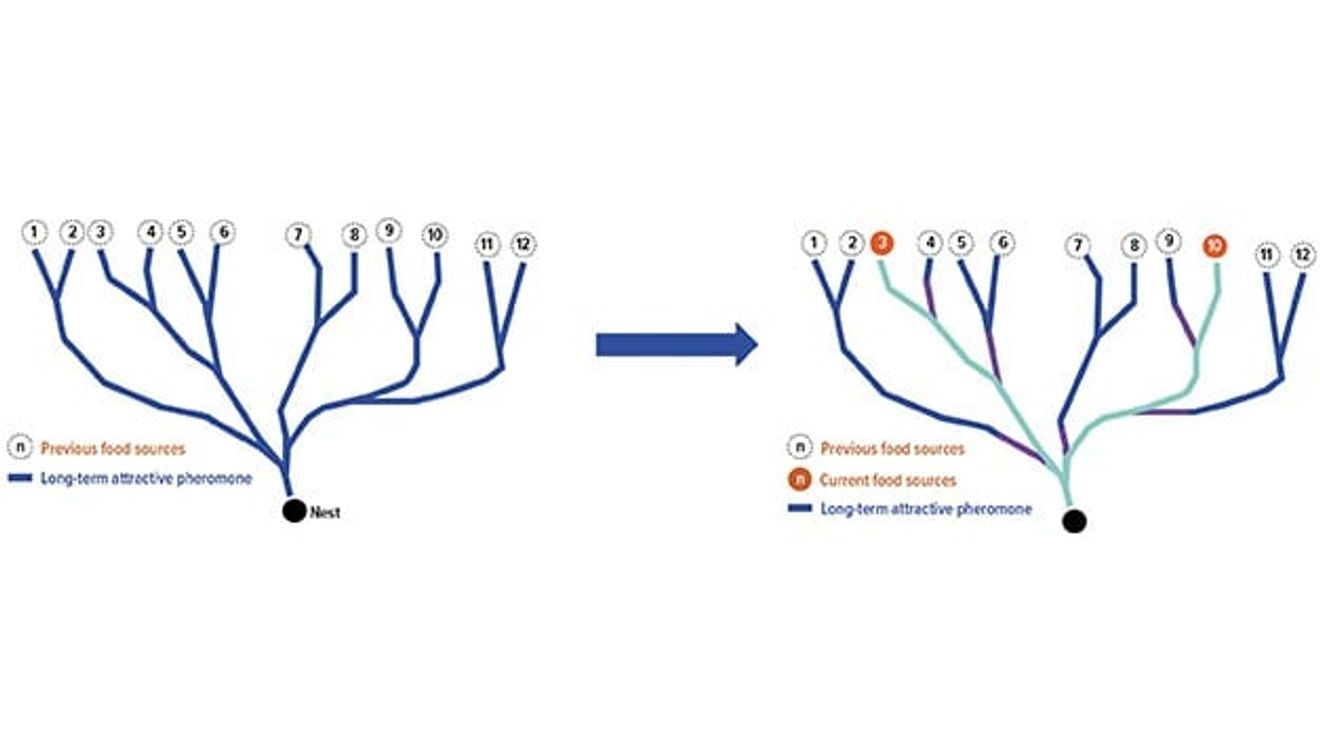
An artificial visualization of pheromone intensity. This type of communication is one of the most effective in nature.
© A Multiple Pheromone Communication System for Swarm Robotics and Social Insects ResearchSeparation: This behavior causes an agent to move away from its neighbor when the distance between them becomes too small to avoid a collision. This also guarantees a minimum distance between all agents.
With these simple rules, it is possible to simulate swarm behavior. However, as they alone are often not sufficient, this swarm behavior can be supplemented by further, individual rules in order to achieve a more complex or meaningful movement. All possible forms of general behavior can be modeled as attraction and repulsion to certain things, for example 'strong wind', 'speed limits' or 'obstacle avoidance'. For example, if the three basic behaviors are supplemented by the rule of obstacle avoidance, the swarm changes direction to avoid obstacles on the way to the target point.
One of the most common applications of this type of algorithm is in search tasks: A certain number of small drones with self-localization and measurement capabilities undertake search missions in rural, natural or complex environments where access by humans or large aircraft is limited or dangerous. The characteristics of swarm intelligence are used to solve problems cooperatively in a scalable way. Performing the same task by a single drone would take more time. In addition, this single drone would have to be more complex, which would increase costs.
ACO - Ant Colony Optimization

ACO is a probabilistic technique developed by Marco Dorigo in 1992 to solve computer problems based on the foraging behavior of ants. The model is based on the approach that independent units with simple and unpredictable behaviors cooperate with each other. The goal of each ant is to find the optimal path from the nest to one or more food sources. The ants swarm out randomly in different directions and return to their nest as soon as they have found a food source. On their way, they leave pheromones on the ground. Other ants follow the first ant along different paths. This process is repeated until, after some time, the shortest path contains a higher quantity of pheromones than the others. The probability increases that this path will be taken: In the end, all ants take the shortest path.

The ACO algorithm is suitable for complex optimization problems such as the Traveling Salesman Problem (TSP) or the Vehicle Routing Problem (VRP). It can be used to determine the most efficient route between points and locations to be visited. The ACO algorithm is particularly useful when the graph changes dynamically. Therefore, this algorithm has already been applied to many combinatorial optimization problems in the past and helps to find the optimal solution in each case.

For the use of swarm robotics, the type of communication, the complexity of the algorithm with regard to the calculation and the associated identification of possible use cases are important. These three points vary in complexity and present the user with various challenges. The possible applications mentioned so far are examples. This is because current research and development shows that many other application scenarios are conceivable in the future in areas such as traffic - both on the road and in the air - monitoring and controlling large areas and performing tasks in hazardous areas.


You might also be interested in
Platform for controlling autonomous mobile robots
Roboverse Reply demonstrated at the European Land Robot Trial (ELROB) 2024 how autonomous mobile robots enable remote reconnaissance work and received the 'Best Performance' award in the Recon Challenge.
 read more...
Controlling mobile robots via VR glasses
Roboverse Reply, the Reply Group company specializing in integration scenarios for robotics and reality capture with mixed reality, has won the 'Advanced Industrial Robotic Applications (AIRA) Challenge' for the second time in a row.
read more...Robotics&AUTOMATION 2/2021
The 'robot colleague' is establishing itself - in large companies, in SMEs, in private and public spaces. What trends are accompanying its appearance? What are the benefits of swarm robotics? How can it help to understand it as an edge component?...
read more...Follow-up with Thomas Hartmann
"Large and agile"
In June 2017, Reply presented an excerpt from its product portfolio from a wide range of segments at its Xchange event - from Industry 4.0 to chatbots and VR games. CEO Dr. Thomas Hartmann reveals how the company operates.
read more...Digital Material Selection reduces CO₂ Emissions
Using an industrial gripper as an example, Schunk and CADFEM demonstrate that simulation-based material selection can reduce CO₂ emissions from secondary materials and additive manufacturing by up to 40%.
read more..."AKIMI" Research Project develops AI for Flexible Robotics
The AKIMI research project is launching at the WZL at RWTH Aachen University. The goal is to develop agent-based AI that simplifies the programming and reconfiguration of robotic systems for small and medium-sized enterprises.
read more...Barcelona Declaration on Robotics and...
Robotics Associations Adopt Global Automation Strategy
The global robotics industry is stepping up its collaboration. The associations AER Automation, A3, IFR, and VDMA Robotics + Automation have formed a long-term alliance by signing the “Barcelona Declaration on Robotics and Automation 2026.” The...
read more...Humanoid Robotics at BMW in Spartanburg
"Physical AI" combines digital AI with real machines and robots. This allows intelligent systems, such as humanoid robots, to be integrated into real-world production processes. Following the successful deployment of the Figure 02 humanoid robot at...
read more...SensoPart and Cambrian Robotics
Partnership for 3D-Guided Robotics
Cambrian Robotics and SensoPart are jointly developing an AI-powered solution for 3D-guided robotic applications. The combination of vision sensors and AI is designed to simplify gripping and positioning processes.
read more...