

Material flow / handling
Mobile robotics in semiconductor production
Semiconductor production is complex and intricate. Hundreds of production steps are required before the finished product is ready. One challenge here is the transportation and handling of sensitive components from one step to the next.

Semiconductors already have a significant impact on our daily lives. They can be found in every cell phone and microcontrollers are also of central importance to the automotive industry - think of keywords such as autonomous driving, intelligent battery management or connectivity in general. The German Electrical and Electronic Manufacturers' Association (ZVEI) estimates that semiconductors worth 474 billion dollars were sold worldwide in 2018 - an increase of 15% compared to the previous year. And growth will continue to develop dynamically in the future, not least because demand is constantly increasing in areas such as consumer electronics, but also in the industrial environment.

The production of semiconductors requires dozens of production steps - the linking of the individual steps is still done manually today.
© iStockThe majority of semiconductors and microchips are based on the chemical element silicon. Silicon itself is not particularly suitable as an electrical conductor, but its electrical properties can be precisely adjusted by doping. In semiconductor production, the doped silicon is processed in the form of wafers. These wafers, produced in various sizes and with a thickness of less than one millimeter, are stored in special plastic cassettes during production. While the processing of the wafers is already largely automated - a total of well over 100 process steps are necessary for the production of microchips! -However, the transport from one processing machine to the next and the loading of the processing machines is still largely manual.
Why is it that automated transport solutions and thus a more efficient linking of the individual processing stations have hardly been found in practice to date? On the one hand, this is due to the challenging environment; on the other hand, it is due to the difficult framework conditions. For example, the production of highly sensitive semiconductors is subject to the highest requirements in terms of climate, cleanliness and functionality in the manufacturing process. These are only possible in a clean room. In addition to air purity, which must be ensured with complex and energy-intensive air conditioning systems and multi-stage filtering, special equipment and tools as well as the appropriate work technology are required in order to comply with the specified cleanliness classes. Another challenge is the high sensitivity of the wafers. Due to their nature, the components are very susceptible to mechanical damage, for example from vibrations or pressure.
Theoretically, it would be possible to completely demolish and rebuild the production facilities for the automated transportation of the cassettes and rely on static transport solutions such as linear gantries. However, manufacturers have invested heavily in their existing production facilities. In reality, this scenario is therefore not an alternative for cost reasons alone. The same applies to a large-scale conversion. An automated solution for linking the individual production steps would therefore have to be able to be integrated into an existing production environment, combine the most important characteristics of man and machine and at the same time minimize the challenges that human intervention entails. After all, despite cleanroom equipment, there is always a risk of particles being introduced. Furthermore, even the most careful manual handling does not guarantee loss-free production. Given the high cost of a wafer, the costs of such errors quickly add up to enormous sums.
The requirements for automated handling
In addition to the necessary sensitivity to be able to perform the handling tasks with the required sensitivity, a modular mobile solution is ideally required that can be integrated into an existing production environment and allows the wafer cassettes to be transported autonomously from one process step to the next, independently loading and unloading the respective machines. Another challenge is that in the existing production environment, wafer processing is rarely linear - the individual processing machines are not necessarily directly next to each other, but often far apart.

The combination of mobile platform and lightweight robot can also be efficiently integrated into existing production environments.
© KukaWith the 'Wafer Handling Solution', Kuka has developed such an application - consisting of a standardized Automated Guided Vehicle (AGV), a lightweight robot of the type LBR iiwa and a gripper system specially designed for this purpose. Mobility is provided by the KMR 200 CR platform with its Mecanum wheels. These consist of two rims and nine free-running rollers mounted at a 45° angle. The wheels move independently of each other so that the vehicle can not only move forwards and sideways, but also diagonally and in circles. Each individual wheel is driven by its own electric motor.
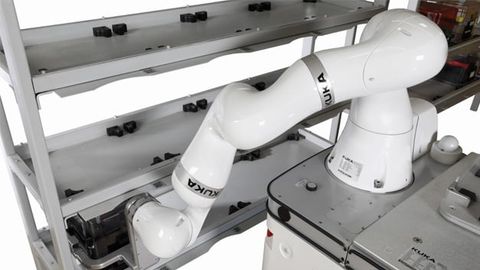
The platform's safety is ensured by numerous sensors that monitor their surroundings in real time to prevent collisions with objects, other mobile platforms or even people. To this end, laser sensors with freely configurable warning and safety fields mark out a virtual protective field around the platform to safeguard access areas - divided into an inner safety field and an outer warning field. If a person enters the warning field, the platform slows down. If a person is in the safety field, the platform stops immediately. To take account of reaction and braking times, the fields are larger at higher speeds; if the platform is moving slowly, they are smaller. The sensors have been developed in such a way that there is no need for floor markings to guide the mobile robot. The mobile robot therefore moves completely autonomously. So-called anti-fall-down sensors are also installed on the platform. These use laser scanning to detect obstacles - for example in the form of open floor panels in the typical raised floor corridors of semiconductor production.
The second important component of the platform is the lightweight robot capable of human-robot collaboration with a payload of up to 14 kg. On the one hand, the robot's sensitivity enables safe and thus fence-free collaboration with the workers. On the other hand, it is able to handle the sensitive wafer cassettes safely and without vibration. Both the lightweight robot and the mobile platform have ISO 3 cleanroom class certification, meaning that they are certified for use in the sensitive environment of wafer production. In addition, the complete system is certified to UL1740, UL1998 and the current SEMI standards.
The third component of the application is a customized gripper. It is also equipped with features such as earthquake protection, stacking and placement sensors and a camera for the safe handling of wafer cassettes of different sizes. Specifically, the gripper system can safely grip cassettes with a diameter of 200 mm - the so-called PODs - and with a diameter of 300 mm - the FOUPs. A storage system, in which the cassettes are stacked during transport to the next machine, completes the hardware.
Fleet management via software
In addition to the hardware, which is tailored to the needs of the semiconductor industry, the software integration of the application into the existing machine network plays a major role. Via the standardized E82 and E84 interfaces, the software, which also comes from Kuka, fits seamlessly into the semiconductor manufacturer's manufacturing execution system. The integrated fleet manager processes incoming transport orders according to vehicle availability, the specified priorities and the routes in order to optimally serve production. It does not matter whether it is a single-robot solution - i.e. one vehicle per production line - or a multi-robot solution, where there are several vehicles per production line.
The system also enables co-existence between vehicle and employee. This is based on sophisticated error handling and safety concepts when it comes to interactions between man and machine. Last but not least, all robot arm movements are cataloged and standardized for the requirements of chip production, resulting in extremely short commissioning times at the end of the day.
Author:
Ralf Ziegler is Business Development Manager Electronics at Kuka.


You might also be interested in
Hydraulic cylinders become smart
Avoiding sudden machine breakdowns and optimizing maintenance routines - what operator of mobile machinery wouldn't want that? Vehicles can provide the necessary information automatically - for example with the help of position measurement in...
 read more...
Schaeffler manufactures electric motors
Schaeffler is entering electric motor production with a modular technology platform. Series production is planned from 2021.
read more...AGVs and robots - cornerstones of modern intralogistics
Increasing efficiency is a requirement that applies not only to the production process, but also to upstream and downstream warehouses. An example from the beverage industry shows what modern automated guided vehicles (AGVs) can achieve in this...
read more...Micromotors in use with diving robots
Deep-sea diving robots have to function reliably up to 10,000 meters below sea level and withstand enormous pressures - a particular challenge for the drive technology used, among other things.
read more...Thermal images guide autonomous robot 'Anymal'
When autonomous robots such as 'Anymal' help to search for casualties in rough terrain, thermography is almost indispensable.
read more...New drive concept for driverless shuttles
Automated guided vehicles are an essential cornerstone of modern intralogistics concepts. In order to meet the demand for compact systems, innovative design solutions are required - including in terms of drive technology.
read more...Smart support
Mobile devices are inexpensive, constantly online and with their apps, up-to-date information is quickly available at all times. This also opens up potential in the industrial environment, but requires well thought-out integration.
read more...The automated grape harvest
"In vino veritas" is the saying. A very simple truth is that the grape harvest comes before enjoyment. But how? By hand or automatically?
read more...Audi - The future is called 'modular assembly'
Audi is working on a new production concept to get to grips with the rapidly increasing number of vehicle variants in car manufacturing: moving away from assembly line production towards modular assembly. Mobile solutions play a key role here.
read more...