
Automotive production
Audi - The future is called 'modular assembly'
Audi is working on a new production concept to get to grips with the rapidly increasing number of vehicle variants in car manufacturing: moving away from assembly line production towards modular assembly. Mobile solutions play a key role here.

On January 14, 1914, Henry Ford started the first complete assembly line production in automotive history in his newly built 'River Rouge' factory in Dearborn, USA. Since then, this principle has formed the backbone of all large-scale production. At the Audi plant in Ingolstadt, for example, the second largest car factory in Europe, the Audi A3, A4, A5 and Q2 models roll off the production line today - a car is completed on one of the three lines every 30 seconds.
Despite the high volumes and well-established processes, Ingolstadt is convinced that the assembly line has seen its best days. This is because the greater the number of variants, the more time-consuming it becomes to master the complexity of a rigid sequential process and to integrate more and more new processes. The fixed cycle times lead to idle time in many places - for example when installing special equipment such as auxiliary heating, which only some of the cars receive. The more heterogeneous the model mix on the assembly line, the more such losses add up.
It becomes even more difficult when strongly deviating variants are added to the line. One example of this is the assembly of the Audi A3 Sportback e-tron. The plug-in hybrid model, which only accounts for a relatively small percentage of total A3 production, runs through seven separate work cycles in which it receives the majority of its electric components. Meanwhile, the models with conventional drive systems float along the overhead monorail under the hall ceiling and complete an empty loop. This extends the time to completion for all cars on the assembly line.
Audi's answer to this challenge is a completely new concept: modular assembly. The idea behind it is production without an assembly line, broken down into its individual work steps. The new production stations are manned by one or two workers. Unlike today, they work in a continuous rhythm. This is because they no longer have to adapt their activities to the speed of the conveyor belt. And they no longer have to move with the conveyor belt, so they no longer have to walk backwards.
In modular assembly, driverless transport systems - AGVs for short - are used to transport the car bodies and parts between the stations. Although these have been standard in automotive production for decades and transport parts, containers and in some cases even entire car bodies, they follow guide wires or RFID chips in the hall floor. As part of the modular assembly concept, Audi now wants to give AGVs a whole new level of intelligence.
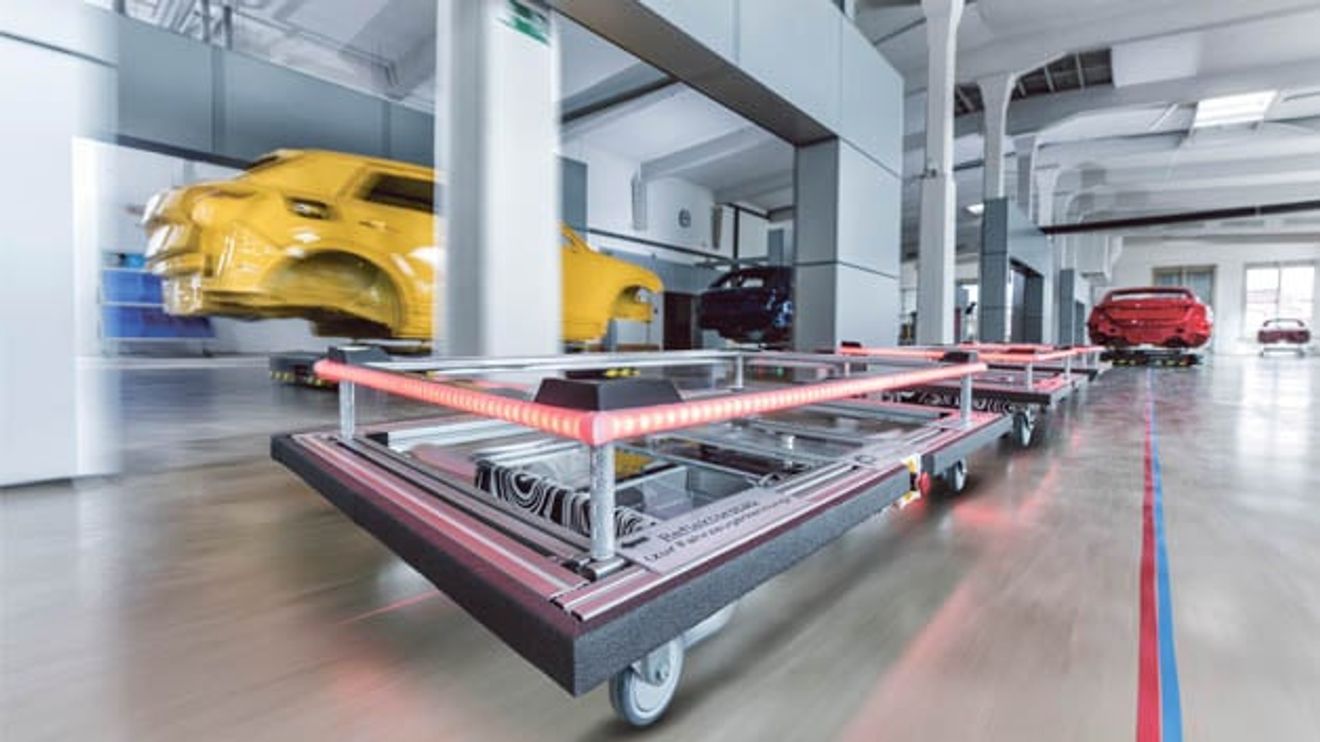
The new AGV concept
Specifically, two innovative AGV concepts are currently being designed and developed at the Technical Center for Production Assistance Systems in Ingolstadt: the 'Audi Laser Tracking System' and 'Audi AGV' (Automated Guided Vehicle).
The laser tracking system is a solution that can recognize and control a group of AGVs. A fast computer locates them using their reflector rods via a high-resolution laser scanner and gives them maneuvering commands via a radio network. Stepper motors drive all four wheels of the AGV individually, allowing precise control - important when maneuvering around obstacles and docking onto the large transport containers. The speed of the transport robots is roughly the same as a pedestrian, i.e. just under six kilometers per hour. At the current stage of development, the central computer can direct the AGVs within a radius of twelve meters - individually or in trains. To cover an entire hall, you either need several laser scanners or a computer with a laser scanner as a mobile unit that moves through the hall.

Audi expects the Automated Guided Vehicle concept in particular to have great potential: by networking the navigation data of several individual vehicles with a comprehensive fleet manager, an intelligent overall system is created.
© AudiThe second AGV technology goes even further: the Audi AGVs use intelligent navigation software developed in-house based on automotive software and automotive software development processes. This allows them to deliver goods from the warehouse to the assembly line with complete freedom. They recognize complicated traffic situations and react flexibly to them. The navigation system enables the AGV to drive autonomously on a defined route that has been designed and simulated on the computer in advance. Alternatively, the AGV can learn and save a route on a manually guided journey. Based on this map, it then moves freely within its radius - always seeking the most favorable path according to the principles of machine learning.
The Audi AGV, also known internally as 'Paula', has three onboard laser scanners - two at the front and one at the rear. They enable it to find its way and also ensure that it cannot collide with people. One of the front scanners is tilted upwards so that it can detect objects hanging from the ceiling. The sensors are also used to record measurement data - the AGV's computer then compares this with the stored map data. In addition, the navigation software compares the measurement data from the laser scanners with the rotations of the wheels, enabling precise localization.
The Audi AGV's driving strategy is defensive. It recognizes an employee and an electric tractor unit crossing the same path. They always have priority. The speed is limited to 4.2 km/h. All decelerations are smooth and energy-efficient - the developers used algorithms similar to those used to control adaptive cruise control (ACC) in cars.
With its laser scanners, the AGV recognizes the workpiece trailer based on its contours. It moves to it with millimeter precision, even if it is not exactly in its intended position. It parks over the loading plate with the same precision. A touch display at the front, a comprehensive visual signal concept and voice output enable communication and interaction with the environment. The Audi AGV is currently undergoing extensive test drives in the A3/Q2 assembly line at the Ingolstadt plant.
Expected savings: 20 % plus x
A central computer controls the AGVs with pinpoint accuracy - it recognizes the requirements of each individual station and thus ensures a smooth workflow. In this way, smaller AGVs repeatedly supply the stations 'just in time' with the components they need - from screws to sunroofs. The so-called supermarkets, which are currently used for picking parts and in some cases are located in outsourced logistics areas, are no longer necessary in this form - they are partially dissolved or relocated to the assembly hall.
Unlike on the production line, the processes in modular assembly are highly flexible in terms of time and space. According to Audi, the installation of door seals for a coupé, for example, takes half as long as for a four-door saloon. If the central computer detects a traffic jam at the station that a driverless transport system is aiming for, in many cases it directs it to another, free station. This is because it makes no difference to the car whether it has received its luggage compartment trim or door seals first. Even the integration of an e-tron derivative or another variant is no longer a problem with modular assembly.
In terms of the overall system, including logistics, the Ingolstadt-based company expects modular assembly to deliver a productivity advantage of around 20% plus x. The greater the number of variants, the greater the 'x'. And the intelligent AGVs, which Audi says other companies have long been interested in, would become cheaper as the number of units increases.
To develop the new assembly concept, a start-up company called 'arculus', in which Audi has a stake, was established in an empty old factory building near the Ingolstadt plant site back in spring 2016. The decision to outsource the implementation of modular assembly to a start-up is partly due to the fact that, according to Audi, there was no provider on the market that could have mastered the systems and their central control at the same time. It will not be long before the new ideas are implemented in series production. Audi is initially using the new principle for test purposes in engine production in Györ, Hungary. There are also plans to use it in two other projects.
Delivered through the air

The flight speed of the drone at Audi is initially based on the speed of conventional industrial trucks: 2.2 meters per second.
© AudiThey have become indispensable as flying camera tripods: multi-rotor drones. Audi is currently testing another interesting application - automated parts transportation in the factory halls.
The transport infrastructure in an established automotive plant is often close to its load limit, and in most cases there is simply not enough space for additional transport routes. At Audi in Ingolstadt, the majority of goods transportation in series production is handled by floor-bound conveyor vehicles; these bring the components to the desired location at specified times. However, the established system has its limits: In the event of a repeat order, known as an express call-off, longer replenishment times can occur under certain circumstances. In this case, the direct route by air would be a quick alternative.
Audi has not yet used the airspace in the production halls for transportation purposes - but this could soon change. At the beginning of September 2016, a drone was used for the first time to transport components in Audi production - on test flights on a non-production day. The defined test route of the electrically powered UAV (unmanned aerial vehicles) led mostly straight through the A3/Q2 production hall. However, it also included one change of direction to the right and two to the left. The drones used - with four rotors enclosed for safety reasons - carried out the previously programmed flight maneuvers without any problems.
Under normal conditions and in the open air with a stable GPS signal, the short flights would not be a major technical challenge. In the hall of an automotive plant, however, the situation is somewhat different - strict safety rules apply here. In addition, the departments involved (logistics, assembly, occupational safety) have different requirements for deliveries from the air.
The initial tests and all flight maneuvers were carried out by specially trained pilots using remote control. A new intelligent sensor system, which is currently being developed specifically for the needs of the automotive industry, helped with orientation.
Further series of tests during ongoing production operations should soon provide new insights into the wide range of possible applications for the drones. In addition to the transportation of urgently needed components, use in camera-based maintenance and servicing work or a 'follow me' function for trucks on the factory premises, another conceivable scenario would be the high-speed transportation of urgently needed utensils, such as a defibrillator for first aid operations.
Smart glove in logistics

'Smart' gloves will make work easier for logistics employees at the Audi plant in Ingolstadt in future: they will use a glove with an integrated barcode scanner for shipping parts worldwide.
In the so-called 'ProGlove', which is used at selected international logistics workstations in the packaging plant instead of conventional barcode scanners, the scanner is already integrated into the glove. The latter also has an ergonomically optimized trigger button on the index finger, which triggers the scan function by pressing the thumb. Visual (LED light), acoustic (buzzer) and haptic (vibration) signals let the picker know that the item has been scanned.
The employee can thus trigger the scan function by simply pressing their thumb and index finger together, leaving both hands free for their work and saving them additional movements, such as picking up or putting down the scanner. Walking distances are also minimized and the workflow in the packaging plant becomes more ergonomic. "The scanner glove is a real relief for our employees. They are more flexible, can move around easily and can scan and pack the boxes more easily," says Hartmut Bartsch, head of the CKD (Completely Knocked Down) packaging operation.
The scanner communicates with the receiver unit via radio. This access point is connected via USB or a standard serial port; no additional software needs to be installed. The battery is designed to last for one shift and is fully recharged within two hours.
Parallel to the CKD packaging operation in Ingolstadt, the glove is currently also undergoing pilot phases in other areas of production.
Flexible screwing - with lightweight robots

Assembly trolleys of the future at Audi: flexible lightweight robots are used instead of rigid screwdrivers.
© AudiOne model requires special attention on the assembly line at the Audi plant in Ingolstadt: the Audi A3 Sportback e-tron. The compact plug-in hybrid differs from its sister models in some respects, for example in the attachment points of the underbody paneling.
Audi currently uses an assembly trolley for the Audi A3 with conventional drive, which consists of a rigid frame with 14 screwdrivers. With the so-called LBRinline - a lightweight robot in the line - the engineers in the technical center have now further developed the assembly trolley in such a way that it solves the challenge of increased complexity in a new, flexible way. It is an assembly trolley made of aluminum profiles with four lightweight robots from Kuka on a mobile platform. An employee couples the trolley to the monorail system via pins, which then travels under the car for a good 20 seconds. The lightweight robots screw the so-called cw underbody paneling to the e-tron model as well as to the conventional models completely automatically. A safety system with three laser scanners ensures that the robots, each of which weighs just 18.4 kg, do not come into direct contact with the employee.
If the robot proves itself in daily use, its principle can be transferred to similar work steps. For example, ergonomically unfavorable overhead work in production can be avoided in the long term.


You might also be interested in
Audi receives VDA Logistics Award
Audi has won the 2017 Logistics Award from the German Association of the Automotive Industry (VDA) with an innovative driverless transport system (AGV) for vehicle shipping. The parking robots called 'Ray' sort up to 2,000 cars per day for loading...
 read more...
Kuka - the first figures after the takeover
Last year, the Chinese Midea Group acquired over 95% of Kuka shares. The Augsburg-based company has now published its first figures following the takeover - for the fourth quarter and for 2016 as a whole.
read more...Hand in hand with the robot
With 'Mixed Reality Production 4.0', DFKI researchers and the BMBF will be presenting new, cross-location forms of human-robot collaboration (HRC) for cross-location production at this year's Cebit.
read more...Hydraulic cylinders become smart
Avoiding sudden machine breakdowns and optimizing maintenance routines - what operator of mobile machinery wouldn't want that? Vehicles can provide the necessary information automatically - for example with the help of position measurement in...
read more...Schaeffler manufactures electric motors
Schaeffler is entering electric motor production with a modular technology platform. Series production is planned from 2021.
read more...Mobile robotics in semiconductor production
Semiconductor production is complex and intricate. Hundreds of production steps are required before the finished product is ready. One challenge here is the transportation and handling of sensitive components from one step to the next.
read more...AGVs and robots - cornerstones of modern intralogistics
Increasing efficiency is a requirement that applies not only to the production process, but also to upstream and downstream warehouses. An example from the beverage industry shows what modern automated guided vehicles (AGVs) can achieve in this...
read more...Micromotors in use with diving robots
Deep-sea diving robots have to function reliably up to 10,000 meters below sea level and withstand enormous pressures - a particular challenge for the drive technology used, among other things.
read more...Thermal images guide autonomous robot 'Anymal'
When autonomous robots such as 'Anymal' help to search for casualties in rough terrain, thermography is almost indispensable.
read more...