
Additive manufacturing
Medical robots from the 3D printer
Five international research teams are working on a robot for tumor therapy. Although it consists of various components, joints and actuators made from different materials, it can be produced in a single process step using a 3D printer.
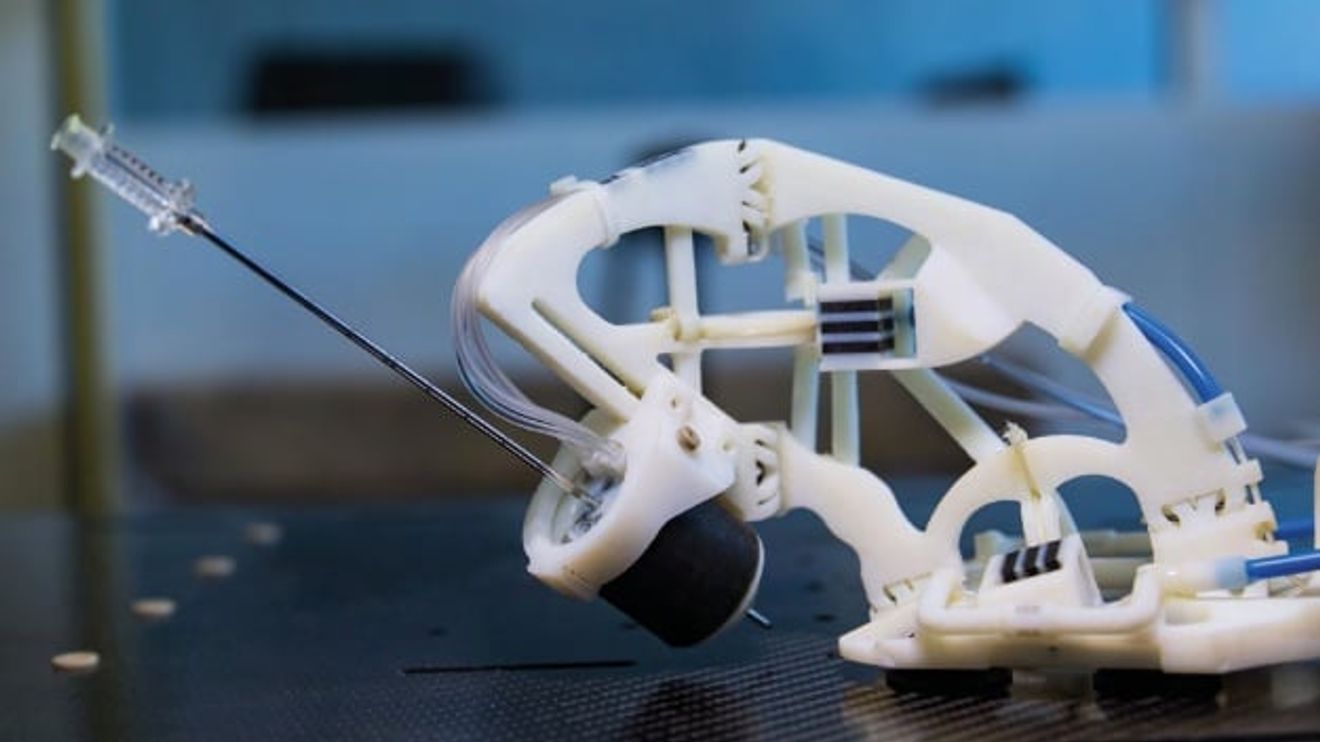
Prototype of the medical robot from the 3D printer
© Photothèque ICube, A. MorlotJust press a button and the 3D printer does the rest automatically. Similar to an inkjet printer, liquid is sprayed onto a surface. However, the PolyJet printer uses plastic instead of different colors: the nozzles can apply two different polymer solutions individually or mixed with pinpoint accuracy. UV light hardens the plastics before the next layer is applied. This creates a medical robot layer by layer. Once development is complete, the robot will assist doctors in taking tissue samples and in thermal tumor treatment.
"Positioning a needle or probe during a minimally invasive procedure like this is a particularly difficult task, because the doctor can best orient himself with the help of computer tomography or MRI images - and that means he has to work while the patient is lying in a narrow tube. There is hardly any freedom of movement," explains Marius Siegfarth from the Project Group for Automation in Medicine and Biotechnology (PAMB) of Fraunhofer IPA at the Mannheim Medical Faculty of Heidelberg University.
Robot fits into the tube with the patient
The robot, which his team is developing together with four other research groups from Germany, France and Switzerland in the 'SPIRITS' project, is so small and light that it can be pushed into the tube together with the patient. It can be controlled from the outside using hydraulics. The doctor can therefore sit a few meters away and even in another room, where he is protected from radiation in the event of a CT scan. The abbreviation 'SPIRITS' stands for 'Smart Printed Interactive Robots for Interventional Therapy and Surgery'. "The challenge of the project was to develop a design that could be produced in a single step using a PolyJet printer, but at the same time consisted of fully functional components - such as swivel joints with hydraulic actuators and a drive for the needle feed. All of these components have different material properties," explains Siegfarth.
In-house hydrausic drive system developed

At the Institut 'national des sciences appliquées de Strasbourg' (INSA), where the research project is being coordinated, the PolyJet is already printing the first prototypes. These have lever arms that are connected via joints. They can be used to rotate a needle around the penetration point in all spatial directions. A specially developed hydraulic system provides the drive: tiny tubes with diameters of just 4 mm, seals and pistons. The special thing about it: the pistons could be designed using 3D production technology so that the hydraulic pressure acts on the seal and reinforces its effect.
Initial tests show that the hydraulic drive from the 3D printer works. Further components will be integrated into the prototype in the coming months: the intelligent needle with force sensor, for example, a development of the 'École polytechnique fédérale de Lausanne' (EPFL). The feed mechanism for the needle was developed by INSA researchers. Added to this is the "haptic feedback". It transforms the measurement results of the force sensor into resistances that the doctor feels when he guides the needle through softer or harder tissue. This feedback system was developed by researchers at Furtwangen University. And at the University of Applied Sciences and Arts Northwestern Switzerland FHNW, printable, non-magnetizable metal components are currently being developed for the next generation of prototypes.
The first fully printed medical robot is to be tested on dummies before the end of 2019. With a total budget of 1.67 million euros, 'SPIRITS' is co-financed by the 'INTERREG V Upper Rhine' program with 436,201 euros from the European Regional Development Fund. As part of the 'Offensive Sciences' initiative, which funds top cross-border research projects, the project is also supported by regional and cantonal partners. The project is co-financed by the Greater Region East, the state of Baden-Württemberg, the state of Rhineland-Palatinate, the Swiss Confederation, the canton of Aargau, the canton of Basel-Stadt and the canton of Basel-Landschaft.


You might also be interested in
MTCON and Sensor-Technik Wiedemann combine expertise
MTConnectivity power2pcb (MTCON) has a new shareholder: Sensor-Technik Wiedemann (STW) has held a stake in the power element manufacturer since the end of 2019.
 read more...
Electromobility / green electricity
Intelligent charging saves fossil fuels
Charging electric cars can overload the electricity grid and lead to fossil fuel power plants having to step in. This is unnecessary and leads to high costs for grid operators. BMW and Tennet want to change this.
read more...Service robotics at Conrad Electronic
Sales robots in use around the clock
To provide its customers with a 24/7 shopping experience in Berlin Schöneberg, Conrad Electronic has now deployed a sales robot. The robot 'Alex' is designed to provide a high-tech shopping experience. It comes from the manufacturer pi4_robotics.
read more...Ridesharing field test in Paris
Renault tests Zoe as a robo-taxi
Renault launches a ridesharing field trial in Paris with two autonomous Zoe robo-taxis. The two prototypes have been specially modified. In addition to the technology for automated driving, they have a modified interior with multimedia and on-board...
read more...Robots for the hospital of the future
ABB has opened its first global Health Care Hub dedicated specifically to healthcare research on the campus of the Texas Medical Center (TMC) in Houston, Texas. A number of technology concepts were presented at the opening, including a mobile YuMi...
read more...Weidmüller, Enercity and Wallbe form alliance
Weidmüller Mobility Concepts, a wholly owned subsidiary of the Weidmüller Group, has acquired a 25.1% stake in Paderborn-based Wallbe GmbH from Hanover-based Enercity AG. Wallbe is a full-service provider of e-mobility charging solutions.
read more...New 'Digital Products and Services' division
With the new product division 'Digital Products and Services', Ecom is introducing a ready-to-use service for all mobile devices. What exactly is behind this announcement?
read more...Smart exosuit for faster walking and running
An American research team has succeeded in developing a wearable exosuit that supports the wearer both when walking and running. It is intended to be worn inconspicuously under clothing, especially in the military.
read more...48 V motors with hundreds of kW
New drive concepts are set to revolutionize e-mobility
48 V motors will revolutionize e-mobility. Two start-up companies - the Finnish company Toroidion and Volabo, based in Ottobrunn near Munich - are convinced of this.
read more...