

International Federation of Robotics
Robot density increasing in Europe, Asia and America
The integration of robots plays a key role in increasing industrial productivity worldwide. In 2024, Western Europe installed a record 267 industrial robots per 10,000 employees in the manufacturing sector, putting it ahead of North America with 204 units and Asia with 131 units in the international automation race.
"The robot density indicator relates the total number of robots used in a country to the number of employees as a measure of the respective economic performance and thus provides a good benchmark for comparison between economies of different sizes," says Takayuki Ito, President of the International Federation of Robotics.
Robot density by region
Western Europe recorded a 3% increase in robot density. Eight countries from this region are among the top 20 worldwide: Germany, Switzerland, the Netherlands, Austria, Italy, Belgium & Luxembourg, France and Spain. The European Union (EU-27) has a robot density of 231 units, which is above the global average of 132 robots per 10,000 employees.
Robot density in North America increased by 4%. The United States ranks eighth worldwide with 307 robots per 10,000 employees. It is followed by Canada with 241 units and Mexico with 62 units.
Asia has an average robot density of 131 units per 10,000 employees in the manufacturing industry, an increase of 11%. The economies of South Korea, Singapore, Japan and Taiwan are among the ten most automated in the world.
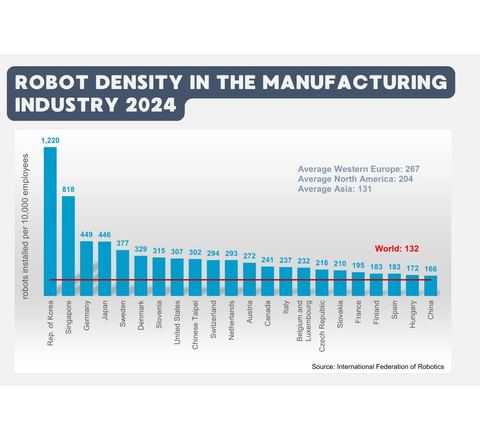
Based on the updated labor market data from the State Bureau of Statistics of the People's Republic of China, China ranks 6th in Asia and 22nd in the world, with a robot density of 166 units per 10,000 workers - an increase of 17% on the previous year.
As a large country with a considerable number of employees in the manufacturing industry, China requires an enormous operational stock of industrial robots in order to achieve a high robot density. This applies to production centers as well as rural areas. China's outstanding position in industrial robotics is clearly reflected in its operational stock - the largest in the world: the country has around 2 million units - around 4.5 times more than second-placed Japan. The annual installation figures are also impressive: 54% of all robots installed worldwide in 2024 were used in China (295,000 units).
Countries with top robot density
The Republic of Korea has the highest robot density in the world with 1,220 robots per 10,000 employees. Since 2019, the number has increased by an average of 7% per year. The Korean economy benefits from two major customers for industrial robots: a globally recognized electronics industry and a major automotive industry. Singapore follows in second place with 818 units. As a small country with a comparatively low number of employees in the manufacturing industry, Singapore can achieve a high robot density with a relatively small operational robot population. Since 2019, this figure has risen by 13% annually.
Germany ranks third worldwide with 449 units per 10,000 employees. Robot density in Europe's largest economy has risen by 5% annually since 2019. Japan ranks fourth with 446 units. The robot density of the world's leading robot manufacturer has increased by 5% annually since 2019. Sweden (377), Denmark (329), Slovenia (315), the United States (307), Taiwan (302) and Switzerland (294) complete the top 10.
These figures are taken from the World Robotics 2025 report published by the International Federation of Robotics (IFR).


You might also be interested in
SensoPart and Cambrian Robotics
Partnership for 3D-Guided Robotics
Cambrian Robotics and SensoPart are jointly developing an AI-powered solution for 3D-guided robotic applications. The combination of vision sensors and AI is designed to simplify gripping and positioning processes.
 read more...
IFR Elects Jane Heffner as President
Jane Heffner is the new president of the International Federation of Robotics. Adrien Brouillard has been appointed vice president of the global federation.
read more...Production and Distribution Capacities
Yaskawa Opens Robotics Center in Slovenia
Yaskawa has opened a new robotics distribution center and an assembly hall in Kočevje. The 32-million-euro investment strengthens production and logistics for the EMEA region.
read more...Alibaba Expands 'Qwen' for Robotics
Alibaba is expanding its Qwen model family with a robotics suite for Physical AI. The three models support manipulation, navigation, and simulation for autonomous robotic systems
read more...International Federation of Robotics
U.S. Robotics Industry Sees Double-Digit Growth
In the U.S., sales of industrial robots rose by 11% compared to the previous year: 38,000 units were newly installed in 2025. This significant recovery is driven by robust growth in the food industry and other non-manufacturing sectors. However, the...
read more...Development Collaboration for Humanoid Robotic Hands Launched
Schunk is entering into a new development partnership with Robert Bosch Robotics. Their shared goal is to develop an industrial-grade robotic hand that can be integrated into various humanoid robot systems.
read more...International Federation of Robotics
The 2026 IERA Award was presented
The 2026 “Award for Innovation and Entrepreneurship in Robotics & Automation” (IERA) goes to the Swiss deep-tech company Verity for its fully autonomous indoor drone system. The flying robots support the logistics and retail sectors by...
read more...Quantum-resistant hardware security for Nvidia robotics platform
Infineon Technologies integrates the hardware security module 'Optiga TPM SLB 9672' into Nvidia's 'Jetson Thor' computing platforms for robotics and autonomous systems. The module secures cryptographic keys directly at chip level and thus protects...
read more...AI-supported lighting robot wins German Innovation Award 2026
Ledvance, provider of innovative lighting solutions, was named "Winner" in the Excellence in Business to Consumer Lighting category at the German Innovation Awards 2026. With the AI Companion Lighting Robot 'Elix', the company presents an...
read more...