
Robotics
Impressions from iREX 2017 in Tokyo
The international Robot Exhibition (iREX) took place for the 22nd time in Tokyo at the beginning of December 2017. Together with the System Control Fair, which takes place at the same time, this biennial event is considered the largest robot and automation show in Asia.
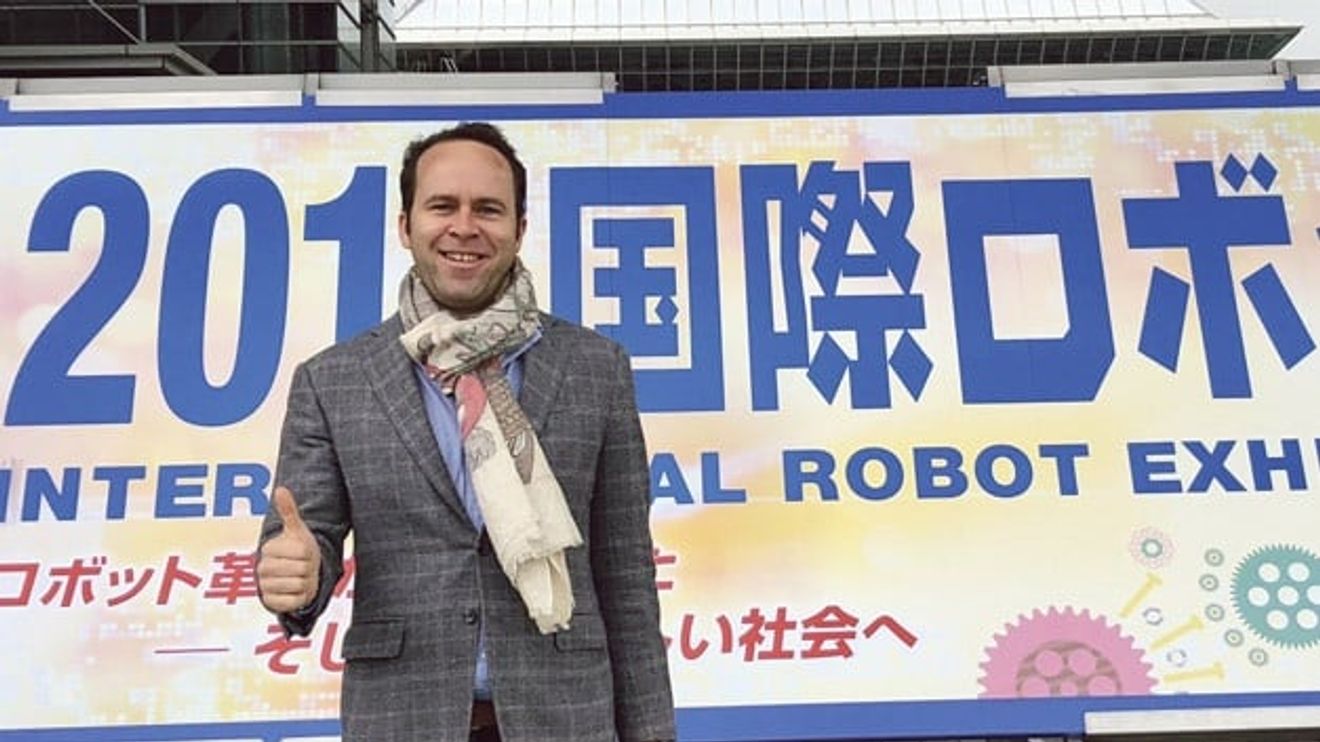
The mood at iREX 2017 was excellent, which is not surprising: According to the Japan Robotics Association (JARA), orders in the first three quarters of 2017 were 20% higher than in the same period of the previous year. Sales figures have been rising continuously for 17 quarters now and have recently reached a new all-time high. JARA is therefore assuming that annual production in 2017 will break the old record of 800 billion yen - the equivalent of 6 billion euros.
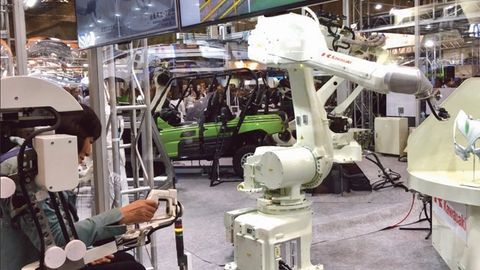
The topic of teleoperation could be seen in many places at iREX - for example at the Kawasaki stand, where visitors were able to control a paint-spraying robot themselves.
© Stieler Technology and Marketing ConsultingEven if - as expected - domestic manufacturers such as Fanuc, Yaskawa, Kawasaki and Denso dominated the trade fair, 'foreign' manufacturers such as Kuka and ABB also had a strong presence in Tokyo; the latter provided a talking point with the announcement of a cooperation with Kawasaki in the field of collaborative robotics, among other things. A clear trend that was equally apparent among all suppliers in Tokyo: industrial robots are becoming increasingly 'smarter', easier to operate and more and more networked.
The simplest and also most popular version of how robots can be taught movement sequences without programming knowledge is so-called 'lead through programming' - a demonstration of the movement by the operator by hand with subsequent, independent repetition by the robot. Although this concept has been around for over 30 years, manufacturers are only now really focusing on it. The reason for this is that end customers, particularly from general industry, are increasingly recognizing new applications for robots in their production processes - especially for low-volume products, which ultimately requires a high degree of flexibility in terms of programming. In particular, the increasing number of collaborative robots coming onto the market are ideally suited for this.
As far as the latter is concerned, ABB, for example, showed a preview of a larger cobot with the model name IRB14100 in Tokyo alongside a one-armed version of the YuMi. This is essentially based on the Roberta robot from Gomtec - the company that ABB acquired in 2015 to expand its cobot product portfolio upwards. The 'Melfa Cobot', with which Mitsubishi is now also entering the field of human-robot collaboration, also made its official debut in Tokyo.
From 'machine vision' to 'deep learning'
Due to major advances in machine vision and pattern recognition, robots have become much 'smarter' in recent years. Almost all manufacturers, usually together with technology partners, exhibited machine vision solutions for picking and sorting tasks or for surface inspection - in some cases in combination with deep learning. Another trend that could be seen at many trade fair stands - including those of Kawasaki and Denso - were 'Teleops' robots that humans can control remotely in real time. The corresponding trade fair demos - some in combination with augmented reality (AR) - proved to be real crowd pullers.

A robot that helps you get dressed - for the students at the Kyushu Institute for Technology, this is quite conceivable in the future.
© Stieler Technology and Marketing ConsultingOne topic that Japanese manufacturers have been comparatively slow to address is the development of concepts for the intelligent linking of production processes, as is currently being propagated everywhere in Germany under the label 'Industry 4.0'. For the past two years, however, the Japanese Ministry of Economy, Trade and Industry (METI) has been actively encouraging domestic companies to develop comparable concepts under the slogan 'Society 5.0'. As a result, all major Japanese robotics and automation companies are now introducing data collection and analysis solutions to give customers an even deeper understanding of how to gradually improve their production processes - a field in which Japanese companies are traditionally strong.
Japan, on the other hand, has long been a leader in the field of service robots. People there have been used to a high degree of automation in their everyday lives for some time now. For example, there are 4.9 million vending machines in the Land of the Rising Sun, which corresponds to the equivalent of one machine for every 26 people. In addition, the country has the fastest ageing population in the world. More than 2000 people retire every day. And as the population refuses to compensate for this decline by increasing immigration, Japan must make even greater use of the opportunities offered by robotics and the Internet of Things in the future.
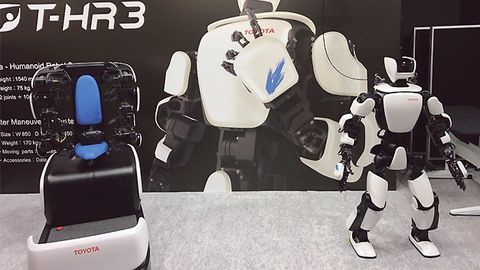
With its two arms and two legs, the T-HR3 from Toyota is the starting point for future robot applications in the industrial sector, in care for the elderly and sick or in disaster areas.
© Stieler Technology and Marketing ConsultingBoth leading companies and research institutions are therefore working intensively on solutions to the challenges of an ageing society. One of the most popular iREX exhibits from the field of service robotics was the Toyota Humanoid Robot 3 (T-HR3). A special feature of the robot is the so-called torque servo technology, which enables flexible control. It can react appropriately and quickly to any object with which the robot comes into contact - for example, the T-HR3 can grasp a balloon without bursting it. In addition, the two-legged robot demonstrated an impressive sense of balance and gravity - at least as far as its use on stage at iREX was concerned.
Author:
Georg Stieler heads the Shanghai branch of Stieler Technology and Management Consultants.
Japan - robot supplier no. 1
In 2016, Nippon's production capacities reached a new record of 153,000 units. This means that Japanese companies currently cover around 52% of global demand.
According to the latest figures from the International Federation of Robotics (IFR), Japan exported almost 115,000 industrial robots worth 309 billion yen (equivalent to around 2.7 billion US dollars) in 2016. The export ratio is 75%. In contrast, Japanese imports of robots are extremely low at only around one percent of installations. Accordingly, foreign robot suppliers only achieved a low sales volume in Japan. Overall, robot sales in Japan itself rose by 10% to around 39,000 units in 2016 - the highest level in the last ten years.


You might also be interested in
Manual assembly processes digitized
The main focus of Industry 4.0 is on the intelligent networking of machines. Human work in production, on the other hand, is often still measured and analyzed using antiquated methods. Computer vision and artificial intelligence can remedy this.
 read more...
Robotics in China
The International Federation of Robotics (IFR) assumes that China will be responsible for 40% of the global robotics market in just two years' time. What are the drivers behind this? - An on-site trend report.
read more...How does China use the Internet?
Which are the most popular apps on China's consumer Internet and how do they compare with Internet usage worldwide? The Shanghai team of Stieler Technology and Marketing Consultants analyzed eight apps.
read more...China as a lead market?
Can China develop into a leading Industry 4.0 market? Despite some misguided incentives due to government intervention, investment bubbles and overcapacity, China's innovative strength should not be underestimated: There are pioneers to learn from...
read more...Database for innovations
Suppliers of agricultural and construction machinery must keep pace with the technical development of the industry and should keep an eye on trends in order to generate growth through new products. A look at the 'innovation database' is helpful here.
read more...Digital Material Selection reduces CO₂ Emissions
Using an industrial gripper as an example, Schunk and CADFEM demonstrate that simulation-based material selection can reduce CO₂ emissions from secondary materials and additive manufacturing by up to 40%.
read more..."AKIMI" Research Project develops AI for Flexible Robotics
The AKIMI research project is launching at the WZL at RWTH Aachen University. The goal is to develop agent-based AI that simplifies the programming and reconfiguration of robotic systems for small and medium-sized enterprises.
read more...Barcelona Declaration on Robotics and...
Robotics Associations Adopt Global Automation Strategy
The global robotics industry is stepping up its collaboration. The associations AER Automation, A3, IFR, and VDMA Robotics + Automation have formed a long-term alliance by signing the “Barcelona Declaration on Robotics and Automation 2026.” The...
read more...Humanoid Robotics at BMW in Spartanburg
"Physical AI" combines digital AI with real machines and robots. This allows intelligent systems, such as humanoid robots, to be integrated into real-world production processes. Following the successful deployment of the Figure 02 humanoid robot at...
read more...