
Market study
Robotics in China
The International Federation of Robotics (IFR) assumes that China will be responsible for 40% of the global robotics market in just two years' time. What are the drivers behind this? - An on-site trend report.

China has been the world's largest robot market since 2013. Despite the already high level, sales rose again last year by around 30%. And the growth momentum is also expected to continue beyond 2017. Rising labor costs, a still low level of automation and the increasing capabilities of intelligent and collaborative robotics solutions make this possible, not to mention the Chinese government's ambitious goals for this sector.
At the same time, the market is very opaque. According to the Chinese Ministry of Industry and Information Technology (MIIT), the number of companies in the robotics sector has risen from just under 300 to over 3,400 since 2012. However, many of these are small companies with limited future prospects. However, new, powerful players from the traditional mechanical engineering or internet sectors are constantly entering the business.
According to Stieler Technologie- und Marketing-Beratung's own on-site research, there are currently around 80 companies in China that produce robots. However, only 27 of these have the necessary size to produce robots at competitive prices in the medium to long term or have their own in-depth technological expertise. In addition, we consider twelve other companies that do not produce in China to be relevant to the market.
Foreign manufacturers are still responsible for around 70% of robot sales in China. However, domestic robot manufacturers are catching up - albeit from a low starting point. Sales of the seven leading domestic robot manufacturers increased by an average of 36.7% last year. By comparison, the figure for the seven leading foreign manufacturers in China was 26.6%. However, it should not be forgotten that the strong growth of domestic manufacturers was driven in particular by extensive subsidies.
The majority of Chinese robots are simple handling devices, although the proportion of six-axis robots in their sales has grown steadily over the past three years. Domestic manufacturers mostly compete in low-margin applications such as loading and unloading and increasingly in simple welding applications. Foreign manufacturers, on the other hand, score points primarily with their concepts for intelligent and flexible production as well as with the argument of simple and safe operability. However, they are also increasingly paying for their record sales with extremely low margins.
The goal: 45% market share by 2025
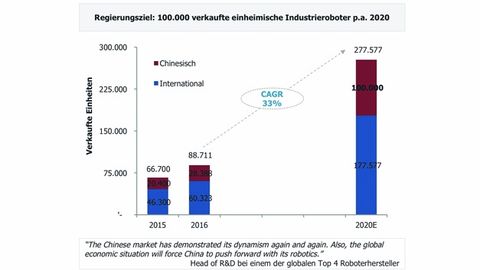
Chinese and international robot manufacturers are confident that the ambitious goals of the 13th five-year plan for the robot industry will be achieved.
© Stieler / MIIT, NRDC, STM Interviews & AnalysesIf the Chinese government has its way, domestic robot manufacturers should have a market share of 45% by 2025. Ambitious, but a lot can happen in eight years: During this time, domestic manufacturers will build up further expertise - for example, by Chinese employees who are employed by international competitors leaving them or through further international takeovers. The 45% target is therefore a realistic goal that could even be exceeded.
As of today, over 80% of robots on the Chinese market are sold via system integrators. The number of companies in this sector is estimated to be in the low four-digit range. While most of them are small and very specialized companies, there are others with several thousand employees. Some of them, such as Dalian Auto or Guangzhou Mino, have already established branches in Europe and North America in order to be closer to their suppliers or to be able to serve their international customers - including German automotive groups - overseas.
What robot manufacturers are (still) lacking
The Chinese robotics industry still lacks high-performance key components such as controllers, servo motors and gearboxes. As a result, on average around 70% of the production costs of domestic robots are currently passed on to foreign suppliers. Due to their comparatively low production volumes, domestic robot manufacturers also have significantly higher purchase prices than their international competitors.
According to the plans of the National Manufacturing Strategy Advisory Committee, this is set to change in the foreseeable future through the development of strong domestic suppliers. In other words, the ability to produce its own controllers, servo systems and precision gears for robots is part of Beijing's 'Made in China 2025' strategy. And if Chinese companies can't do it themselves, they buy in - see Midea: After the manufacturer of household appliances made one of the most spectacular takeovers from China last year with its purchase of German robot manufacturer Kuka, the company acquired a majority stake in Israeli motion control specialist Servotronix in February 2017.
In May 2017, Midea also announced that it was entering the robotics business for elderly and nursing care in cooperation with Japanese robot manufacturer Yaskawa. The Chinese side benefits from the expertise of the Japanese, who in turn benefit from Midea's market access. The boundaries between industrial and service robots are also clearly blurring here - a phenomenon that is likely to be observed more frequently in the future, particularly in Asia.
Although there are now stricter capital controls from the Chinese side, which will certainly have an impact on outbound M&A activities in the current year, strategic deals that are in line with Beijing's objectives can still be expected to be approved.
Strongest growth in collaborative robots and AGVs
The strongest growth in the Chinese market for robotics is expected in the segment of low-cost collaborative robots. Starting at a low level, growth rates of over 50% per year could be achieved here in the foreseeable future, depending on market availability. In addition to prototypes from established robot manufacturers such as Siasun, we are seeing promising initiatives from Aubo, Han's Motor and Elephant, to name but a few.

Most of the products created in this environment are simple six-axis cobots. They range in price from 10,000 to 15,000 US dollars. They do not fully meet the strict European or North American safety standards, although this is accepted in China. As soon as they are available on the market, this will lead to a greater spread of so-called cobots and put pressure on companies such as Universal Robots or Rethink Robotics.
Large manufacturing companies such as Foxconn are still hesitant when it comes to using collaborative robots on a large scale. Most of the so-called Foxbots are in fact handling systems with two to three axes. For products with short life cycles, such as the iPhone, it is currently simply easier and cheaper to train human workers than to fully automate production. However, the availability of cheaper collaborative robots will change this in the next few years. The same could apply to battery production, for example, especially as the Chinese government is striving to position itself as a leading market for e-mobility.
Strong growth is also expected in the field of Automated Guided Vehicles (AGVs), which is already dominated by domestic companies with a sales share of around 80%. One of the reasons for this is that China still spends 10% more of its GDP on logistics than developed countries such as Germany or the USA. The modernization of traditional manufacturing sectors such as automotive, 3C and tobacco is therefore generating strong demand for automated logistics solutions. In addition, e-commerce is booming. In addition to the established AGV manufacturers, large e-commerce companies are therefore entering this market: Alibaba through an investment in Geek+ in April and JD.com with its own robotics division, which is comparable to Amazon's strategy.
In a nutshell: despite a still widespread lack of local know-how, uncertainty about quota targets for its domestic companies or obscure new cyber security laws, China currently offers the most dynamic environment in the global robotics market and has a good chance of becoming one of the leading global markets for intelligent manufacturing concepts.
Study on the topic
The study 'Industrial Robots in China 2020' by Stieler Technologie- und Marketing-Beratung is aimed at international suppliers of robot and automation technology. In particular, it answers the following questions: Who are the relevant companies in the Chinese market? What are their strengths and weaknesses? How will this market and its sub-segments develop in detail? Who are the right partners?
The study consists of two separately available parts:
1. market analysis Industrial Robots in China (120 pages)
2. system integrator database: Detailed description of the 300 most important robotics system integrators in China.
For further information on the content and conditions of purchase, please send an email to [email protected]


You might also be interested in
Manual assembly processes digitized
The main focus of Industry 4.0 is on the intelligent networking of machines. Human work in production, on the other hand, is often still measured and analyzed using antiquated methods. Computer vision and artificial intelligence can remedy this.
 read more...
Impressions from iREX 2017 in Tokyo
The international Robot Exhibition (iREX) took place for the 22nd time in Tokyo at the beginning of December 2017. Together with the System Control Fair, which takes place at the same time, this biennial event is considered the largest robot and...
read more...How does China use the Internet?
Which are the most popular apps on China's consumer Internet and how do they compare with Internet usage worldwide? The Shanghai team of Stieler Technology and Marketing Consultants analyzed eight apps.
read more...China as a lead market?
Can China develop into a leading Industry 4.0 market? Despite some misguided incentives due to government intervention, investment bubbles and overcapacity, China's innovative strength should not be underestimated: There are pioneers to learn from...
read more...Database for innovations
Suppliers of agricultural and construction machinery must keep pace with the technical development of the industry and should keep an eye on trends in order to generate growth through new products. A look at the 'innovation database' is helpful here.
read more...Digital Material Selection reduces CO₂ Emissions
Using an industrial gripper as an example, Schunk and CADFEM demonstrate that simulation-based material selection can reduce CO₂ emissions from secondary materials and additive manufacturing by up to 40%.
read more..."AKIMI" Research Project develops AI for Flexible Robotics
The AKIMI research project is launching at the WZL at RWTH Aachen University. The goal is to develop agent-based AI that simplifies the programming and reconfiguration of robotic systems for small and medium-sized enterprises.
read more...Barcelona Declaration on Robotics and...
Robotics Associations Adopt Global Automation Strategy
The global robotics industry is stepping up its collaboration. The associations AER Automation, A3, IFR, and VDMA Robotics + Automation have formed a long-term alliance by signing the “Barcelona Declaration on Robotics and Automation 2026.” The...
read more...Humanoid Robotics at BMW in Spartanburg
"Physical AI" combines digital AI with real machines and robots. This allows intelligent systems, such as humanoid robots, to be integrated into real-world production processes. Following the successful deployment of the Figure 02 humanoid robot at...
read more...