
Adlink
From FTF to AMR
Autonomous mobile robots are considered the next step up from driverless transport vehicles. What is behind this development?
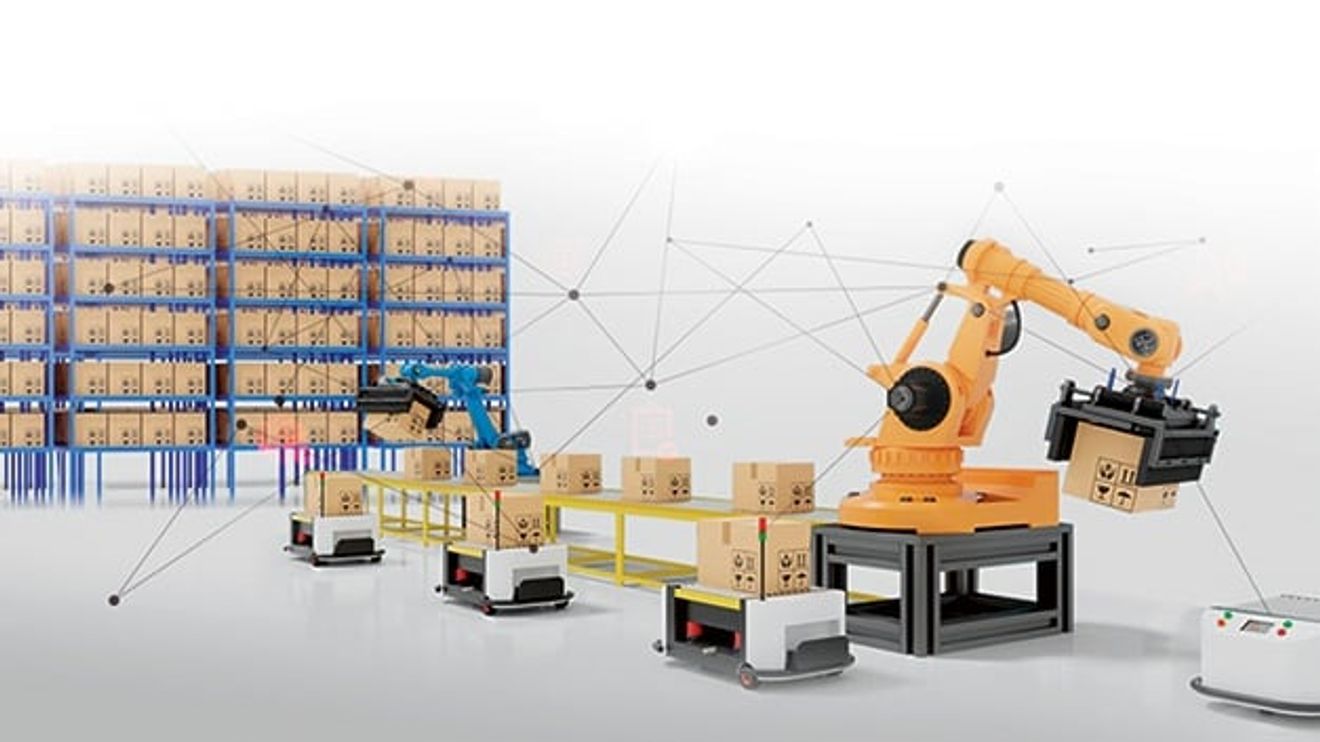
The market for autonomous mobile robots - AMR for short - is booming. In 2020, the market size amounted to USD 356 million - and MarketWatch forecasts growth to USD 1011 million by 2026 at a compound annual growth rate (CAGR) of 15.9%.
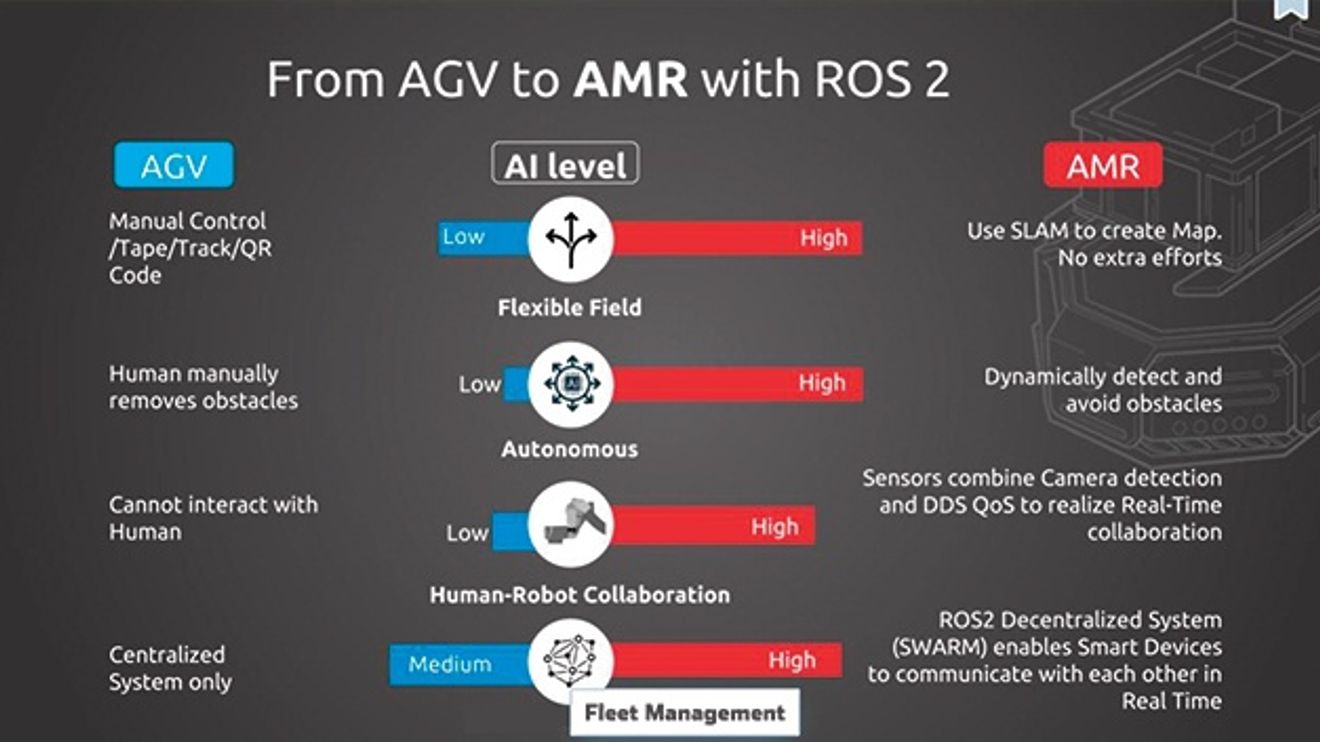
Until recently, AGVs were the representatives of the latest technology with their ability to transport raw materials and unfinished and finished products to production lines or store and retrieve goods from warehouses and logistics centers. AGVs use a combination of software and sensor-based guidance systems to control their movements. They perform safe and reliable work when moving loads, as they work on a fixed route and have precisely controlled acceleration and deceleration as well as obstacle detection.
However, AGVs lack flexibility. If, for example, the layout of a production line changes, the track guidance must be adapted accordingly, which is usually time-consuming and costly. If an AGV detects an obstacle, it stops until someone removes the object. Furthermore, AGVs cannot interact with humans as the fleet management system is centralized and works without peer-to-peer communication.
AMRs are far more flexible: if an operational layout changes, simultaneous localization and mapping (SLAM) allows the robot to explore the as yet unknown space to automatically create a map without additional effort or cost to the contractor. AMRs use a range of sensor technologies and a combination of camera detection and real-time communication technologies to dynamically detect and avoid obstacles, including people.
A new direction
The Robotic Operating System (ROS) is an open source framework for the development of robotic software, i.e. neither a robot nor an operating system. ROS was developed in 2007 by two Stanford PhD students, Eric Berger and Keenan Wyrobek, with the goal of enabling software developers with minimal knowledge of robotics hardware to write software for robots.
Today, ROS Classic (ROS 1) provides numerous stable packages, tools and tutorials that include the hardware for developing various robotic applications. ROS building blocks include sensor fusion, navigation, visualization and motion planning.
Originally developed for academic use, ROS 1 assumes perfect communication. In practice, however, this is anything but perfect, especially in the industrial sector. Variable factors such as bandwidth, networking options, communication ranges and the transceiver power consumption of battery-powered mobile robots make it even more difficult to find optimal solutions. Furthermore, ROS 1 was only intended for use with a single robot. To make factories with multiple robots work smarter, collaboration capabilities are needed. This is where ROS 2 comes into play, which, based on the DDS communication framework, decentralizes the fleet management system by enabling real-time peer-to-peer communication - known as swarm autonomy - for AMR.
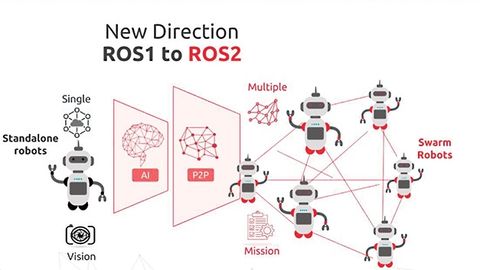
A swarm of autonomous mobile robots can perform their tasks with little or no supervision from human operators. However, the industry will need to migrate from ROS 1 to ROS 2 to realize this goal. This migration is a challenge.
For developers already using ROS 1, there are three main challenges: Complexity, scalability and upgradeability. AMR design is complex. To build a robotic system, users must select and purchase the hardware and install the software (the operating system (OS), drivers and packages), from computer platforms to sensors, motion controllers and mechanical design. If they are not familiar with a system, it can take up to a month to complete the system integration. If advanced functionalities such as real-time capability or dedicated Quality of Service (QoS) are required, the developer must write the code themselves. If a robot is built as a feasibility study, the issues of scalability and deployment pose greater problems.
ROS 1 is not designed for communication across multiple AMRs. In such cases, there would be a risk of accuracy problems, failures or damage to the fleet system. In addition, ROS 1 support will reach end of life (EOL) by 2025; affected companies must decide how they want to manage the migration from ROS 1 to ROS 2.
ROS 2 is the update that transfers ROS 1 from the academic world to the industrial sector. ROS 2 enables industrial use with multiple collaborative robots and reliable, fault-tolerant real-time communication. With DDS as the backbone, ROS 2 provides a unified data exchange environment (such as a data flow) that enables an AMR swarm to communicate. Additional devices with Distributed Data Service (DDS) technology can also use the data flow to share data.
DDS is a key component of ROS 2, and at the core of the technology is the Data-Centric Publish-Subscribe (DCPS) standard, which provides a global data space that can be accessed by all independent applications. The United States Navy used ROS 2 to solve the compatibility problems that arose in the course of extensive software upgrades in the complex network environment of ships. Since its release by the Object Management Group (OMG) in 2004, DDS has become the standard solution for the data publish-subscribe pattern for distributed real-time communication in autonomous and sophisticated systems.
The right AMR solution
There are several aspects to consider when looking for the right ROS 2-based AMR solution.
Companies must first determine whether the systems are optimized for AMR navigation, including hardware and software integration, to avoid time-consuming dependencies, version issues and compilation errors.
To achieve high accuracy in sensor fusion, time synchronization of several integrated sensors, for example GMSL (Gigabit Multimedia Serial Link) images and Inertial Measurement Unit (IMU), is essential.
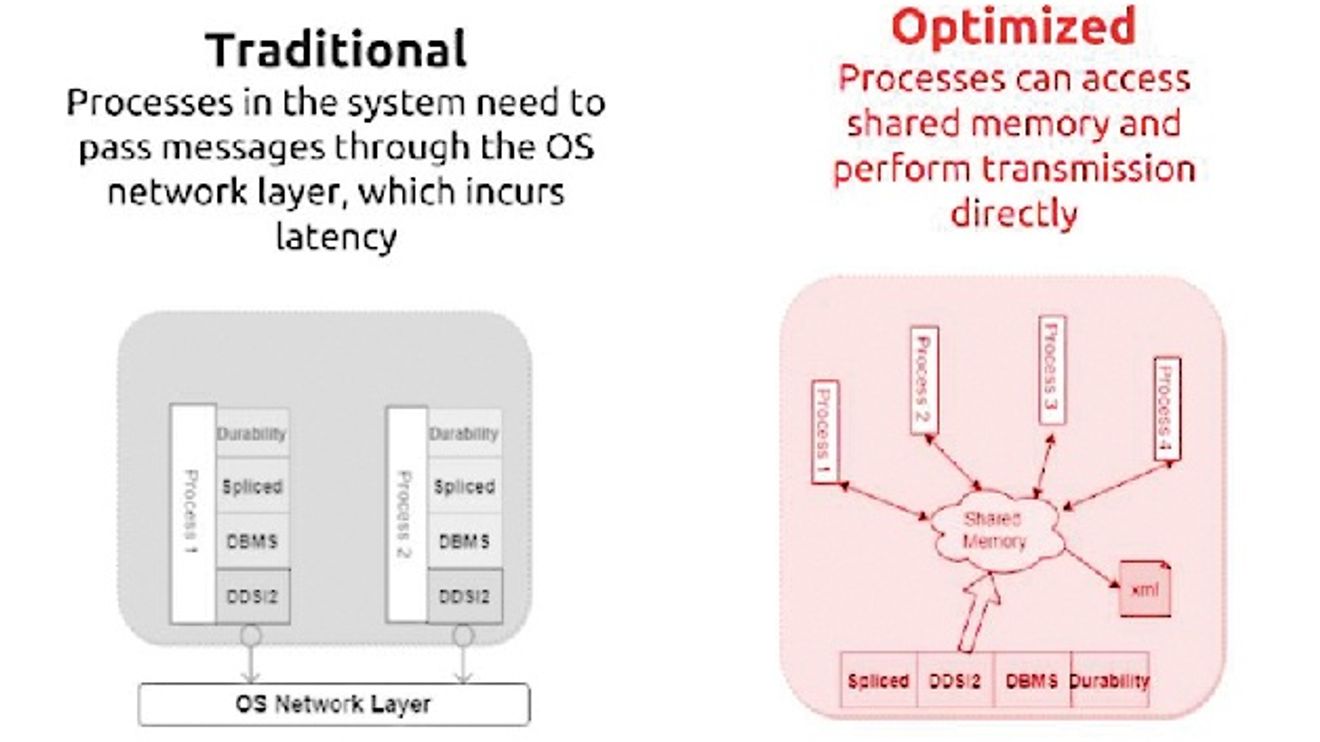
To optimize internal data processing, the system should have a shared memory mechanism. In conventional implementations, processes in the system have to forward messages via the network level of the operating system, which leads to latencies. Access to shared memory and direct transmission are optimized approaches that significantly reduce latencies.
The solution developed should enable decentralized communication, support the autonomy of the swarm and at the same time ensure fault tolerance and redundancy.
Finally, an assessment should be made as to whether the solution is easy to implement. Some vendors offer software development kits with optimized DDS performance to support a swarm architecture and ensure reliable communication. Eclipse Cyclone DDS is a fast and reliable DDS implementation that has been selected by the ROS 2 Technical Steering Committee (TSC) as the default ROS middleware (RMW) for the ROS 2 Galactic Geochelone release. This default configuration works for most developers, but non-standard RMW configurations are also possible.
For easier implementation and faster deployment, it is a good idea to choose vendors that offer an integrated development environment (IDE), apps with tested and verified packages, and sample code for reference designs. To help developers move from ROS 1 to ROS 2, some vendors offer a migration guide with different approaches that highlight the benefits and issues associated with the migration process.
FARobot for swarm autonomy
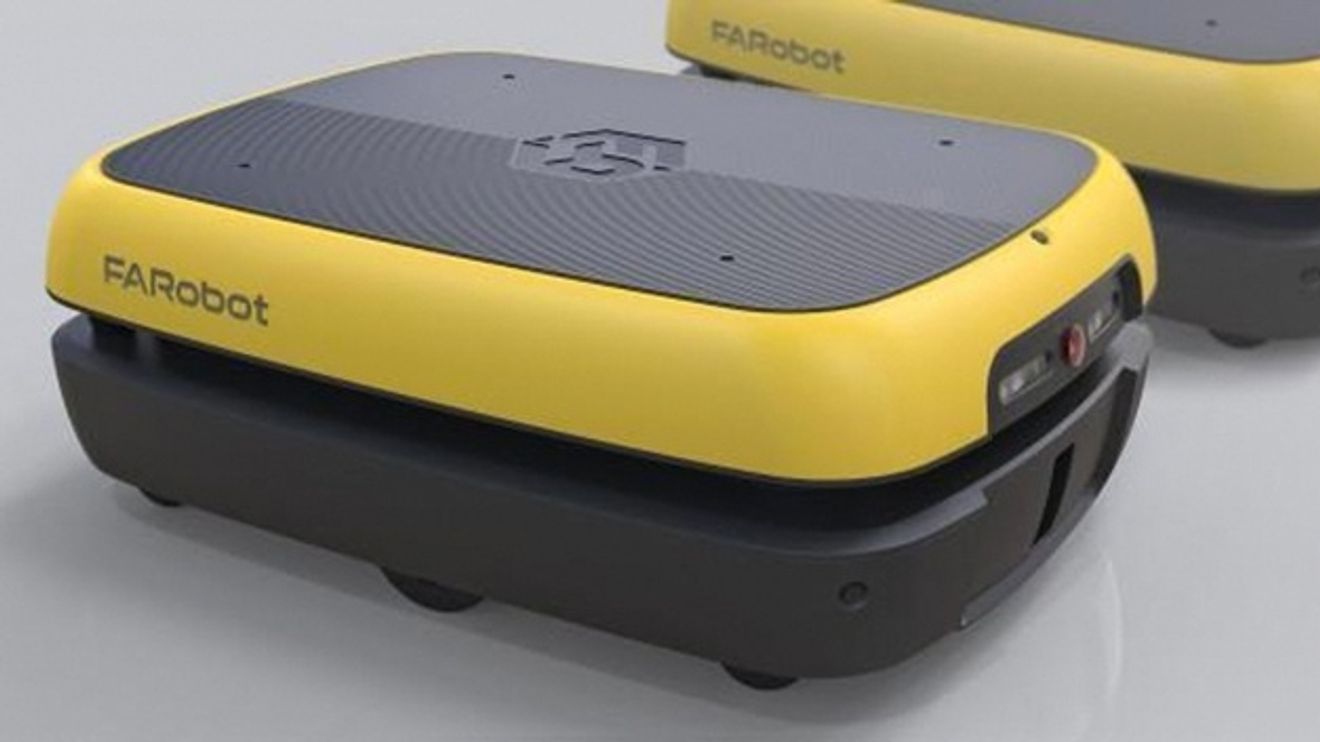
Adlink is currently working with the Hon Hai Technology Group (Foxconn). Foxconn used AGVs in its production facilities, but wanted to improve the flexibility of its production lines. Therefore, Foxconn has formed a joint venture with Adlink called FARobot to develop advanced swarm robot systems (SRS) and autonomous mobile robot solutions using ROS 2.
Since AMRs communicate with each other in real time, they can perform task planning and assignment and determine the location path for each ARM via peer-to-peer communication. In the event of a fault in one of the AMRs, the fleet immediately provides a backup and sends the most suitable robot to assist.
Private 5G with DDS for real-time integration
By using AGVs, machine tool manufacturer Fair Friend Group (FFG) wanted to improve flexibility in order to increase efficiency and reduce costs. Together with Adlink and the Institute for Information Industry (III), FFG is planning to build smart factories. Manufacturing flexibility, factory expansion and rapid production line changes must be taken into account. As communication is key in such environments, DDS is suitable as middleware for both wired and wireless production environments as well as those with multiple wireless technologies.

The first implementation of swarm autonomy was in production lines for industrial-grade spray guns at FFG member Anest Iwata's factory in Hukou Township, Hsinchu County, Taiwan. The Production Equipment and Operations Surveillance Center used private 5G with DDS for real-time integration with production line information and connectivity with AMR to transport parts and components to multiple inspection departments to increase productivity.
The implementation includes three technology applications: an AMR solution, automated optical inspection (AOI) and augmented reality smart glasses. The combination increased the factory's yield by 15% and reduced production costs by 20%.


You might also be interested in
Autonomous agricultural robots for agriculture
How can farmers reconcile economic yields and ecological farming methods? Autonomous agricultural robots are seen as a promising solution here - for example from the Dutch company Pixelfarming Robotics.
 read more...
The autonomous forklift truck
Mobile Industrial Robots and Logitrans have entered into a strategic cooperation to develop autonomous forklifts. These are designed to enable the safe and automated picking up of pallets or other goods directly from the ground and their autonomous...
read more...AI for autonomous mobile robots
ABB is entering into a strategic partnership with Sevensense. The start-up will expand ABB's new portfolio of autonomous mobile robots (AMR) with artificial intelligence and 3D mapping technology.
read more...Heterogeneous to AI at the edge
Adlink Technology relies on heterogeneous computer platforms to optimize artificial intelligence at the point of origin.
read more...Start of the user group
The large-scale European digital project GAIA-X was launched on October 29 last year. The project is now becoming an organization with legal capacity to act.
read more...News from the industrial computer sector
What's new on the market for industrial PCs and operating systems? Our picture gallery shows you the latest products from these areas.
read more...Building blocks for Industry 4.0
I4.0-capable components on machines and systems are essential for the smart factory of the future - everything from sensors and control systems to cloud connectivity is required. Below is a small selection.
read more...Controller and gateway combined
Adlink is launching a controller with an IoT gateway onto the market. The computing power of the MXE-210 is provided by an Intel Atom x7-E3950/x5-E3930 processor (codenamed Apollo Lake-I).
read more...Current products for Cloud in Industry
The topic of the cloud is also making great strides in the factory environment. Computer&AUTOMATION presents the latest products from the 'Cloud in Industry' sector in a series of images.
read more...