

DFKI research project
Deep learning to become more reliable
DFKI scientists want to combine deep learning methods with formal calculation methods to make them more reliable. To this end, they are teaching a robot how to juggle - it will perform calculated movements and at the same time decide on the next arm movement.
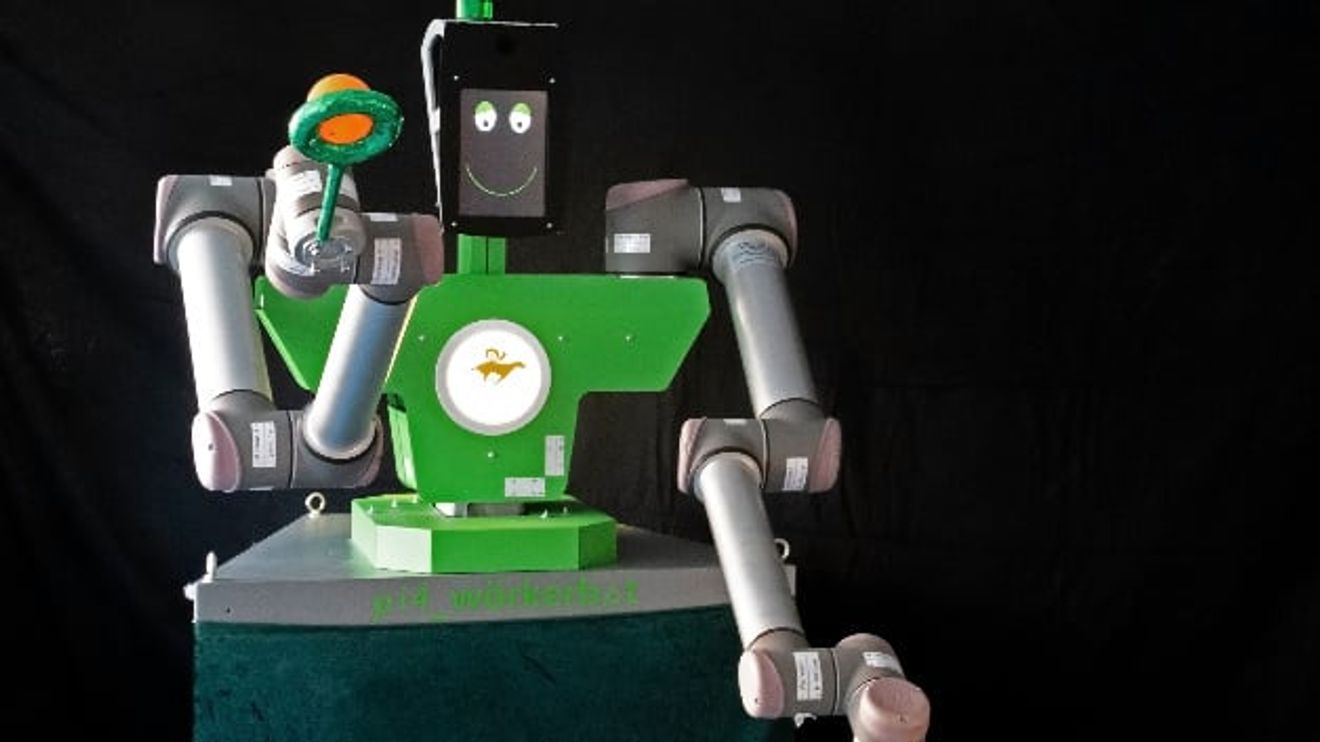
When people are faced with a problem, they can either look at it logically and calmly - or decide spontaneously and emotionally. Modern deep learning methods deliver fast results thanks to their training with large amounts of data, but these results are not verifiable. Scientists at the German Research Center for Artificial Intelligence (DFKI) are now investigating how these results can be verified using formal methods and thus become more reliable - without slowing down deep learning. The new method is to be tested using a juggling industrial robot, among other things. The "Fast&Slow" project is being funded by the Federal Ministry of Education and Research (BMBF) with around 1.2 million euros.
How can juggling be better learned: through observation and trial and error or through lengthy planning of the individual hand movements and throws? According to psychologist Daniel Kahneman, this is based on the two systems that determine human thinking - fast, emotional and unconscious decision-making or slow, logical and calculating decision-making. Although computers are still a long way from being able to imitate the complexity of human thinking, there are two comparable approaches that artificial intelligence can use to make decisions. While deep learning methods lead to quick but rationally unjustifiable results, formal calculations can provide verifiable and mathematically correct answers - which, however, take more time.
In the "Fast&Slow" project launched on November 1, 2019, DFKI scientists are investigating how the two methods can be combined. At the Cyber-Physical Systems research department, headed by Prof. Dr. Rolf Drechsler, the aim is to enable artificial intelligence to make both fast and reliable decisions at the same time. This is because deep learning methods alone only provide sub-symbolically calculated solutions based on millions of parameters and vast numbers of test examples. In many fields of application, however, this approach does not meet the requirements for reliability and trustworthiness - for example in autonomous driving. It is therefore necessary to be able to check the results and train the AI to produce the correct results.
To this end, these sub-symbolic methods are to be combined with symbolic methods in order to utilize the advantages of both - the speed as well as the verifiable correctness of the results. To do this, it is first necessary to define problems that can be solved both formally and using deep learning algorithms - for example, the planning of action sequences. The first step is to train the formally correct result before attempting to solve the problem using the faster, sub-symbolic method. The result can be checked afterwards using the symbolic method and corrected if necessary.
To test the combination of methods, the DFKI scientists are planning two test runs: In the first experiment, so-called TurtleBots (small autonomous transport robots that can be used as transportation aids, among other things) will find their way safely through a smart home. In the second experiment, a "pi4_workerbot" - an industrial robot from the manufacturer pi4_robotics with two arms - will be taught how to juggle. The aim is to allow the robot to juggle both alone and together with a human by knowing the calculated movement sequences and at the same time being able to quickly decide on the next arm movement using deep learning methods.
First, however, the "Fast&Slow" project is concerned with looking at the fundamental problems of the two methods: How can the information from the different AI methods be merged, which problems can be formally verified, and in which cases is this verification particularly important? A well-known example of the weaknesses of deep learning are methods that develop biases because of the data they were trained with. Especially in such situations, it is important to obtain formal results.
DFKI scientists are aiming to develop the foundations for a safer and more reliable use of deep learning methods so that the potential of machine decision making can also be used in challenging areas. The Federal Ministry of Education and Research (BMBF) is therefore funding the "Fast&Slow" project with around 1.2 million euros over a period of three years.


You might also be interested in
Research building opened in Bremen
One of the most important research institutions in Germany in the field of artificial intelligence has opened a new building in Bremen. The DFKI intends to use the extension to advance research into future topics, according to a press release.
 read more...
Three tips for a successful application
Since mid-September, companies have been able to apply for tax concessions for personnel expenses in the area of R&D as part of the Research Allowance Act. With these three tips, you can receive up to one million euros in funding.
read more...New president for robotics association IFR
The International Federation of Robotics (IFR) has elected Steven Wyatt (ABB, Switzerland) as its new President. Wyatt succeeds Junji Tsuda (Yaskawa Electric Corporation), who has served in the rotating role since December 2017.
read more...Industrial robots at Bloomingdale's
Robots as Christmas helpers
They decorate Christmas trees, play in an orchestra and serve customers coffee - in the New York department store Bloomingdale's, robots and cobots from ABB are mutating into hard-working Christmas helpers. But see for yourself!
read more...Sub-area to be realigned
Kuka is realigning a sub-division in the Robotics segment, which is responsible for automated manufacturing solutions such as cells and special machines. The aim is to give it a sustainable business model in economically challenging times.
read more...Safety first
The development of cobots into a commodity product is closely linked to the issue of safety in robotics - a challenge that needs to be mastered efficiently.
read more...'H2Eco Award' presented
At the Hannover Messe, Federal Minister for Economic Affairs Robert Habeck visited selected companies whose technologies support the transition to climate-friendly production. On Tuesday afternoon, he presented the 'H2Eco Award'.
read more...Psychosocial aspects of human-robot collaboration
How can robots be used outside of production? Kuka is researching this in collaboration with the BMBF, the German Sport University and RWTH Aachen University. The RoboGym shows what it can look like in reality.
read more...Three tips for a successful application
Since mid-September, companies have been able to apply for tax concessions for personnel expenses in the area of R&D as part of the Research Allowance Act. With these three tips, you can receive up to one million euros in funding.
read more...