
Robot welding
Control coolant circuits to optimize the process
Controlling the coolant circuits in welding applications makes sense for several reasons. New plug & play system solutions are now so compact that they fit directly next to the robot's supply platform on the base plate.
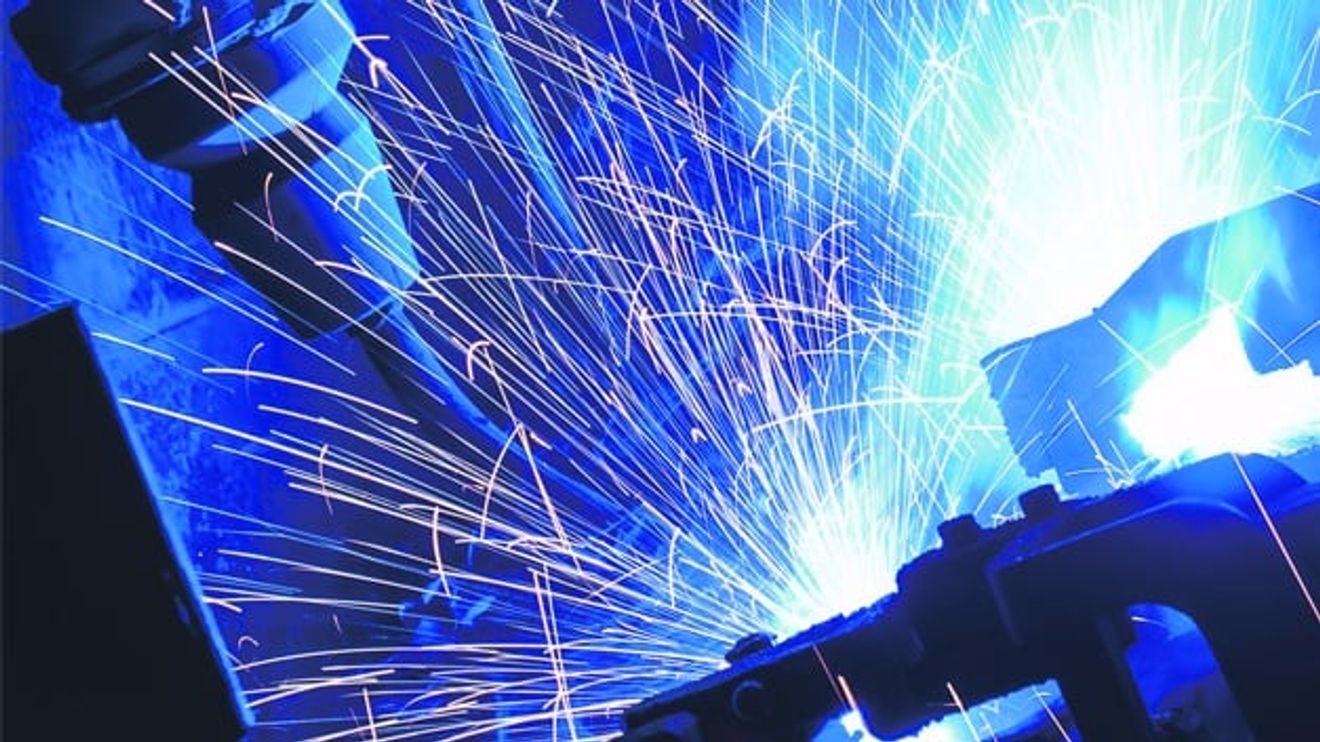
There are sometimes hundreds of spot welding robots in an assembly hall in the highly automated production facilities of the automotive industry and its suppliers. The welding process must run reliably to ensure smooth production. Optimum cooling of the welding caps plays a decisive role here in order to dissipate the heat load caused by the high currents in a targeted manner. The caps used in this process are designed from the outset as wearing parts that need to be replaced regularly. However, if the heat is not dissipated or is dissipated insufficiently, wear increases and the replacement intervals are extremely short. This not only results in higher costs, but also leads to additional production losses due to maintenance-related system downtime.
The high-precision monitoring and control of the cooling water volume to the individual welding guns of the robots makes sense for several reasons: The flow rate is always adapted to the demand, not only in normal operation, but also in subsystem operation and system expansions. In addition, less cooling water is required without sacrificing optimum cooling conditions. Last but not least, controlled flow rates prevent water hammer in the cooling water circuit, which can lead to pressure surges in the system and loss of the welding caps.
Depending on the material and design, between four and eight liters of cooling water per minute and cap usually flow to the welding caps of the spot welding robots. In nominal operation, the cooling water has a temperature of between +20 °C and +40 °C and is subjected to a pressure of up to 8 bar. However, only if the quantities are monitored can it be ensured that cooling is also properly guaranteed during operation. This is because the welding caps wear out despite the cooling, which can lead to leaks, for example. If these are not detected in time, leaking cooling water can lead to system downtimes and even damage other sensitive system components. There is also a risk of the operator being endangered by leaking cooling water. The cooling systems must therefore detect leaks or cap losses quickly and immediately interrupt and shut off the coolant flow if the worst comes to the worst.

However, there are other requirements in addition to the fast response times: The cooling system should react flexibly to changing conditions, for example by adapting the cooling water flow rate to the number of welding robots in operation. This not only guarantees optimum cooling under different operating conditions, but also ensures the best possible utilization of the pumping station capacity. Last but not least, space requirements play a decisive role. Conventional solutions for cooling the welding caps usually consist of components from different manufacturers. A flow monitor, a flow and return valve, a retraction cylinder and possibly pneumatic control valves are piped together. One of the main disadvantages of this design is the relatively large space requirement, which can be compared with a household refrigerator. This can be a problem, especially in systems where many robots work together in a confined space.
A compact system solution, as developed by Bürkert as a ready-to-connect plug & play solution (Fig. 1), promises to remedy this situation. In principle, the welding cap cooling system consists of a pneumatic and coolant unit as well as the process controller, which communicates directly with the higher-level robot controller or PLC. This allows permanent control of the amount of cooling water flowing through the guns. The flow sensor used works with a repeat accuracy of ±0.4 % of the measured value (under reference conditions) at a flow rate of between 0.3 m/s and 10 m/s.

Figure 2: Installation is possible close to the process, for example directly on the robot platform next to the supply unit.
© BürkertAs all components are coordinated and no complex piping is required, the complete cooling system weighs just under 27 kg and takes up only a fraction of the space of conventional solutions. When welding, the robot is therefore not restricted in its working area by the cooling system. The controller, which is used to configure the system, can be mounted in any easily visible position - for example on the outside of the safety guard. In most cases, however, there is not much to do during commissioning, as the system is already preset at the factory for standard dual-circuit clamps with 16 mm caps.
The maximum limit and setpoint are stored in the controller and only in special cases do other values have to be adjusted manually on the controller using the menu.
Commissioning is also simple in other respects. Coded connection technology and colored hoses facilitate the commissioning of the pneumatic and coolant unit. For commissioning, simply open the air supply line on the inlet side of the pneumatic unit using a stopcock and check the compressed air connections. If the system is tight and supplied with sufficient pressure (pressure switch feedback), the coolant unit can be put into operation.
The 'System Run' signal from the robot controller or PLC now starts and operates the welding cap cooling process. The controller adjusts the preset setpoint value (Fig. 2). If the lower limit value is exceeded and the upper limit value is not exceeded, a 'Water flow OK' signal is generated and an LED indicates regular cooling operation.
Advantages of controlled cooling
Thanks to the direct connection of the sensitive flow sensor and the process controller to the higher-level robot controller or PLC, the cooling water flow can be regulated at any time and is adapted to the actual requirement. The welding caps are sufficiently cooled right from the start and any resulting cap sticking is reliably prevented. In addition, the system compensates for the water resistances of different cooling lines by regulating them or - if unsuitable - immediately recognizes them as faulty. The factory default settings also ensure that the cooling water circuits are standardized, which ultimately makes servicing much easier. Furthermore, the controlled cooling water flow eliminates the need for subsequent manual calibration after modifications or extensions. The coolant quantity is reproducible and errors are quickly detected.
Ultimately, this improves welding quality and process reliability. And last but not least, there are also savings in operating costs: demand-based control reduces energy consumption and pumps no longer need to be oversized in order to have enough reserves.
Author: Hartmuth Lotha works in Field Segment Management at Bürkert.


You might also be interested in
International Federation of Robotics
U.S. Robotics Industry Sees Double-Digit Growth
In the U.S., sales of industrial robots rose by 11% compared to the previous year: 38,000 units were newly installed in 2025. This significant recovery is driven by robust growth in the food industry and other non-manufacturing sectors. However, the...
 read more...
Hans Seifert to Become Chief Sales Officer
Sigmatek has appointed Hans Seifert as Chief Sales Officer (CSO). His area of responsibility includes international sales, marketing, application engineering, and support.
read more...International Federation of Robotics
The 2026 IERA Award was presented
The 2026 “Award for Innovation and Entrepreneurship in Robotics & Automation” (IERA) goes to the Swiss deep-tech company Verity for its fully autonomous indoor drone system. The flying robots support the logistics and retail sectors by...
read more...Quantum-resistant hardware security for Nvidia robotics platform
Infineon Technologies integrates the hardware security module 'Optiga TPM SLB 9672' into Nvidia's 'Jetson Thor' computing platforms for robotics and autonomous systems. The module secures cryptographic keys directly at chip level and thus protects...
read more...6 Criteria for the objective comparison of humanoid robots in industry
A new benchmark from Fraunhofer IPA is intended to enable the first standardized and neutral analysis of humanoid robots for industrial use based on six key criteria.
read more...Regulation and safety slow down robotics projects in Germany
QNX has published the study "Inside the Robot: Architecture Benchmark Report". The results of the global survey of 1000 robotics developers show that software and safety requirements are increasingly becoming the central bottleneck for innovations...
read more...'Physical AI' as a turning point for robot use?
Physical AI - AI that can act more freely in the physical world beyond predefined processes - is regarded as the next evolutionary stage of artificial intelligence. Companies see great potential in this, especially for robotics, in the coming years....
read more...Schaeffler cooperates with VinDynamics
Schaeffler and VinDynamics, a company of the Vietnamese Vingroup, have agreed on a strategic partnership in the field of humanoid robotics. The collaboration focuses on the development and supply of planetary gearboxes, central components of...
read more...International Federation of Robotics
China puts AI robotics at the center of its national strategy
With its 15th five-year plan, China has placed robotics at the center of its new industrial strategy. The aim is to focus AI research on physical applications and use robotics as the main driver of economic growth.
read more...