

ETH Zurich
Artificial muscles for robotic leg
Researchers at ETH Zurich and the Max Planck Institute for Intelligent Systems have developed a robotic leg with artificial electro-hydraulic muscles that automatically adapts to uneven terrain.
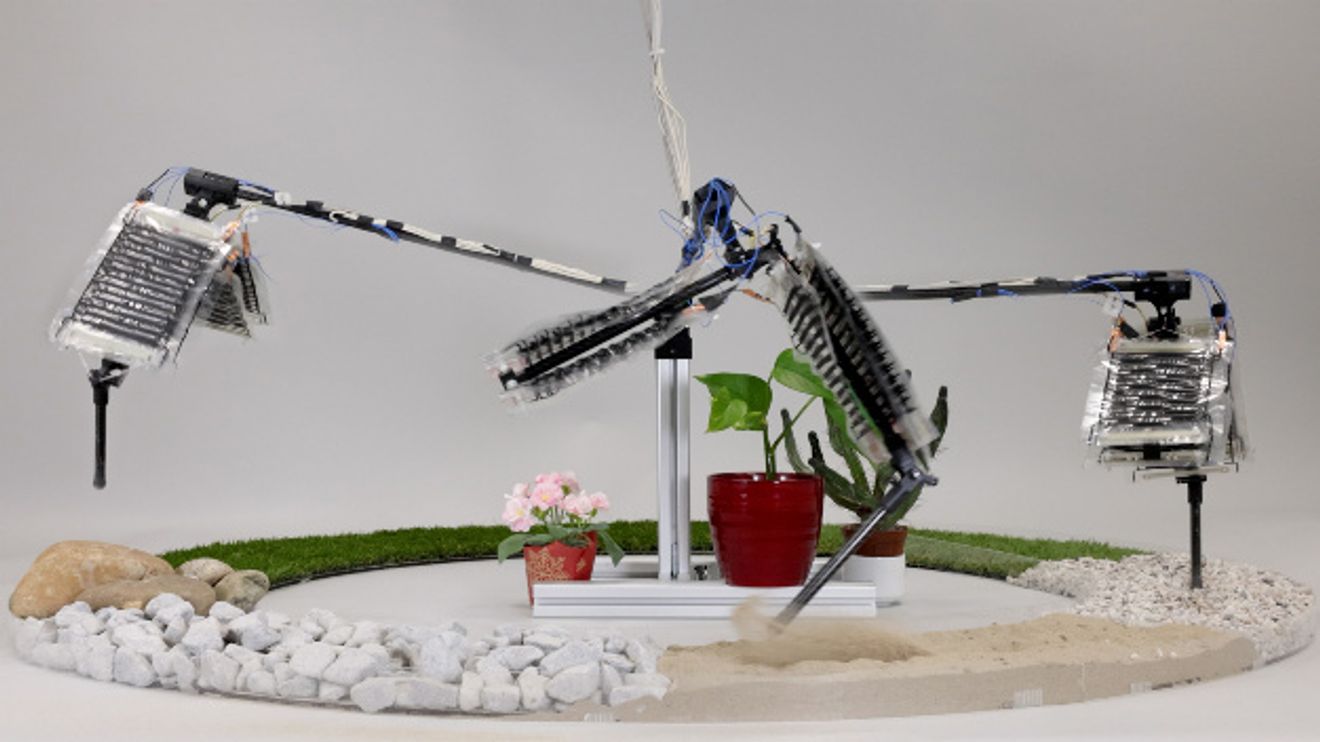
The robot leg jumps over different terrain
© Thomas Buchner / ETH Zurich and Toshihiko Fukushima / Max Planck Institute for Intelligent SystemsThe robotic leg can perform high jumps and fast movements as well as recognize and react to obstacles without complex sensors. It was developed by researchers from ETH Zurich and the Max Planck Institute for Intelligent Systems (MPI-IS) as part of the research partnership known as the Max Planck ETH Center for Learning Systems, or CLS for short. The CLS team was led by Robert Katzschmann from the Soft Robotics Lab at ETH Zurich and Christoph Keplinger from the MPI-IS
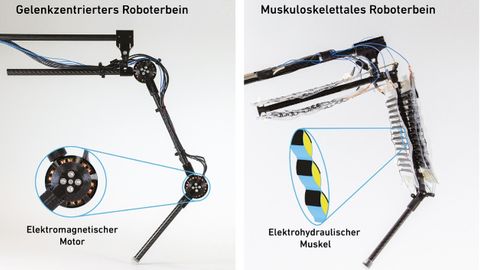
Conventional robotic legs are driven by an electromagnetic rotary motor (left), while the researchers use electrohydraulic actuators - artificial muscles - in the musculoskeletal system (right).
© Thomas Buchner / ETH Zurich and Toshihiko Fukushima / MPI-ISAs in humans and animals, an extensor and a flexor muscle in the robot leg ensure that movements are possible in both directions. These electro-hydraulic actuators, which the researchers call 'Hasels', are attached to the skeleton via tendons. The actuators are plastic bags filled with oil. Around half of the bag is coated on both sides with a black electrode, i.e. a conductive material. As soon as voltage is applied to the electrodes, they attract each other due to static electricity. If the voltage is increased, the electrodes pull closer together and push the oil in the bag to one side, making the bag shorter overall. Pairs of these actuators, which are attached to a skeleton, lead to the same paired muscle movements as in living beings: When one muscle shortens, its counterpart lengthens. The researchers use a computer code that communicates with high-voltage amplifiers to control which actuators should contract and which should lengthen.
More efficient than electric motors
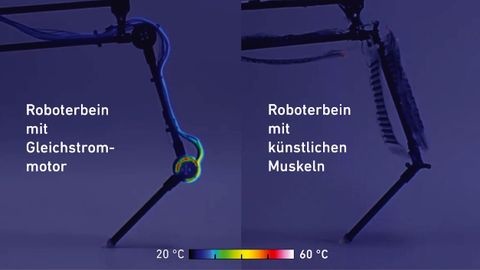
If robot legs have to hold a certain position for a long time, a lot of current flows through the driving DC motor (left). Over time, energy is lost in the form of heat. In contrast, the artificial muscles remain cold (right). The artificial muscles work on the principle of electrostatics and are efficient because they have no current flow under constant load.
© Thomas Buchner / ETH Zurich and Toshihiko Fukushima / MPI-ISThe researchers compared the energy efficiency of their robotic leg with that of a conventional robotic leg driven by an electric motor. Among other things, they investigated how much energy is unnecessarily converted into heat. "On the infrared image, you can quickly see that the motorized leg consumes much more energy if it has to be held in a bent position, for example," explains doctoral student Thomas Buchner. In contrast, the temperature in the electrohydraulically driven leg remains the same, which is due to the fact that the artificial muscle is electrostatic. "Electric motors require heat regulation, which means that additional cooling units or fans are needed to dissipate the heat into the air. Our system does not require such components," adds doctoral student Toshihiko Fukushima.
Agile movement over uneven terrain
The robot leg's jumping ability is based on its ability to lift its own weight explosively. The researchers were also able to show that the robot leg has a high degree of adaptability, which is particularly important for soft robotics. Only if the musculoskeletal system has sufficient elasticity can it adapt agilely to the respective terrain
While a sensor has to constantly tell the electric motor what angle the robot leg is at, the artificial muscle adapts adaptively by interacting with the environment. It constantly receives the same two input signals as a drive: one for flexion and one for extension of the joint. Fukushima explains: "The ability to adapt to the terrain is a key aspect. When a person jumps into the air and lands, they don't have to think about whether they should bend their knees at a 90-degree or 70-degree angle." The same principle applies to the musculoskeletal robot leg: if the environment is soft, the robot leg reaches a different joint angle than on a hard surface.
Technology opens up new possibilities
The research field of electrohydraulic actuators is still young and has only existed for around six years. Katzschmann says that electrohydraulic actuators will probably not be used in heavy machinery on construction sites, but that they offer specific advantages over standard electric motors, especially in applications with robotic hands, where the movement has to be very individual and adaptive, depending on whether it is a ball, an egg or a tomato, for example. However, he qualifies: "The current system is still limited compared to walking robots with electric motors. At the moment, the leg is attached to a pole, hops in circles and cannot yet move freely." Future work should overcome these limitations so that real walking robots with artificial muscles can be developed. Katzschmann continues: "If we combine the technology of the robotic leg into a four-legged robot or a humanoid robot with two legs, we will one day be able to use it as a rescue robot as soon as it is battery-powered."


You might also be interested in
New star at the Museum of the Future
The humanoid robot 'Ameca' is new to the Deutsches Museum Nuremberg, welcoming guests to the Museum of the Future and expanding the robotics theme area. Its hardware and software are designed to create a human-like counterpart.
 read more...
SensoPart and Cambrian Robotics
Partnership for 3D-Guided Robotics
Cambrian Robotics and SensoPart are jointly developing an AI-powered solution for 3D-guided robotic applications. The combination of vision sensors and AI is designed to simplify gripping and positioning processes.
read more...IFR Elects Jane Heffner as President
Jane Heffner is the new president of the International Federation of Robotics. Adrien Brouillard has been appointed vice president of the global federation.
read more...Production and Distribution Capacities
Yaskawa Opens Robotics Center in Slovenia
Yaskawa has opened a new robotics distribution center and an assembly hall in Kočevje. The 32-million-euro investment strengthens production and logistics for the EMEA region.
read more...Alibaba Expands 'Qwen' for Robotics
Alibaba is expanding its Qwen model family with a robotics suite for Physical AI. The three models support manipulation, navigation, and simulation for autonomous robotic systems
read more...International Federation of Robotics
U.S. Robotics Industry Sees Double-Digit Growth
In the U.S., sales of industrial robots rose by 11% compared to the previous year: 38,000 units were newly installed in 2025. This significant recovery is driven by robust growth in the food industry and other non-manufacturing sectors. However, the...
read more...Development Collaboration for Humanoid Robotic Hands Launched
Schunk is entering into a new development partnership with Robert Bosch Robotics. Their shared goal is to develop an industrial-grade robotic hand that can be integrated into various humanoid robot systems.
read more...International Federation of Robotics
The 2026 IERA Award was presented
The 2026 “Award for Innovation and Entrepreneurship in Robotics & Automation” (IERA) goes to the Swiss deep-tech company Verity for its fully autonomous indoor drone system. The flying robots support the logistics and retail sectors by...
read more...Quantum-resistant hardware security for Nvidia robotics platform
Infineon Technologies integrates the hardware security module 'Optiga TPM SLB 9672' into Nvidia's 'Jetson Thor' computing platforms for robotics and autonomous systems. The module secures cryptographic keys directly at chip level and thus protects...
read more...