

Material flow / handling
AGVs and robots - cornerstones of modern intralogistics
Increasing efficiency is a requirement that applies not only to the production process, but also to upstream and downstream warehouses. An example from the beverage industry shows what modern automated guided vehicles (AGVs) can achieve in this context.

The beverage industry is predestined for automated transportation and material flow - especially as the storage processes in this sector often involve large quantities of uniform and easily stackable goods. Block storage systems with a high degree of space utilization and a high degree of flexibility at comparatively low costs are common here. The latter can be further reduced by automated processes, saving the operator time and, not least, reducing potential sources of error. In addition, suitable technologies also help to make many processes more ergonomic.
In order for an AGV to achieve the desired results, a number of key questions must first be clarified as part of the system design:
- What load is to be transported and transferred and how?
- How maneuverable does the vehicle need to be and how much space is available?
- How long are the routes?
- How many transports will be carried out per hour?
- Which lane guidance or navigation is best suited?
- What does the energy concept look like depending on the duration of use?
- Are there any special safety aspects or difficult environmental conditions?
- Is a simple call control system with traffic control sufficient or is a complex control system with a wide range of functions such as a warehouse management system required?
An example: The specific task of a company from the beverage industry was to develop an AGV for a block storage system that can hold 10,000 pallets on a storage area of 80 × 80 meters. The pallets were to be stacked automatically and precisely on top of each other on four levels. The top pallet had to be able to be set down or picked up again at a height of approx. 5.2 meters. A major advantage of the block storage system is its high level of flexibility: as it does not have any shelving at all, it can be converted without any major technical effort - i.e. storage rows can be moved and rotated, for example.
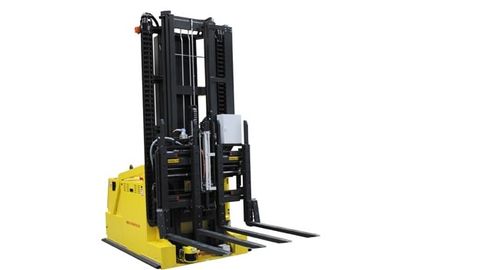
With its double fork with fork adjustment, the fully automated counterbalance truck enables two pallets to be transported at the same time - with scanners at the front and rear to ensure personal safety.
© EK AutomationAs a solution to this task, EK Automation, a company specializing in transport robotics solutions for automated material flow and storage systems based in Rosengarten, Lower Saxony, proposed fully automated counterbalance trucks with a lift of 5.5 meters and equipped with a double fork with fork adjustment for transporting two pallets simultaneously. Specifically, these were vehicles from the so-called Compact line, whose models are optimized for the medium-heavy load range of up to 2,500 kilograms load weight. The Compact GG used is characterized by a compact design and a chassis with a small turning radius, making it ideal for use in block warehouses with narrow aisles. It achieves lifting heights of up to eight meters and a travel speed of up to 2 m/s forwards and backwards.
Various types of navigation can be combined with the Compact GG. In the case described, for example, hybrid navigation was used, which is controlled via laser scanners and magnetic points. Laser navigation is used to determine the position, i.e. a laser sensor attached to the AGV determines the current vehicle position with the help of reflectors mounted at various points in the hall. Magnetic point navigation, on the other hand, is responsible for the route taken by the magnets embedded in the floor along the lane. A PC server is responsible for guidance control and all communication is handled via WLAN.
Last but not least, an important aspect of an AGV system is the suitable energy system. Factors such as duration of use, shift operation, investment costs and flooring all play a role here. In the example chosen, the decision was ultimately made in favor of an efficient automatic battery system with automatic recharging, which guarantees an optimum supply around the clock.
Pallet recognition in 3D
A special feature of the case described is the height that this block storage system reaches with a transfer height of 5.2 meters. This was only made possible by a new development from EK Automation: its vehicles can be equipped with 3D pallet recognition for precise stacking at great heights. This allows precise evaluation of the actual position of the pallet and therefore reproducible storage and retrieval as follows: The forklift moves to the programmed target position, creates a 3D photo and evaluates it. The fork position is then adjusted laterally and in the lifting height according to the pallet position and the vehicle picks up the pallet safely.
Special safety measures are also required if a warehouse is to be automated in which people also move around. For this purpose, EK Automation has developed a modular system that can be used to put together a combination of safety devices optimized for the specific application. In the case of the block storage system, the vehicles are equipped with personal protection scanners at the front and rear to protect employees. With these scanners, which allow the warning and protective fields to be set flexibly, the vehicle is able to scan its surroundings precisely - even when driving with the forks in front. If a person or object enters the protective field, the AGV brakes gently. However, in the case described above, where goods are stacked four levels high, only trained service personnel may be present in the warehouse.
In principle, automated warehouses in the beverage industry can be designed in different ways using AGVs: From individual buffer rows for dispensing or picking up pallets provided in production or in the warehouse to area-filling buffer rows. A classic example is production running over three shifts and goods issue running over two shifts. The automated guided vehicle system then takes over the buffering of ongoing production in a block warehouse during the night shift, for example, and at the same time provides the goods for dispatch in the outgoing goods area.
Author:
Ronald Kretschmer is Head of Sales & Marketing at EK Automation.
AGV + robot - an ideal combination

Another example of a modern AGV-based concept is the CarryPick storage and picking system from Swisslog, which can also be ideally combined with robot-assisted solutions.
On the one hand, the CarryPick system consists of the actual transport vehicles. These can carry out orders independently of each other and lift goods carriers weighing up to 600 kg. On the other hand, the racks that go with the system are variable and can be equipped with shelves, compartments, drawers, trays or even hanging rails as required. At the respective workstations, the solution supports application-specific processes via pick-by-light and put-to-light - and this is where robotics comes into play:

With the ItemPiQ, Swisslog has designed a solution for repetitive item picking. Its core component - the robot cell - can be seamlessly integrated into goods-to-person systems such as CarryPick. A multifunctional gripper can pick items of different sizes. The basic model with its four fingers is a combination of one plus three suction units. The three fingers can also clamp items to enable a wide range of different products to be picked by combining suction and mechanical gripping. Vision technology is used for object recognition in the source container, consisting of a 3D camera that recognizes a point cloud and a 2D camera that identifies the product textures. Using a software algorithm, the vision system is able to determine gripping points of unknown products. This is a major advantage, particularly in logistics environments with thousands of items, as it significantly simplifies the process of learning new products.
So much for what is already feasible today: While further development measures for AGVs in recent years have primarily focused on topics such as safety scanning, vehicle navigation and fleet management, the research and development department at Swisslog and its parent company Kuka are currently taking the next steps towards artificially intelligent AGV systems. One aim is to transfer important decisions from conventional fleet management and WMS solutions to the autonomous transport vehicles themselves. In the 'smart logistics factory' of tomorrow, people and machines should not only be able to communicate and cooperate with each other, but also be able to share knowledge, learn from each other and adapt autonomously to new tasks. In other words, the simple requirement for AGV systems to transport goods from A to B will be the exception rather than the rule in a world characterized by machine learning. Instead, the AGV of the future will be able to anticipate situations and make the appropriate decision for each situation within the supply chain within a short space of time.


You might also be interested in
Hydraulic cylinders become smart
Avoiding sudden machine breakdowns and optimizing maintenance routines - what operator of mobile machinery wouldn't want that? Vehicles can provide the necessary information automatically - for example with the help of position measurement in...
 read more...
Schaeffler manufactures electric motors
Schaeffler is entering electric motor production with a modular technology platform. Series production is planned from 2021.
read more...Mobile robotics in semiconductor production
Semiconductor production is complex and intricate. Hundreds of production steps are required before the finished product is ready. One challenge here is the transportation and handling of sensitive components from one step to the next.
read more...Micromotors in use with diving robots
Deep-sea diving robots have to function reliably up to 10,000 meters below sea level and withstand enormous pressures - a particular challenge for the drive technology used, among other things.
read more...Thermal images guide autonomous robot 'Anymal'
When autonomous robots such as 'Anymal' help to search for casualties in rough terrain, thermography is almost indispensable.
read more...New drive concept for driverless shuttles
Automated guided vehicles are an essential cornerstone of modern intralogistics concepts. In order to meet the demand for compact systems, innovative design solutions are required - including in terms of drive technology.
read more...Smart support
Mobile devices are inexpensive, constantly online and with their apps, up-to-date information is quickly available at all times. This also opens up potential in the industrial environment, but requires well thought-out integration.
read more...The automated grape harvest
"In vino veritas" is the saying. A very simple truth is that the grape harvest comes before enjoyment. But how? By hand or automatically?
read more...Audi - The future is called 'modular assembly'
Audi is working on a new production concept to get to grips with the rapidly increasing number of vehicle variants in car manufacturing: moving away from assembly line production towards modular assembly. Mobile solutions play a key role here.
read more...