
Automatica 2016
'Smart' robots on the rise
One of the exhibition areas at Automatica is robotics. A topic that will certainly be the subject of much discussion there: Is the breakthrough of smart robots imminent or how practicable are available concepts of direct human-robot cooperation - and collaboration?


Welding for batch size 1: CoWeldRob scans workpieces and automatically finds weld seams that the worker can adjust in a graphical system.
© Fraunhofer IPAWith a robot density of 292 units per 10,000 employees, the German economy is one of the most automated locations in the world, ranking first in Europe according to the latest robot statistics from the International Federation of Robotics (IFR). Following the example of large corporations, German SMEs are now set to experience a revolutionary wave of automation. However, high variant diversity and quality requirements as well as small batch sizes have so far made the economic use of 'classic' robot systems in small and medium-sized enterprises (SMEs) difficult. This is because their complex set-up, often inflexible programming and high space requirements or strict spatial separation by means of rigid safety fences are not suited to the production methods commonly used in SMEs.
Against this backdrop, the European SMErobotics initiative was launched at the beginning of 2012 with the aim of developing intelligent robot systems specifically tailored to the needs of SMEs. The results of the project, which ends on June 30, will be presented at Automatica at the Fraunhofer IPA stand (Hall 4A, Stand 131). The robot solutions developed are characterized by the fact that they work with and next to their human colleagues without separating protective devices. New technologies for intuitive programming and robust sensor-monitored program execution should also allow companies to use robot systems efficiently for many product variants.
Key component software
A key objective of SMErobotics is to enable application specialists to instruct robots easily and operate them reliably and quickly. This is to be made possible by programming assembly and handling tasks using intuitive graphical operating systems. This means that with the help of a 'skill-based' graphical programming system, i.e. based on ready-made program modules, the specialist instructs the robot in clear applications.
In another graphical programming system for complex assembly tasks, for example in gearbox assembly, the user specifies the assembly sequences interactively on the CAD model independently of a specific robot system. Powerful planning and reasoning systems then automatically calculate the necessary robot movements based on models of the individual parts and the robot system performing the task. According to the Fraunhofer IPA, skilled workers without robotics experience were able to program assembly tasks ten to fifteen times faster in tests than experienced robot programmers with handheld control units.
The skill-based program execution also makes it possible to deal transparently with inaccuracies in the environment and on workpieces. This is essential for SMEs because robot systems often process manually prepared workpieces, for example, which have tolerances or deviations from the design data. The use of sensors for workpiece localization and measurement also makes fixed positioning and fixtures for workpieces largely unnecessary.
The software modules described for intuitive programming and robot program generation were developed independently of specific robot types. They are available as stand-alone modules and can be integrated into system solutions by suppliers of automation technology and industrial IT.
Applications for welding processes and flexible assembly
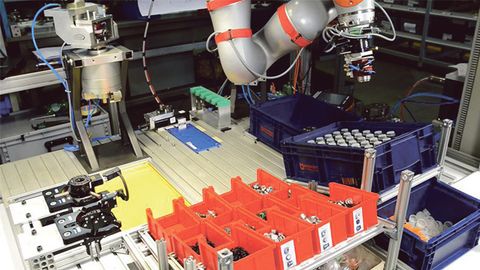
Precision assembly of loose components by robot: tests have shown a 30% reduction in the error rate in the assembly of a slide compared to the current manual method.
© Fraunhofer IPAVarious robot cells and workstations for human-robot collaboration that have been tested in initial practical trials will demonstrate the practical benefits of the software components in typical SME production scenarios. Fraunhofer IPA's 'CoWeldRob', for example, is a welding cell for batch size 1. Robust 3D sensor technology, comprehensive technology and process models and an intuitive graphical user interface enable seam welding of pre-assembled components in just a few simple steps. The system scans new workpieces, identifies the seams to be welded and suggests suitable parameters for the welding process to the welder. The system also identifies and locates known workpieces and then generates the welding program fully automatically. The welder can adapt this in the user interface or have it executed directly. The system learns any desired changes and takes them into account for subsequent tasks.
Several applications are realized with a two-arm robot as part of SMErobotics. One example of this is the welding of large components, for example for the construction sector. The robot moves the components with both arms and holds them with one arm while it carries out welding seams with the other arm.
The fact that assembly processes with tolerances in the micrometer range are also possible is further demonstrated by the precision assembly of an entire component group without complex, product-specific fixtures and guiding devices. The cell, which is currently in test operation at an end user and is to be integrated into ongoing production in the future, assembles valve assemblies, for example, in several consecutive steps. This also includes threading a gate valve with a tolerance of just three micrometers. Precise object detection and localization allow loose components to be reliably picked up from material boxes and the assembly point to be precisely controlled. Finally, sensitive sensor technology and targeted compliant movements enable jam-free assembly.
In addition to the project coordinator Fraunhofer IPA, the partners in the SMErobotics initiative include the manufacturers Comau, Güdel, Kuka and Reis (now Kuka Industries) as well as the universities and research institutes Lund University (Sweden), the DTI Danish Technological Institute (Denmark), the Fortiss An-Institut of the Technical University of Munich (TUM) and the Institute of Robotics and Mechatronics at the German Aerospace Center (DLR). Furthermore, eight small and medium-sized companies as well as 13 system integrators and regional application-oriented research institutions are also involved.
Delta kinematics for food & beverage
In addition to the trending topic of 'humans and robots', classic industrial robotics will not be neglected at Automatica. One sector that places particularly high demands on these steel assistants is the food and beverage industry. High-output solutions with output rates of well over 100,000 units per hour are in demand here, depending on the application. In addition, compliance with the strictest hygiene requirements when handling open foodstuffs is a priority in this environment.

Accordingly, many innovations in the field of high-speed kinematics can be expected at Automatica - including delta robots. The forefather of these kinematics, the FlexPicker from ABB (Hall B5, Stand 320), now covers almost every requirement with its many variants in the IRB 360 product family. Important for food applications: With their hygienic design, all FlexPickers are suitable for harsh wet area environments when processing meat and dairy products. There is even an all-stainless steel version with protection class IP69K, which is particularly suitable for wet cleaning with industrial cleaning agents and high-pressure hot water.
Adept Omron Technologies (Hall B5, Stand 310) will also be presenting the Hornet 565 in Munich, a newly developed delta kinematic system that masters pick & place at top speed. Fanuc (Hall B6, Stand 330) is equipping its robots with three-axis wrists, resulting in a total of six-axis kinematics. The background: three axes are sufficient as long as 'only' picking is carried out. If quality inspection tasks are added or picked products have to be rotated around an axis, the robot needs more degrees of freedom - according to the Japanese.
Something else will be revealed at the industry trade fair: In the high-speed sector, Delta robots will have to hold their own against robots such as the Spider from Epson (Hall B5, Stand 319) and the extremely fast Fast Picker TP80 from Stäubli (Hall B5, Stand 321). Neither robot will be in Munich for the first time, but Stäubli will be presenting new versions of the Fast Picker especially for use on open food products. The four-axis robots are available both in a splash-proof HE version and with food-compatible H1 oil. In this configuration, they achieve peak values of up to 200 picks per minute.
Flexible thanks to seven pivot points

With a maximum required height of five meters, this innovative robot gantry axis can even be used in very low production halls without any additional effort.
© Swabian machine toolsThe focus at Automatica is not only on the robot itself with its specific performance features. Users are increasingly demanding 'turnkey' complete solutions for their automation tasks, such as those jointly designed by Schwäbische Werkzeugmaschinen (SW) and Bartsch, the expert in automated manufacturing and assembly systems acquired by SW almost a year ago. A current example will be presented to the general public for the first time in Munich (Hall A5, Stand 512) and at the almost parallel CIMES in China: a new robot gantry axis which, compared to conventional, often very large and not particularly flexible multi-axis gantries, is characterized by seven available flexible axes. The latter can be used for process or corresponding component changes or for new components with minimal set-up effort.
"The robot gantry axis is used to load machine tools and performs all logistics and handling tasks that arise between the raw part pick-up and the machining process," explains Sven Makis, Managing Director of Production and Organization at Bartsch, adding: "The robot then transfers the machined component to the subsequent processes." According to Makis, the robot can also be used to load several opposing machines, and it is also possible to pick up the blank from the front or transfer the blank at both ends. Another special feature is that the multi-axis robots load and unload the workpiece fixtures of the machines directly from above. The machines are therefore freely accessible for operators and maintenance personnel without protective enclosures. Depending on requirements, the loading system can be installed at the front, on the move or to the side of the machine.
The new ISO/TS 15066
In mid-February, the International Organization for Standardization (ISO) published new guidelines to ensure the safety of employees working with robotic systems. ISO/TS 15066 is a technical specification that provides supplementary and supporting information to the safety standards for industrial robots from ISO 10218-1 and ISO 10218-2, which were published back in 2011. The specification sets out the various collaboration concepts and describes the corresponding requirements that must be met in order to fulfill them. In addition to the requirements regarding the design and risk assessment of the robots, it includes a research study on the topic of pain threshold versus robot speed, load and effects on defined body parts.
Human-robot cooperation to become safer
On April 1, the three-year research project 'beyondSPAI', funded by the BMBF with around half a million euros, was launched at Bonn-Rhein-Sieg University of Applied Sciences. The aim of the project, led by Professor Dr. Norbert Jung from the Institute for Safety Research, is to improve the safety of collaboration between humans and robots in industrial production. With the help of a multi-level sensor system and intelligent software, industrial robots should be able to recognize when they are getting too close to a person in order to stop any dangerous movement in good time.
Sensors mounted directly on the robot are designed to create a protective space around the moving parts of the system. At this point, both optical point sensors directly on the robot's tool and a network of ultrasonic sensors are provided. Optical sensors enable reliable differentiation of the relevant material surfaces and are particularly suitable for detecting skin based on their special reflection characteristics in the near-infrared range.
A near-infrared camera system is to be used at a medium distance from the robot to monitor a wider protected area. Like the optical sensors for the near range, the camera system is able to detect skin with a high degree of robustness. In this case, special image processing algorithms for detecting people are supplemented by the skin information in order to reliably recognize the silhouette of people. This system is to be mounted on a controllable mobile chassis that enables the camera to be aligned to a critical danger zone depending on the situation. This can be identified by the protection system using the information about the next actions known from the robot's programming. This makes it possible to specifically monitor areas in which there should be no people for the next planned movement of the robot.
Due to the practical relevance for future production processes, the University of Siegen and the Institute for Occupational Safety and Health of the DGUV, the TH Cologne and the company K. A. Schmersal (Hall 6, Stand 326) were able to win as partners. The latter has a safety controller in its portfolio, for example, in which so-called 'Cartesian cams' are stored, which form a virtual work area. The robot uses the safety controller to automatically monitor its position and the speed of the axes. If forces and speeds are low enough and all robot axes remain in their virtual 'cage', the robot can interact directly with humans.


You might also be interested in
IT meets industry
From June 21 to 24, the automation industry will meet at Automatica in Munich. Taking part for the first time: the accompanying trade fair 'IT2Industry', which focuses on the fusion of IT and industry.
 read more...
Robotics Institute Germany co-founded
Fraunhofer IPA is a co-founder of the Robotics Institute Germany, which aims to bundle Germany's cutting-edge research into AI-based robotics.
read more..."Manufacturing-X data room preliminary study" presented
Manufacturing-X is seen as the next step on the road to Industry 4.0, but how could a data room be designed for the data ecosystem? A study presented by VDMA and ZVEI gets to the bottom of this question.
read more...How companies use data for product development
Where do companies stand when it comes to collecting data from products and using it to develop new products? Researchers from the Fraunhofer Institute for Manufacturing Engineering and Automation IPA have investigated this in a study.
read more...Fraunhofer project determines properties of coatings virtually
In the "PaintVisco" project, researchers at Fraunhofer IPA are modeling the development and processing of paints. The bat was the model for the development of a new simulation program that can be used to virtually determine the exact properties of...
read more...The digital value stream analysis
A research team from Fraunhofer IPA is digitizing value stream analysis together with the Stuttgart-based software provider Ifakt. This should enable this optimization method to be carried out in the future with significantly less effort and almost...
read more...The top articles in January 2022
Obstacles and opportunities characterize the top 10 most-read articles in January. Click through the obstacles in companies and find out what opportunities the year 2022 has in store.
read more...Intelligent sensor detects leaks
To simplify the search for leaks in compressed air systems, a researcher from Fraunhofer IPA is working with Sick to develop an additional leakage service for an intelligent flow sensor. Self-learning algorithms evaluate the measurement data.
read more...Improved safety for service robots
In the S³ research project, researchers from Fraunhofer IPA worked with project partners to develop safety technologies and recognition algorithms for service robots. They were tested on the Care-O-bot 4 service robot in a nursing home application.
read more...