

Kübler
'Pancake' makes you flexible
The load and signals in the robot arm are generally transmitted via cables. However, this is accompanied by a restriction in mobility. A shortcoming that a slip ring helps to overcome.
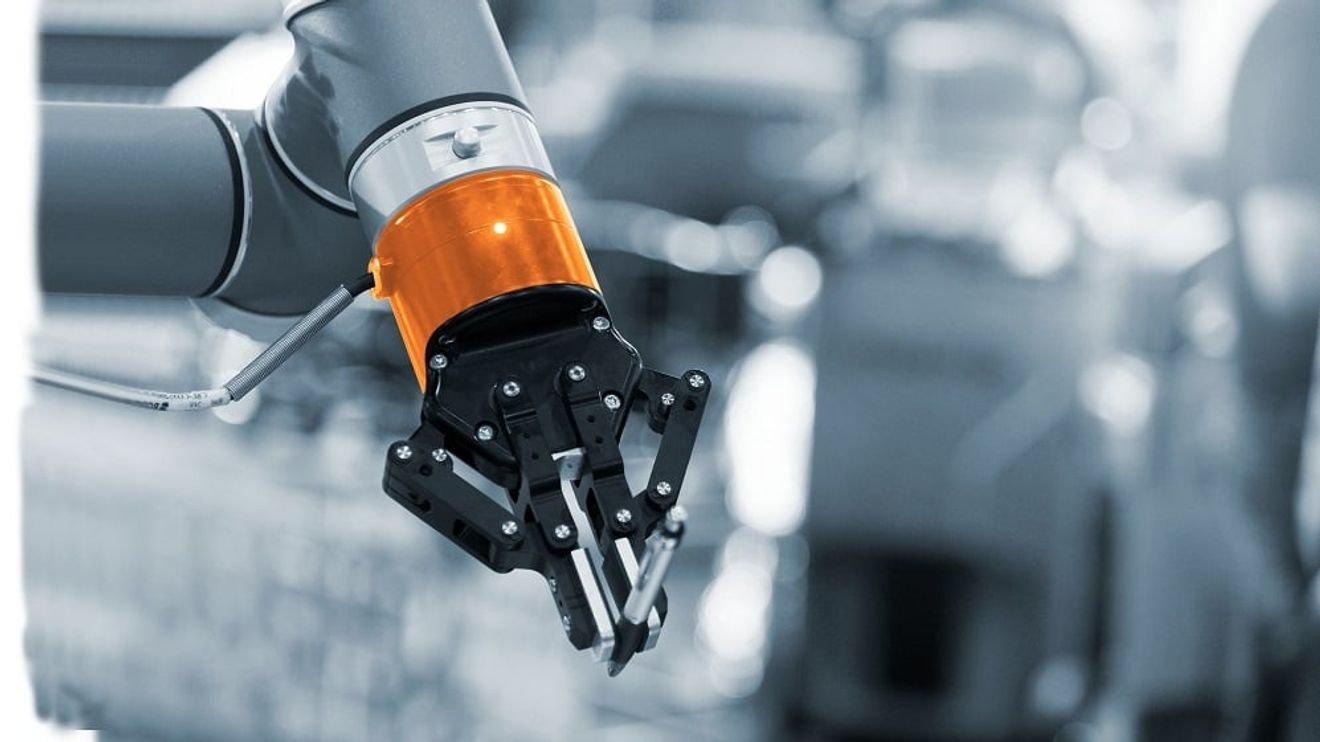
Cobots are characterized, among other things, by their lightweight design and their freedom of movement in terms of multi-axis movements and at the same time maximum safety for humans, realized for example by laser scanners or camera systems. To ensure that the flexible movement and lightness can also be implemented in practice, it makes sense to integrate disk slip rings (pancake slip rings) into the gripper system for electrically controlled grippers that grip various workpieces, objects or weights at the end of the robot arm. These disk slip rings can be used to transmit loads and signals and thus supply the gripping system.
Of course, cables can also be used to transmit the load and signals. However, the main disadvantage of using cables is the limited movement of the robot arm. Continuous rotary movement, for example, is not possible with cables. And even in swivel mode, conventional cables are exposed to such high mechanical loads that they are often the weakest link in the chain.
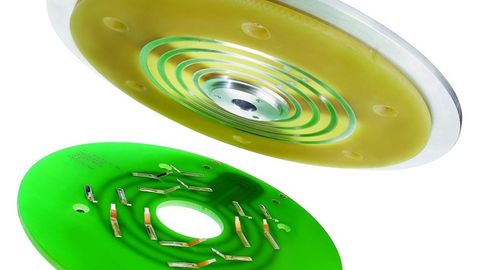
The disk slip ring from Kübler transmits load and signals and can therefore replace cables in the robot arm.
© KüblerUsing disk slip rings, such as those offered by Kübler, the load and signal can be reliably transferred from a stationary platform to the rotating platform - in this case the gripper system at the end of the robot arm.
The weight and length of the robot arm are the main factors that determine its dynamics. In this respect, disk slip rings score highly in terms of installation depth - the slip ring from Kübler, for example, measures 10 to 15 mm in the axial direction and weighs just a few grams in the double-digit range. The shorter the robot arm, the faster movements are possible for the robot, allowing work processes to take place in short cycle times.
Long service life
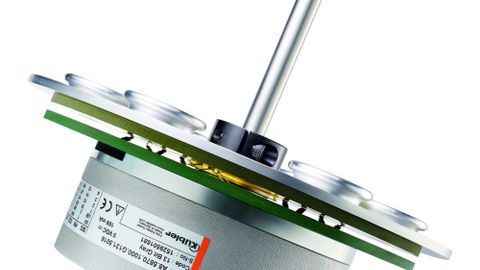
Combined with a rotary encoder, the disk slip ring handles positioning as well as signal and load transmission.
© KüblerFault-free transmission of load and signals is essential for high system availability. To ensure this, the disk slip rings from Kübler are equipped with a multiple redundant system that offers a high level of transmission reliability. In concrete terms, this means that several contacts are implemented per transmission path, each of which in turn has several contact points. An example to illustrate this: there are at least four contacts (brushes) on the circumference of the disk slip ring. Each individual contact uses micro-springs to ensure reliable transmission of load and signal.
The transmission takes place by lightly pressing the two plates or disks together. The slip ring module is usually integrated into the gripper housing. Due to the many contact points, very low contact pressures are sufficient to transmit the load and signals without interference. Thanks to the low contact pressure of the two disks, the disk slip rings are maintenance-free and have a long service life. Common variants currently provide up to 5 A/60 V(AC), 48 V(DC) and are available with up to 20 channels. The disk slip rings are suitable for common fieldbuses or Industrial Ethernet up to 100 Mbit/s and operate in a temperature range between -40 and +75 °C.
Positioning and transmission combined

Manfred Hick is Business Development Manager/Product Manager Slip Rings at Kübler in Villingen-Schwenningen.
© KüblerIn addition to the pure disk slip ring range, there is also the option of a compact slip ring solution that can take on positioning tasks as well as transmitting loads and signals. For this purpose, the slip ring is combined with an absolute rotary encoder. Such an encoder/slip ring combination can be used in gyrocompasses for navigating ocean-going vessels, for example. The power supply and industrial bus-supported data feedback are reliably secured.


You might also be interested in
Multiturn encoder for micromotors
Posital launches miniaturized 22 mm multiturn kit encoders for small and micro drives. Until now, small and micro motors were at best equipped with single-turn or incremental encoders.
 read more...
Planning 'at sight'
The Kübler Group recorded a strong first quarter in its 60th anniversary year. At the annual press conference, it provided an overview of the financial year to date as at September.
read more...Sensorless speed monitoring simplified
With the Safeone DN3PD2 speed monitor, Dina Elektronik simplifies sensorless speed monitoring. According to the manufacturer, installation and maintenance are simple.
read more...ABB acquires Codian Robotics
ABB has acquired the Dutch company Codian Robotics, a supplier of delta robots, which are primarily used in high-precision pick & place applications.
read more...Programming even by non-professionals
The TracePen from Wandelbots makes it possible to assign tasks to robots easily and without programming knowledge. According to the provider, even non-experts can use it to train robots for a task.
read more...International Bionic Award presented
This year's International Bionic Award from the Schauenburg Foundation goes to a young French scientist. Julien Dupeyroux receives the 5000 euro award for his research work on an autonomously navigating robot.
read more...Robots learn to assemble thanks to AI
Flexible robot programming for assembly tasks is still complex. The aim of the 'Rob-akademi' research project is to improve this.
read more...Robot installation via AR app
Deciding whether and how a robot fits into a particular process has never been easier with an augmented reality tool. ABB is now presenting a corresponding ARViewer.
read more...Detect alignment and speed simultaneously
TWK has expanded its family of inclination sensors with a special device that makes it possible to precisely measure the current orientation - i.e. the inclination or position (360°) - and the speed at the same time in a rotating application.
read more...