
Lenze
The drive becomes a sensor
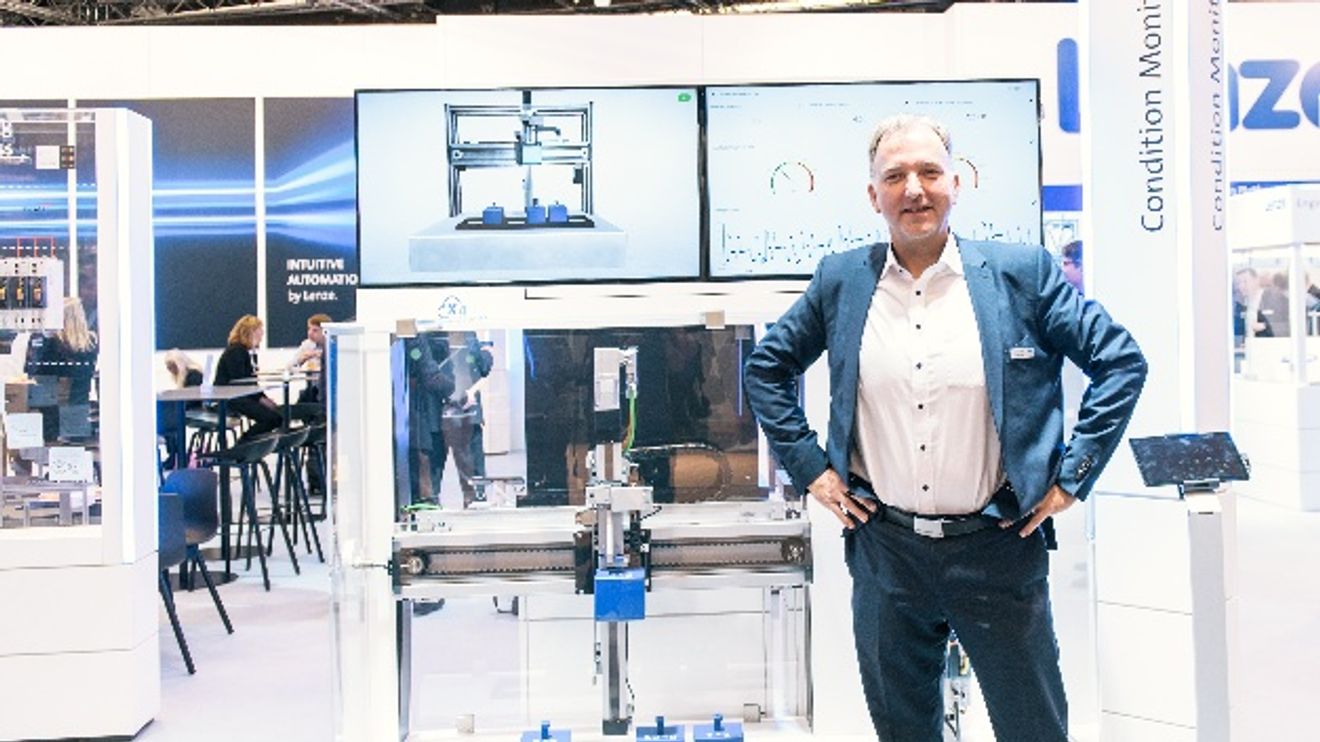
Lenze is convinced that condition monitoring is efficient if it does not require costly additional sensors. At SPS 2019, the Hamelin-based company used a real-life showcase to demonstrate how this can be implemented in practice.
Topics such as predictive maintenance, condition monitoring and forecasting models based on artificial intelligence (AI) are currently enjoying great interest in the mechanical engineering sector. However: "Many customers have no idea what could be predicted," says Lenze CTO Frank Maier from his own experience and adds: "Condition monitoring and predictive maintenance are often used as synonyms - but they are two different concepts."
Predictive maintenance is the prediction of events - for example, when the probability of a gearbox defect occurring in the next 50 operating hours increases to over 90 %. With such a forecast, the replacement of the gearbox can be planned in good time before the system actually fails. Condition monitoring, on the other hand, is a preliminary stage that enables a more in-depth description of the current condition based on the interpretation of existing data. This requires a deep understanding of machines and processes in order to generate meaningful information from 'naked' data.
According to Frank Maier, it is particularly interesting for OEMs if - as is the case with Lenze's approach - the added value offered by condition monitoring does not have to come at the price of higher hardware costs. The key to the solution is to tap into the added value of information from existing data sources.
In Nuremberg, the automation provider will be demonstrating the principle using a showcase with two different approaches. One is model-based: Here, the measured actual values are compared with those resulting from the assumed mathematical description of the machine. If certain tolerances are exceeded, this is interpreted as a fault. The other approach is data-based: An algorithm learns the behavior of the system and the mutual influence of the parameters, for example speed, acceleration, torque, position and current consumption. The real values are compared with this learned description in order to define deviations.
In the trade fair show case, increased friction on the spindle is simulated on the one hand and wear on the belt drive on the other. In both cases, the anomalies can be recognized via current and torque values. Be it through an absolute increase in the value or through superimposed frequencies. In both cases, the condition monitoring system sounds the alarm and displays the causes on a dashboard.
Control or cloud?
The two condition monitoring approaches differ not only conceptually. The data is also evaluated in different ways. Model-based evaluation usually takes place in the control system, because according to Maier, it does not require high computing power. For data-based evaluation, on the other hand, ML and AI analyses could be considered, usually as a cloud application.
Lenze provides the machine manufacturer with a range of differently dimensioned PLCs for model-based condition monitoring. Data-based evaluation can also be carried out locally if the powerful c750 Cabinet Controller is used. Alternatively, the x500 gateway provides access to the cloud. Combined with the so-called x4 platform, this results in a turnkey cloud solution that includes remote machine maintenance and user-friendly asset management in addition to condition monitoring.


You might also be interested in
On the way to the world library
The vision has been in place since the end of 2014: OPC UA is to achieve the status of a globally recognized standard for the Industrial Internet of Things IIoT by 2019 at the latest. During the press conference at SPS, the Foundation took a stand...
 read more...
More investment in software expertise
The economy is leaving its mark: compared to the previous year, Turck expects total sales of around 640 million euros for the 2019 financial year, a decline of 3%. Nevertheless, Managing Director Christian Wolf is optimistic.
read more...A look back at the fair
The 30th SPS was the highlight of the automation industry at the end of November. The keywords 'digitization' and 'digital transformation' were visible right through the halls. The main trends can be seen in the film below.
read more...SPS 2019 in retrospect
The 30th SPS, the trade fair highlight of the automation industry, took place at the end of November. The buzzwords 'digitalization' and 'digital transformation' were visible throughout the halls - the most important things in the film.
read more...Dynamically driving high speed motors
Under the name SD4x, Sieb & Meyer is developing a new generation of frequency inverters for high-speed applications. The first of these is the SD4S version, which is designed for small high-speed spindles and motors with a power output of just a...
read more...Individual standard products
Prime Cube' is a product brand for IPCs and HMI solutions introduced ten years ago. Matthias Klein, Managing Director of Schubert System Elektronik, reports on how the brand is kept fresh.
read more...Industry 4.0 'off the shelf'
iniNet Solutions has developed an automation architecture based on web server-supported SCADA and programming software, which is intended to bring manufacturing companies more easily than ever to industry 4.0 level. This architecture can be seen at...
read more...Plug and play into any cloud
A year ago, Cloudrail unveiled the 'CloudRail.Box' for the first time - a gateway that connects plug-and-play to IO-Link sensors and masters and sends the data to any cloud platform. Now it also handles OPC UA and Edge Computing.
read more...Manufacturing without cables
R3 Reliable Realtime Radio Communications presents its first series products "Echoring Ethernet Bridge" (EREB) and "Echoring System on Module" (SoM) at the SPS. They are intended to complement wired industrial Ethernet networks with equally powerful...
read more...