
Product development
Audi tests 'Virtual Reality Holodeck'
Audi wants to use virtual reality to assess the designs of new cars and thus reduce the number of time-consuming physical test models. The technology also offers potential in production.
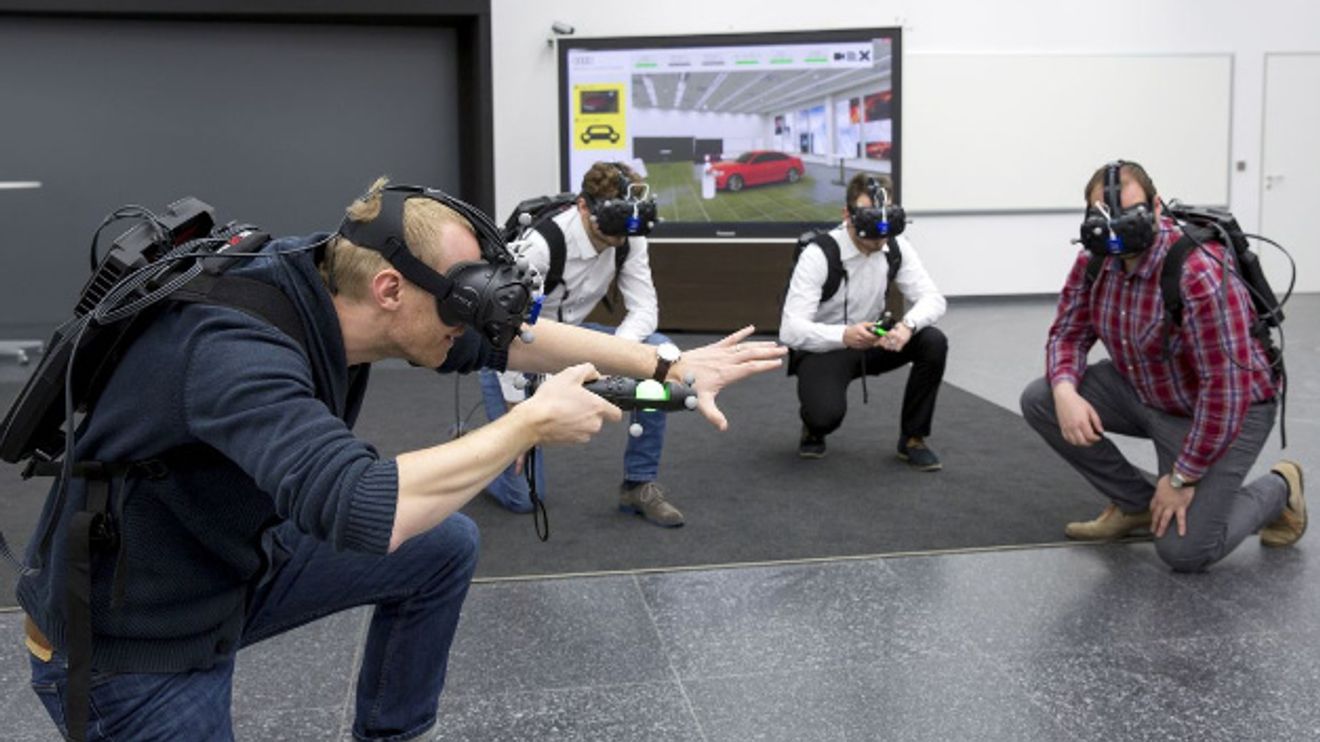
Audi is currently testing a so-called 'virtual reality holodeck'. This is a room measuring around 15 by 15 meters in which car prototypes can be displayed realistically and true to scale. For this purpose, Audi planning staff have recreated the room in which the design assessment takes place in the virtual world on a 1:1 scale. Using current design data, they place the virtual models there, which can be experienced intuitively both from the inside and outside. In contrast to previous VR environments, up to six people can now walk around the car at the same time.
Visual assessment
Audi is testing the holodeck at the interface between development and production. Here, employees from both areas jointly assess the overall visual impression and the surfaces of the new car and adjust the position of individual lines and joints. This assessment is the final step before the tools required for the car go into production. Until now, photorealistic 2D computer graphics and hand-made physical models have been used for this purpose, which are costly and take up to six weeks to build.
However, the two-dimensional representation is still used to analyze individual aspects in detail: "This currently offers a higher resolution and better quality than the walk-in VR installation," says Martin Rademacher, head of the VR Holodeck project at Audi.
Technological implementation
To work in the holodeck, each user wears VR goggles and two hand controllers for interaction. On their backs is a rucksack with a powerful PC weighing just three kilograms. This calculates the scene. The users' mobile PCs are connected via WLAN to a central workstation that controls the data exchange. The three-dimensional model can be transferred to various environmental settings. In a further expansion stage, the holodeck allows participants from other Audi sites to be connected, which makes work organization much easier. Once production has started, the system is used to ensure the quality of a model.
Audi developed the overall concept together with the Stuttgart-based media agency Lightshape. The company intends to introduce it into work processes before the end of this year. The aim of the current test phase is also to sound out possibilities for its use in other areas of the company: The production planners at Audi have already virtually displayed entire assembly line sections in the system in order to visualize future processes. The department is also in contact with other brands in the Volkswagen Group.


You might also be interested in
Facebook announces cheaper VR glasses
Facebook is planning to boost its virtual reality business with an aggressive pricing policy. The online network wants to launch a cheaper version of its Oculus VR glasses, which do not require a PC, at the beginning of 2018 - for 199 US dollars...
 read more...
Drive independently up to 60 km/h
The Audi AI traffic jam pilot in the A8 enables highly automated driving at level 3, taking over the driving task in traffic jams or slow-moving highway traffic at speeds of up to 60 km/h. The driver does not have to constantly monitor the car. The...
read more...Siemens cooperates with Sony
Together with Sony, Siemens presented a solution at the CES that redefines the workflow of engineers and designers.
read more...Securely networked - even in the Ex zone
Seamless communication and fast data transfer are the guarantors of success for digital workflows in the smart factory. In order to benefit from the digital transformation in potentially explosive areas, lone workers need suitable mobile devices.
read more...followed up! - with Rainer Brehm, Siemens
An All Automation Society?
Industrial automation has experienced an enormous upswing in the last 25 years. But where exactly is automation today and where should or must it be in the future? Rainer Brehm takes a stand in this interview.
read more..."Unnecessary uncertainty for companies"
The EU institutions have agreed on the "Data Act", which regulates the use of collected data. The VDMA takes a critical view of the agreement.
read more...Group companies merged under one brand
At automatica 2023, the Hahn Group will be appearing for the first time with a new brand design and under a new name. This step will unite more than ten individual brands into a globally positioned automation company under one brand.
read more...The arrival of augmented reality
With the new version of 'Eplan eView Free', the AR function is now directly accessible via a 3D visualization. Navigation in the project is much easier.
read more...From Multicloud to Metaverse
A whole range of exciting developments in the tech world await the industry in the new year. Dr. Thomas King, CTO of DE-CIX, has identified five trends that will shape the interconnection business and the networked world in 2023.
read more...