
VDI Conference
This is how far augmented reality has come
What possibilities do augmented and virtual reality offer for corporate use? Are the technologies mature? The VDI conference in Munich at the beginning of September got to the bottom of these questions.
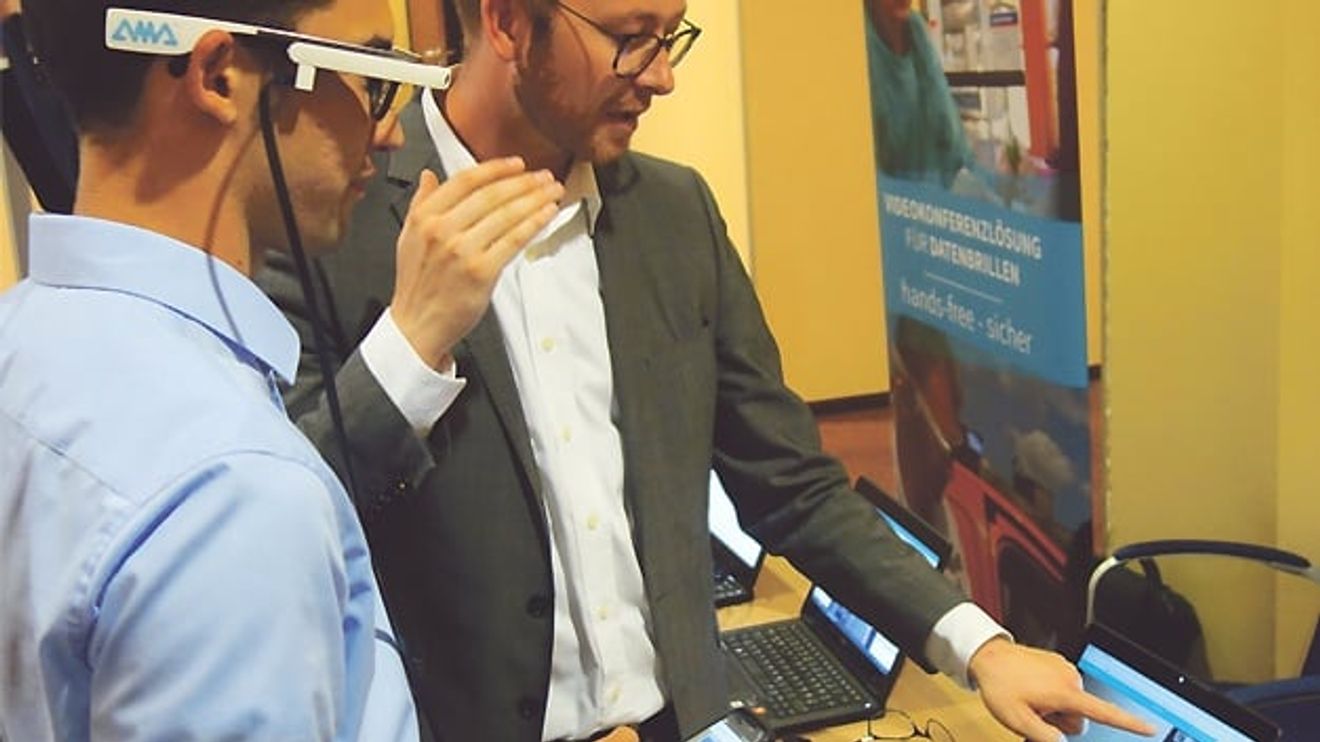
At the accompanying trade exhibition, AMA presented the 'Xpert Eye' video conferencing solution: it enables technical employees, for example, to establish a secure 'live transmission' of their field of vision, including voice and gestures, to experts at other locations with the help of data glasses and the associated smartphone/PC.
© Computers&AUTOMATIONThe 3rd VDI Conference Augmented and Virtual Reality as Smart Assistance on September 5 and 6 at the NH Munich East Conference Center examined the suitability of the trend technologies for companies. One reason why these technologies have not yet achieved enormous market penetration in corporate use is the lack of business models. This is why Dorothee Ebert from KPMG first gave an insight into how companies can develop new business models and then specifically addressed augmented reality (AR). To date, companies have mainly used these technologies to optimize their existing business model or improve the internal value chain. However, this does not yet create a new business model. For this, it is necessary to define an externally visible and customer-oriented service. An example: a company that digitizes its manuals and issues them in AR versions. A new business model here would be to convert this user knowledge into service offerings and use the existing infrastructure for this. This is the approach taken by internet giant Amazon, for example, which has developed its own business model from its own specific need for IT resources and is now one of the largest cloud providers.
Extensive tracking options
Helmut Guggenbichler from Augmensys provided an overview of the tracking options for augmented reality: On the one hand, localization can be implemented using geographical position information. However, this requires position information and sensors for orientation, such as a compass, GPS, WLAN, iBeacons, gyroscopes or tilt sensors. All of this has an impact on the battery performance of mobile devices. There is also AR via optical recognition of the situation - for example via markers, edges, image recognition or SLAM.
Christian Zink from ivii, a business unit within Knapp, brought a simple alternative tracking method into play. Because none of the goggles available on the market could meet the company's requirements - such as battery operation over an entire shift - they developed their own data goggles. The trick with tracking: the AR glasses are based on QR codes, which are attached to the shelf walls at regular intervals in a warehouse and guide the user to the correct storage locations like a navigation device. This means that only camera technology is required for tracking, which saves battery power. The glasses can now be used for an entire shift. This type of tracking is also very cost-effective.
Acceptance is crucial

The 'Kinemic' solution recognizes hand and arm movements using a sensor band or alternatively a smartwatch to simplify the operation of smart glasses, for example.
© Computers&AUTOMATIONBut what about the acceptance of AR technologies among operators? Dr. Ralph Kleedörfer from Lindig provided insights into this question in a field report from the Service division. As a contractual partner of Linde, the company offers forklift trucks, warehouse technology and work platforms - both for hire and as new and used equipment. If a piece of equipment breaks down, Lindig sends a service technician to the customer. To help them diagnose the fault, it can be useful to involve an expert from the head office - using video or image transmission. This allows them to see what the service technician has in front of them and give them tips if necessary. The expert should also be able to draw notes in the image of the service technician - making it an AR application.
For this purpose, the company initially tested a whole range of AR devices - both smart glasses and smartphones - as well as associated or suitable software products. Following laboratory, workshop and field tests, one solution is now being used by all 90 service technicians - via smartphone. This is because the glasses were not accepted by the employees. They were too bulky and too cumbersome to use. But Kleedörfer remains optimistic about smart glasses: "In two and a quarter years, every service technician will be using smart glasses as a special tool."
Lukas Merkel, research associate at the Fraunhofer IGCV in Augsburg, also gave an insight into current research activities and user acceptance. In the learning factory for networked production, the researchers have set up a use case in which the Hololens glasses from Microsoft guide the machine operators through the maintenance of a lathe. It became clear that users cope with the glasses in completely different ways: Sometimes they find their way around within a very short time and work intuitively through the maintenance program, sometimes they don't get on at all and give up after a short time.
The Fraunhofer IGCV is also conducting research into virtual reality (VR) to support factory planning projects through improved visualization. For example, existing factories can be virtualized. To do this, the Fraunhofer researchers first measure the hall with laser scanners and then photograph it. Once the two data sources have been merged, the point clouds can be enriched with color information - resulting in a joint model. Coupled with VR hardware, planners can 'beam' themselves into the factory hall and view it and any future changes realistically.
Waiting for better devices
The event showed that companies are already experimenting intensively with augmented reality and are already using AR in some cases. In addition, the software and tracking options are already sufficiently available to use them efficiently. However, only tablets or smartphones are often used in real-life applications, as AR glasses that cover all company requirements do not yet exist. Although the Hololens enjoys acceptance in the industry, as conference chair Dirk Schart, Head of PR & Marketing at Re'flekt, emphasized, it still has too many weaknesses - such as being too heavy, having too small a field of vision and too short a battery life. We can therefore look forward to the successor, although there are still no reliable statements regarding its release date. Hopes are therefore also pinned on another company: Magic Leap wants to launch a counterpart to the Hololens on the market and has raised 1.5 billion dollars in venture capital for this purpose.


You might also be interested in
Siemens cooperates with Sony
Together with Sony, Siemens presented a solution at the CES that redefines the workflow of engineers and designers.
 read more...
Securely networked - even in the Ex zone
Seamless communication and fast data transfer are the guarantors of success for digital workflows in the smart factory. In order to benefit from the digital transformation in potentially explosive areas, lone workers need suitable mobile devices.
read more...followed up! - with Rainer Brehm, Siemens
An All Automation Society?
Industrial automation has experienced an enormous upswing in the last 25 years. But where exactly is automation today and where should or must it be in the future? Rainer Brehm takes a stand in this interview.
read more..."Unnecessary uncertainty for companies"
The EU institutions have agreed on the "Data Act", which regulates the use of collected data. The VDMA takes a critical view of the agreement.
read more...Group companies merged under one brand
At automatica 2023, the Hahn Group will be appearing for the first time with a new brand design and under a new name. This step will unite more than ten individual brands into a globally positioned automation company under one brand.
read more...The arrival of augmented reality
With the new version of 'Eplan eView Free', the AR function is now directly accessible via a 3D visualization. Navigation in the project is much easier.
read more...From Multicloud to Metaverse
A whole range of exciting developments in the tech world await the industry in the new year. Dr. Thomas King, CTO of DE-CIX, has identified five trends that will shape the interconnection business and the networked world in 2023.
read more...The most important technology trends of the year
The CES in Las Vegas is one of the largest technology trade fairs in the world. This is where innovations are pompously presented and celebrated, which then provide a talking point throughout the year.
read more...Modular AR service platform for industrial production
A cloud-based service platform with open industry interfaces is being developed as part of the "secureAR" project. An AR assistance system plays a central role in this.
read more...