
Fraunhofer FEP
Develop data glasses faster
Scientists from the Fraunhofer Institute for Organic Electronics, Electron Beam and Plasma Technology will be showcasing their latest developments in special microdisplays for augmented reality and virtual reality data glasses at embedded world 2018.

Microdisplays are a key component of augmented reality (AR) and virtual reality (VR) smart glasses.
© Fraunhofer FEP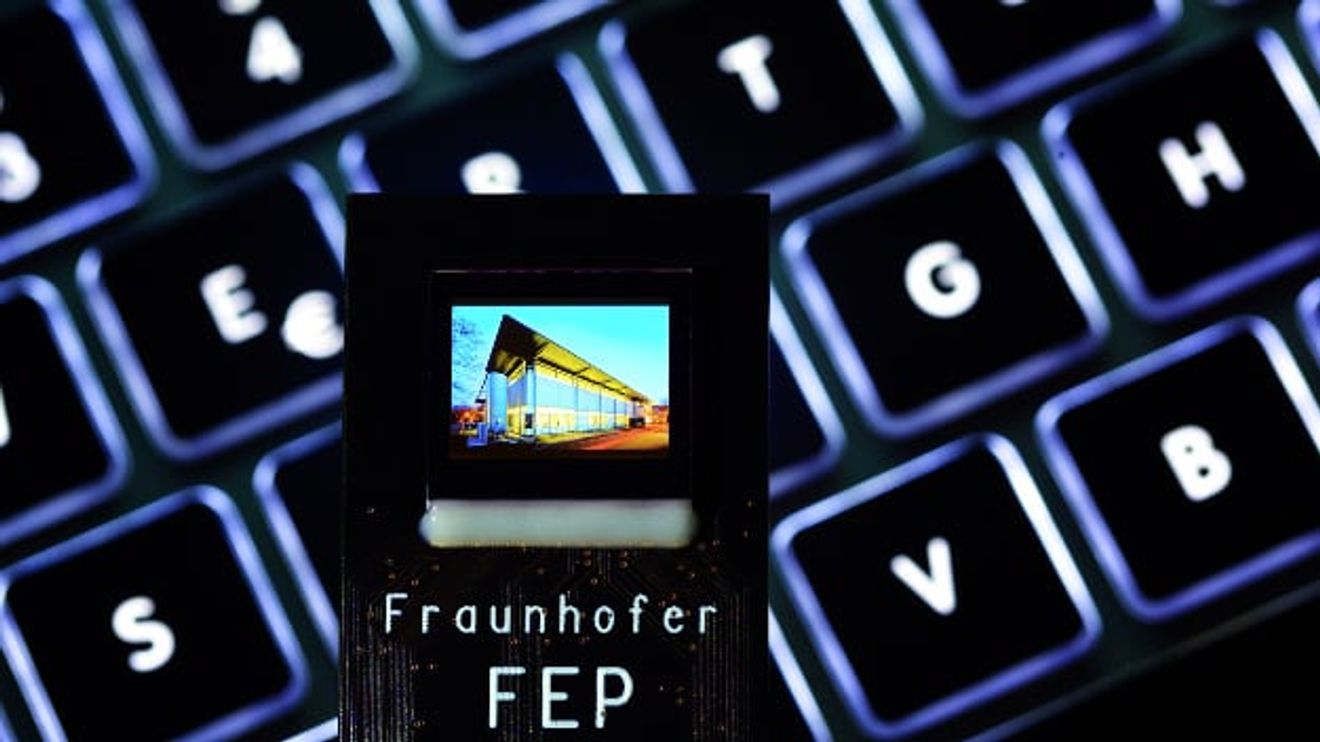
Augmented reality is increasingly finding its way into everyday working life thanks to smart glasses. One reason for this is that the required technologies are now at a level that enables compact, powerful data glasses that are comfortable for the user. "We use OLED-on-silicon technology for our microdisplays. OLEDs are self-luminous and, unlike other display types, do not require any additional lighting, thus enabling simplified optics and significantly higher contrast ratios," explains Bernd Richter, Deputy Head of Microdisplays and Sensor Technology at Fraunhofer FEP. "Other functions can even be integrated directly into the display, such as a camera function that allows the information shown in glasses to be controlled with the eyes."
As different as the areas of application for data glasses are - support in the maintenance of systems, checking the health of people or a simple display of information for joggers or cyclists - as different are the corresponding data glasses.
In order to make it as easy as possible for developers of data glasses to use OLED-on-silicon technology in their glasses in an application-oriented manner, the scientists offer evaluation kits - i.e. development tools.

Content control with the eyes
One specialty here are bidirectional microdisplays that combine high-resolution SVGA OLED microdisplays with embedded SVGA image sensors in an active area. These evaluation kits can be used to develop glasses that allow the user to control the displayed content with their eyes, leaving their hands free for assembly work, for example. In addition, these bidirectional displays can be used as a basis for the development and evaluation of optical sensors, such as optical fingerprint sensors.
Ultra-low power OLED microdisplay
Ultra-low-power displays are particularly suitable for displaying simple information. Although these have a limited resolution, an innovative approach to the design of the display backplane can reduce the power consumption to a fraction and thus enable significantly longer battery life with small and lightweight systems. This is particularly beneficial for data glasses for athletes, e.g. for displaying mobile navigation or fitness data.
Large OLED microdisplay
At embedded world 2018, the FEP is presenting an evaluation kit with a particularly large-area OLED microdisplay for the first time, which is particularly interesting for VR applications. This OLED microdisplay was developed in the LOMID project (Large-Area Cost-Efficient OLED Microdisplays and their Application).
The researchers can also develop customized OLED microdisplays on request - completely adapted to the intended use of the display. OLED-on-silicon technology is also successfully used for sensors: for all sensor tasks in which something must first be illuminated and the reflected light must be detected and evaluated in real time, such as optical biosensors or fingerprint sensors.
Fraunhofer FEP, Hall 4, Booth 470


You might also be interested in
Nine award categories for the first time
The embedded award recognizes outstanding innovations at the embedded world Exhibition&Conference. It is presented in nine specialist disciplines as part of a networking event on the first day of the trade fair.
 read more...
The knowledge hub of the embedded community
The embedded systems industry will meet from March 11 to 13. In seven exhibition halls, exhibitors in Nuremberg will provide information on hardware, software, services and tools. Two accompanying conferences, expert panels and exhibitor forums will...
read more...embedded world 2019 - Summary & outlook
Interview with trade fair director Benedikt Weyerer
What makes embedded world special? How did embedded world 2019 go and what is planned for the 2020 trade fair? Benedikt Weyerer from the trade fair organizer - Nürnberg Messe - in conversation with Ingo Kuss on the 'VIP stage'.
read more...embedded world 2019 / Electromobility
Interview with Formula E racing driver Pascal Wehrlein
Formula E racing driver Pascal Wehrlein was a guest on the 'VIP stage' powered by Markt&Technik and Elektronik at embedded world 2019. Matthäus Hose and Ingo Kuss asked him about Playstation tips and technical innovations in electromobility.
read more...Panel discussion on embedded vision & machine learning
At embedded world 2019, a panel of renowned experts discussed the topic of "Embedded Vision & Machine Learning: new architectures and technologies boosting (new) vision applications." The highlights in the video.
read more...The embedded world 2019 in picture and sound
The second-highest number of visitors in the history of embedded world, more exhibitors, more exhibition space, the new Start-up Area, numerous expert discussions in the forums, the 10th Student Day and around 2000 participants at the two...
read more...Records broken again
The 17th edition of embedded world set new records in terms of exhibitors and exhibition space. At around 31,000, there were slightly fewer visitors than in 2018 - but this is the second-best visitor result in the event's history. The hype topic of...
read more...A rendezvous for marketing decision-makers
13. MEDIA SUMMIT 2019
On February 26, 2019, the 13th Media Summit took place at embedded world, where media and marketing experts from the electronics industry came together. It was about nothing less than the future.
read more...Review of embedded world 2019
More exhibitors, more space and the second-best visitor result: this is how embedded world 2019 can be summarized in figures. WEKA Fachmedien has collected impressions of the trade fair in a series of pictures.
read more...