
Only IoT and AI make it interesting
The foldable display from Samsung
After 'Royole FlexPai', Samsung is now also presenting its first concepts for foldable smartphones. However, the company is making it clear that it is more important to bring IoT and AI to the developer community quickly.
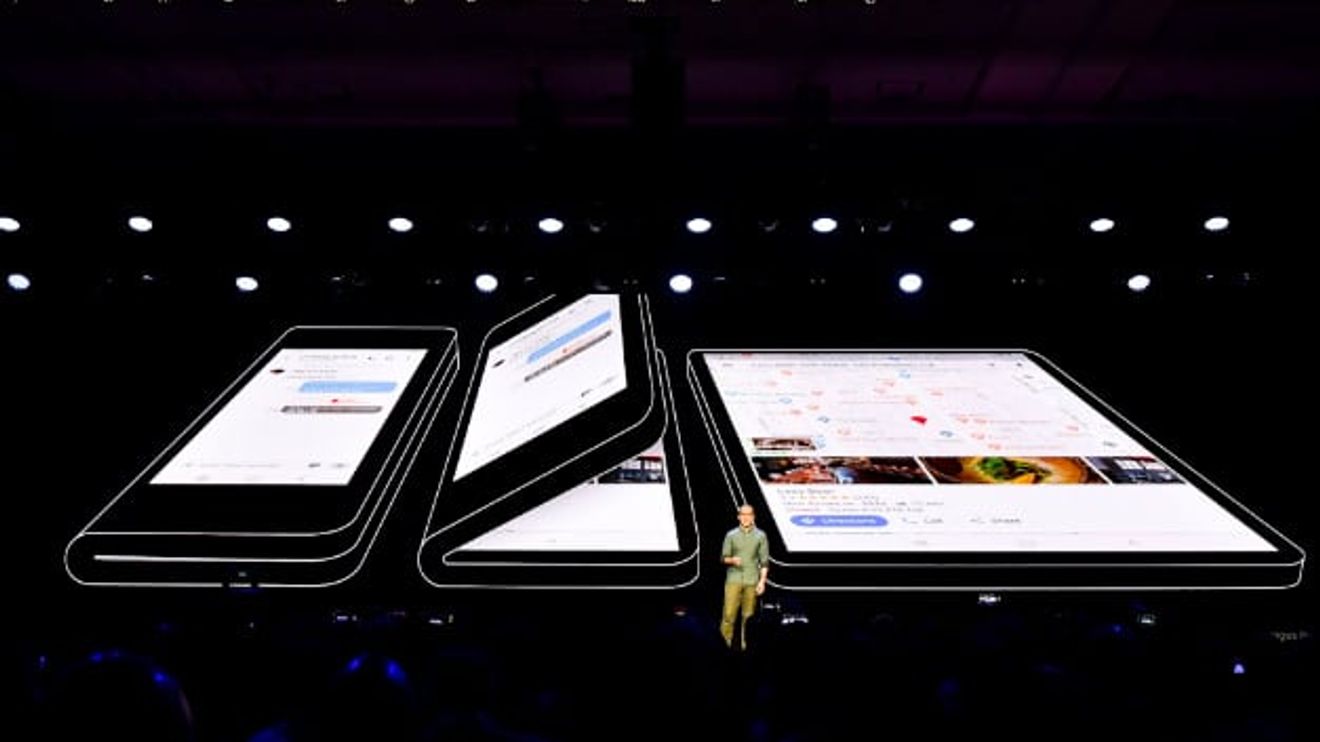
"The foldable cell phone opens up a new world," said Koh Dong-jin, President of the IT & Mobile Communications Division of Samsung Electronics at the 'Samsung Developers Conference' at the Moscone Center in San Francisco. "But we can't just wait and watch to see where technology will take us. That's why we're offering developers a new platform to realize their ideas." So it's not just about the new foldable smartphone with a flexible display, called the 'Infinity Flex Display'.
Incidentally, the Chinese start-up Royole was the first company in the world to present such a device five days earlier.
Samsung made it clear at its Developers Conference that it was not about announcing hardware a few days earlier or later. It was not the company's intention to focus on the new 'Infinity Flex Display' - as interesting as it is in itself.
The topic of AI is much more important
Much more important to Samsung is the topic of AI and how the technology can be used for the benefit of end customers. The hardware - such as the new foldable smartphone - plays an important role here, but not the main one. That role belongs to the voice-activated AI platform 'Bixby', which is an extension of the IoT platform 'Smart Things', and the new 'One UI'.
'One UI' is specially tailored to the new foldable smartphone: it is an intuitive interface that ultimately allows it to show its potential in everyday use, only then can the 'Infinity Flex Display' do more than a conventional smartphone: the "One UI" user interface ensures that both halves of the screen - once folded together - can each display different content and that they can be used as separate screens. This allows the owner to continue using it with one hand, as they are used to with conventional smartphones. When unfolded to full size, the display adapts seamlessly, different functions can continue to run in parallel and the size of the content displayed on the screen adjusts automatically.
The screen itself, the 'Infinity Flex Display', is an AMOLED that is coated with a flexible material instead of glass so that, according to Samsung, the display can survive tens of thousands of folds. Samsung plans to launch the 'Infinity Flex Display' and 'One UI' in January after testing it on the Galaxy S9, S9+ and Note 9 smartphones in Korea and the US.
How Samsung integrates the 'Infinity Flex Display' into the IoT world
'Bixby' was originally created as an intelligent interface to control the smartphone by voice. Samsung has now expanded the system into the 'Bixby Developer Studio'. This environment is designed to allow developers to bring intelligence to their devices and services. They can create 'Bixby Capsules', i.e. run functions and services on the devices that users can easily access via the 'Bixby Marketplace'. The 'Bixby Capsules' can be adapted from smartphones to televisions and other devices in the home that are part of the Samsung ecosystem. To make life easier for developers in Europe, Samsung will offer the 'Bixby Developer Studio' in British English, French, German, Italian and Spanish.
Samsung wants to network the many "things" on one platform via the IoT platform 'SmartThings' - Samsung calls it an open IoT ecosystem. The company has added new tools to the 'SmartThings Developer Workspace'. These include 'Cloud Connector', 'SmartThings Device Kit' and 'SmartThings Hub Connector'. New devices and services can be set up here and devices connected via ZigBee and Z-Wave, for example, can also be integrated. The 'Works with SmartThings' (WWST) certification program allows developers to work with SmartThings experts. ""We are proud of our truly significant progress in the fields of IoT and AI. This is the only way we can actually make our vision of connected life a reality," said Koh. "With Bixby and SmartThings, we are opening a new chapter: developers can now integrate third-party devices and services into the IoT and AI platforms and scale them to their needs."


You might also be interested in
Edge AI HPCs for Vision AI and GenAI
Advantech has announced the 'AIR-410' and 'AIR-420', next-generation compact Edge AI high performance computers (HPCs). Combining AMD Ryzen 7000/8000/9000 series processors, scalable GPU support and Advantech's 'Edge AI SDK' software, the systems...
 read more...
Siemens presents technologies to accelerate industrial AI
At CES, Siemens presented technologies to accelerate industrial AI: new digital twins, AI co-pilots, an Industrial AI Operating System and applications in manufacturing, energy and life sciences.
read more...Hitachi takes over Synvert
Hitachi Group has signed an agreement to acquire Synvert, a Germany-based company, as a wholly owned subsidiary of its US subsidiary GlobalLogic from Maxburg, a private equity fund focused on founder-led technology companies in the German-speaking...
read more...Proalpha takes over Insiders Technologies
The Proalpha Group, provider of business applications for SMEs, acquires Insiders Technologies and significantly expands its 'Industrial AI Platform' with AI applications and services for digital document processing.
read more...Industrial AI at SPS | Endress+Hauser
"AI will become a natural functional component"
Industrial AI is also becoming increasingly relevant in process automation: although field devices themselves still make little use of it, it is already proving helpful in evaluation and peripheral devices as well as control systems. Christian...
read more..."People always remain at the center"
Sick now considers artificial intelligence to be a central component of industrial applications. Phil Krumbein, Market Product Manager Logistic Solutions at Sick in Düsseldorf, reveals exactly where the company relies on AI.
read more...How AI and the cloud are challenging sustainability
The rapid rise of artificial intelligence is driving up the energy consumption of data centers and jeopardizing global sustainability goals. Schneider Electric presents six practical solutions to meet the new requirements.
read more...Critical Manufacturing takes over Convanit
Critical Manufacturing, a provider of Manufacturing Execution Systems (MES) solutions, has announced the acquisition of Convanit - an artificial intelligence company specializing in image-based analytics in high-tech manufacturing.
read more...Technical University of Munich
AI chip developed for decentralized use without the cloud
A new type of AI chip developed at the Technical University of Munich (TUM) works without the otherwise necessary connection to the internet or cloud servers. The 'AI Pro' chip is modeled on the human brain. Its neuromorphic architecture helps it to...
read more...