
Wearables
Smartwatches for production
Business focus, robustness, interoperability, flexibility, ease of maintenance and scalability: with these requirements in mind, smartwatch concepts can also be transferred to manufacturing.
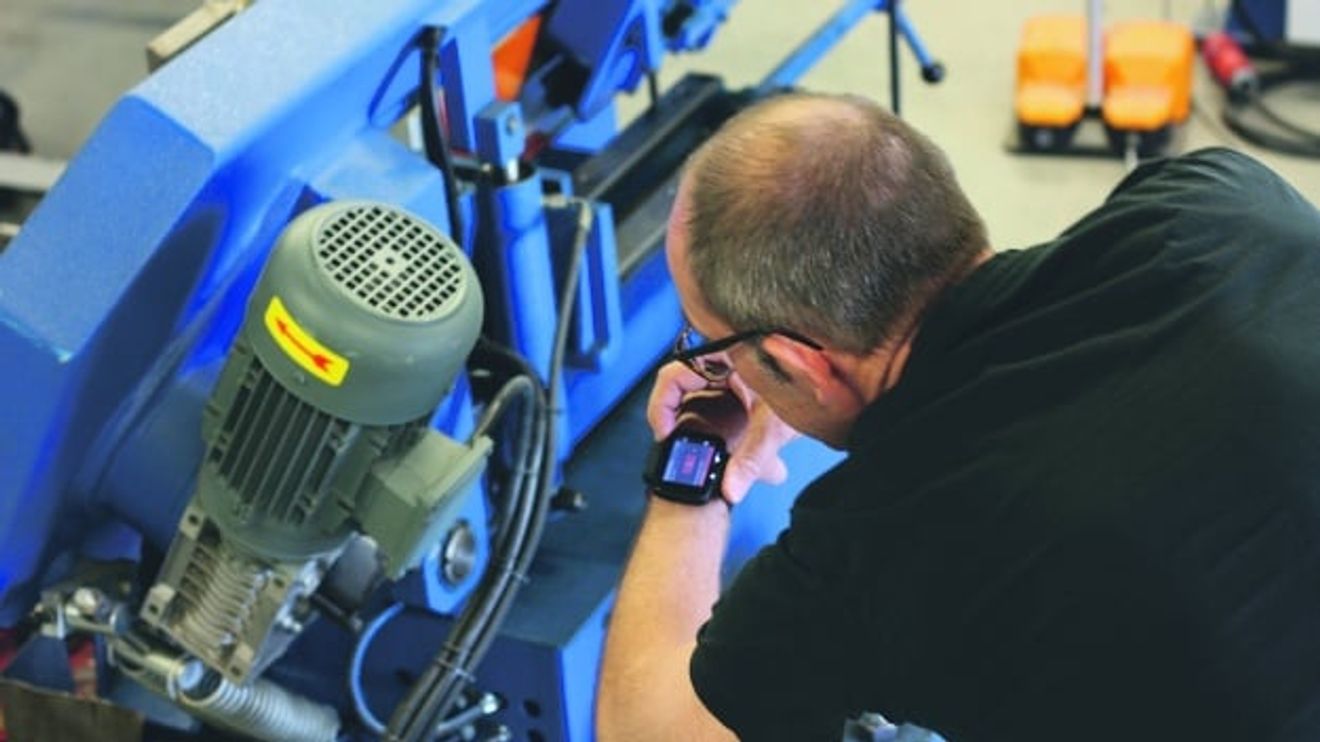
Manual workflows in production are often paper-heavy, time-consuming and inefficient. The existing IT systems do not support employees optimally, and existing IT applications are sometimes cumbersome and complicated to use. In contrast, there are innovations from the consumer world: smartphones, tablets and smartwatches have revolutionized the use of computers and offer simple solutions for a wide range of tasks with apps. It is therefore not surprising that many companies are currently launching projects to use mobile devices to drive forward the digital transformation of their operational processes. The core idea is that employees receive the information they need from various systems via apps on their mobile devices in real time and depending on the situation.
However, if the use of apps is to be successful, the special requirements of the industrial environment must be taken into account when selecting mobile devices. Only a few solutions available on the market support the requirements for efficient use in industry: business focus, robustness, interoperability, flexibility, ease of maintenance and scalability. These core features are now presented using the example of the Workerbase smartwatch, which was specially designed for industrial purposes.
Business focus
Top priority and actually a matter of course: the use of mobile devices must be at the service of the business and deliver added value. Instead of trying out technical gimmicks and chasing after trends such as virtual reality, the focus should be on real business processes. Because when used correctly, mobile devices can solve specific existing problems. One example: In the event of machine downtime, service technicians can be efficiently alerted via smartwatches. Notifications can be enriched with additional information such as the position of the production machine, error message and required spare parts and only forwarded to service technicians in the immediate vicinity of the machine. This reduces distances, increases response times and ultimately reduces machine downtime.
When selecting devices, it is important that functionalities for the efficient execution of work processes, such as barcode readers, cameras or NFC tags, are integrated. The Workerbase Smartwatch offers a built-in barcode scanner and an 8 megapixel camera so that service technicians can read machine information via barcode in the event of a fault and create photo documentation of machine defects. All the functions required to carry out the work are thus combined in a highly integrated device, thereby increasing the efficiency of the processes.
Robustness
The harsh conditions of the industrial world require special devices. Smartphones and tablets can be prepared for use on the store floor with protective covers. Even better is the use of mobile computers specially manufactured for industrial use. If these sometimes rather clunky handheld PCs are too unwieldy for certain work processes, industrial smartwatches can be used. The Workerbase Smartwatch offers a good compromise between robustness and wearing comfort with a stable 2-inch display, physical buttons for operation with gloves and interchangeable wristbands.
Interoperability
The use of apps on mobile devices must be well planned if niche solutions are to be avoided. Only when apps work together with existing systems can truly useful solutions be realized. It must be possible to process data from existing business applications in the apps and to write the data generated by apps back into the existing systems.
The Workerbase platform is designed for interoperability with existing systems and devices: This allows business applications such as ERP and MES systems to be integrated via connectors. Existing hardware can also be connected via Bluetooth - such as RFID readers or scales.
For applications that require a large display, the smartwatch offers tablet-based apps. These are suitable, for example, for displaying PDF sketches or terminals for ordering material replenishment. The connection to other systems is also crucial for order picking applications. For example, picking lists from SAP systems can be displayed on the smartwatch. Employees can use the integrated barcode scanner to pick parts, confirm actions on the watch screen and write the information back to SAP via an interface.
Flexibility
Standing still means going backwards. Following this credo, a key feature of lean management is the continuous improvement process, which strengthens the company's competitiveness through constant improvements in small steps. If this way of thinking is applied to the use of apps, options must be created to adapt the apps to changing processes as easily as possible. Ideally, employees who are not IT experts should also be able to make such adjustments without programming.
The Workerbase system allows apps to be adapted without programming. To do this, work steps can be configured in the web browser and linked together with flexible rules. If a production step changes, the user can adapt a corresponding smartwatch app within minutes. For example, checklists for quality management can be very easily implemented as a smartwatch app. When new values are recorded, the corresponding fields can simply be added to the app via a web browser.
Ease of maintenance
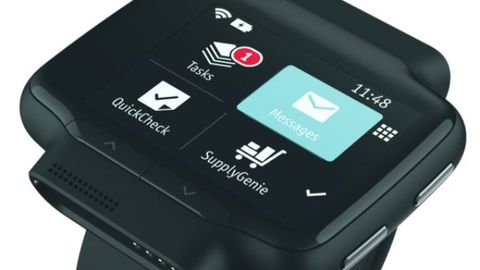
The Workerbase smartwatch is designed for industrial applications. With a Qualcomm Snapdragon 212 chipset, the device has 1 GB of RAM.
© WorkerbaseWhen planning the use of mobile devices, it is important to consider operational and support processes from the outset. There are numerous device management solutions available on the market that offer simple management of users and devices. This includes functionalities such as creating and deleting users, battery management or updating apps via WLAN.
Regulatory requirements, such as those arising from the European General Data Protection Regulation (EU GDPR), must also be taken into account.
The platform combines administrative functions for user, role and device management in one administration console. All apps can be managed and updated centrally, while the built-in device management creates transparency about the distributed smartwatches and their battery and software status.
Scalability
When using mobile apps, it is important to ensure that the underlying IT architecture is designed to be powerful and flexible. Especially when apps are integrated into existing production systems and data is read from existing machines and sensors, a modern system architecture is extremely important. This is why the Workerbase platform is based on a powerful event-based system architecture that also supports a very high number of devices and users. Users can connect data from existing production systems via common machine protocols such as OPC UA or MQTT. The platform can be installed in secure cloud environments or on-premise and grows with the requirements of the business.
Iterative approach
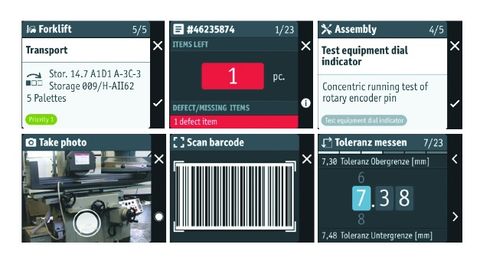
Various functions can be executed and applications displayed on the 2.0-inch QVGA multi-touch display.
© WorkerbaseDigitalization can only succeed if the needs of human workers are taken into account. People in industry will continue to be in demand in the future - only the type and organization of human work will change. In order to successfully follow this path, adjustments must be made: Ideally, we should start with what already exists and gradually introduce new solution patterns. Not according to a master plan defined from the outset, but according to an iterative 'build-measure-learn' approach. The digital transformation requires continuous adaptation to new requirements. The aim is to make production processes more flexible and to enable new business models and product innovations, such as batch size 1.
Modern platforms support the digital transformation: people are integrated into industrial processes in the best possible way via mobile devices. Cloud-based platforms increase the flexibility of production processes by allowing workflows to be adapted quickly and easily without the need for programming. Digitalization does not have to be introduced 'according to a master plan'; instead, applications need to be introduced step by step, app by app, using lightweight pilot projects. For a successful introduction of mobile devices, it is advisable to consider the system characteristics of business focus, robustness, interoperability, flexibility, ease of maintenance and scalability.
Author:
Thorsten Krüger is Co-Founder at Workerbase.


You might also be interested in
Double security through redundancy
The 'Safety Key' from Hy-Line allows the simple integration of safety-relevant switches in glass displays.
 read more...
Operation via touch, glove, pen or digitizer
Getac launches the next generation of 'F110' and 'K120' tablets: The new F110 is suitable for use in a variety of harsh outdoor and indoor scenarios.
read more...Flexible visualization
'Prime Panel Touch' and 'Prime Panel Extend' from Schubert System Elektronik (SSE) are suitable for sophisticated visualization concepts in industry.
read more...Support arm panel expands portfolio
The 'TT 1564' multi-touch operating panel for mounting arm installation extends the Sigmatek range.
read more...Managing Board expanded
Kontron expands its Management Board with Philipp Schulz and Dr. Johannes Fues. As COO, Schulz will be responsible for the Aerospace and North America business units, while Dr. Fues will assume the position of COO for the GreenTec business unit.
read more...Tablet for the Ex area
With the 'Pad-Ex 01 P12', Pepperl+Fuchs is launching a new tablet for professional use in potentially explosive atmospheres in Zone 2/22, Division 2.
read more...Modular embedded touch HMI
Irlbacher, provider of free-form touch solutions, has a new solution kit for modular embedded HMIs.
read more...Control elements that can be used for security
The control element PIToe ETH with activatable Ethernet port from Pilz protects freely accessible Ethernet interfaces in industry against unauthorized access.
read more...Control panel series updated
Kontron has developed a new generation of its Control Panels which, thanks to the more powerful Arm NXP i.MX8M Plus processors, provide a significant performance boost compared to previous models.
read more...