
MGA
Operation via voice
The Würzburg-based company MGA Ingenieurdienstleistungen sees a gap in the market for user-friendly voice control of industrial machinery. Managing Director Lorenz Arnold explains the motivation and background to his project.
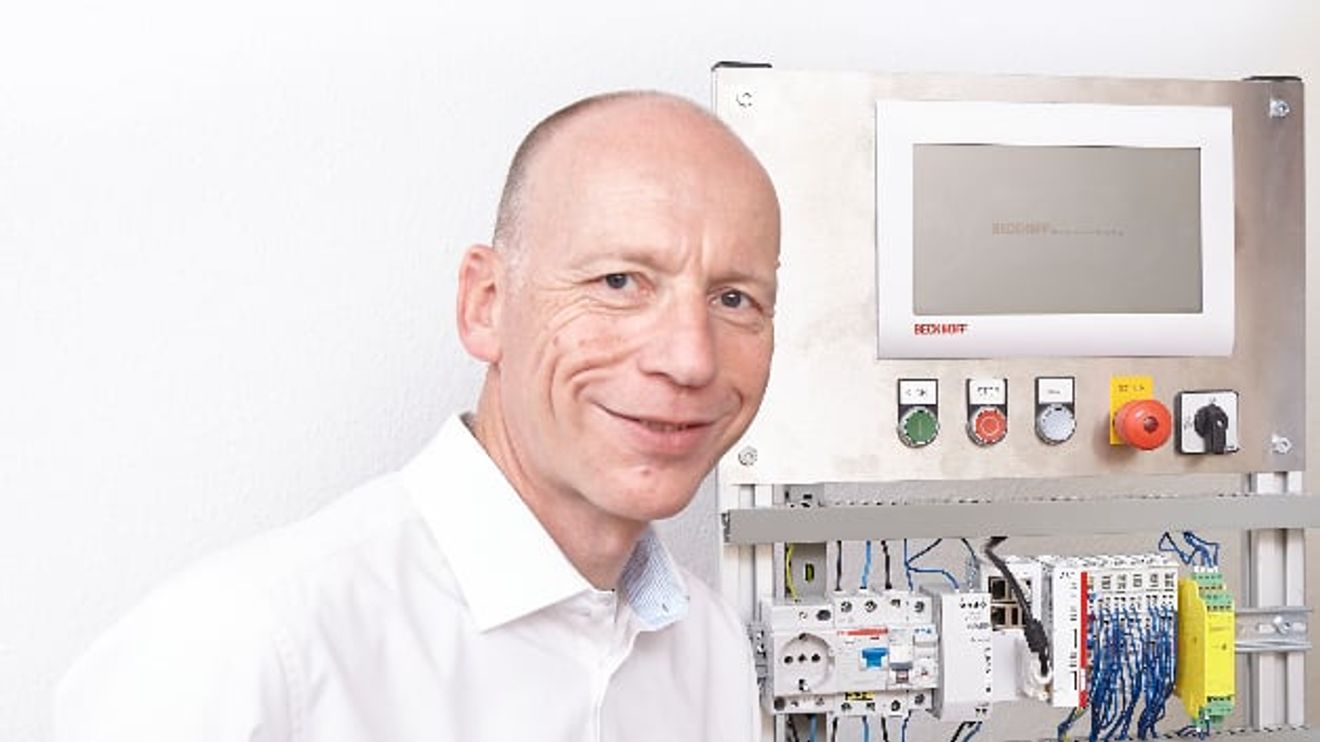
Mr. Arnold, you and your team are developing a voice input system for machines. Why is that?
Lorenz Arnold: On the one hand, we can see the concrete factual arguments for voice control: wherever the operator is either working with dirty hands or - on the contrary - special hygiene and cleanliness requirements are necessary, not having to touch anything is an unbeatable advantage.
But I also believe in a completely different development: we are all already used to being able to operate our cell phones or cars by voice. I am quite sure that operators will demand from their employers that they will also be able to operate the comparatively expensive machine at their workplace by voice. If employers meet this demand, they will stand out as innovative employers who offer their employees a state-of-the-art technical working environment.
This consideration was decisive for me to start the development project at MGA.
How can I imagine the system in concrete terms?
Imagine, for example, a packaging machine that packs toothpaste tubes into folding boxes. Up to now, you have had a touch panel in the control cabinet for operation. In future, you will find a microphone integrated into the control cabinet and a loudspeaker right next to it. You can use this to give commands to the control system and have information such as error messages displayed verbally. This will always be done in conjunction with the touch panel, on which the spoken word is displayed in parallel. You can also switch between touch panel and voice control at any time. We believe that this is particularly important in order to overcome any reservations that users may initially have.
What are the advantages of such a voice input system?
There are a number of them: firstly, it prevents contamination from being carried over. This can be important for the quality of the product that is produced on the machine, as well as for hygiene! Certainly an interesting argument in times of Covid-19!
Secondly, it can boost productivity because the employee can do something with their hands and operate the machine at the same time. And finally, of course, it's a convenience feature.
Which sectors are you primarily targeting?
The solution we are developing should be usable across all industries and be on a par with a touch panel in terms of cost. We want to make voice input possible across the board. Because let's be honest: niche solutions already exist, such as pick-by-voice systems in the order picking sector. However, these are very complex and usually require an additional PC, for example. We want to get away from that. Everything should be integrated into the machine control system.
How do you handle the issue of safety in your solution?
In a nutshell: safety comes before convenience! This means that the existing solutions will be retained for operation, i.e. the physical actuation of buttons and switches. However, additional acoustic instructions and warnings are possible and planned.
And what about dialects, accents and speech coloration or even the issue of mouth-to-nose coverage?
Our concept is to offer various language libraries for the system. The intelligibility of speech can be achieved using microphone technology, i.e. with the help of functions such as background noise suppression. This is then a customized development for the individual application. But of course, such a system can always be tricked if someone wants to. But we assume that the operator will welcome this.
Where do you see the biggest challenges in development?
Functionally, we have to ensure above all that background noise does not have a disruptive effect. Incidentally, this point is the only real reservation expressed by the potential customers we interviewed.
In terms of design, we are aiming for a solution that does not require any additional control hardware, i.e. a pure software solution. This is much easier to implement with IPCs than with the classic PLC.
And what does your roadmap look like?
Our prototype is already in the laboratory in the sense that all the basic functions are in place.
In the coming months, it will now be a matter of fine-tuning the functions. Then, in the fourth quarter, we want to get the solution ready for series production. We will start with an application for an IPC from one of the well-known manufacturers. Ultimately, we want to be able to offer an 'out of the box' solution for 80% of the PLCs and IPCs installed on the market. This is a goal that we want to achieve in 2021.


You might also be interested in
Remote Assist supports operators
With the Remote Assist software application, Optima can support operating personnel in solving problems via live video and audio transmission.
 read more...
Exclusive interview on the Digital Days
"New paths for hybrid formats"
After the Hannover Messe had to be postponed and ultimately canceled due to the coronavirus pandemic, the digital version will take place shortly. Arno Reich, Business Unit Director Industry, Energy & Logistics of the organizer Deutsche Messe,...
read more...The Industry 4.0 hype - an opportunity?
The number of successful Industry 4.0 implementations is still relatively small. Why is it that the industrial revolution that was touted years ago is not really making progress?
read more...Bus-compatible operating modules for mobile machines
For decentralized machine operation, Griessbach offers bus-capable input units with its CAN modules, which can be integrated into the control network with little assembly and installation effort.
read more...Visualization via app
With the industrialPhysics app from Machineering, which is available via iTunes, simulation models created on the desktop can also be transferred to handheld devices.
read more...The modular HMI concept
Customize HMIs according to your needs! A modular system for glass, display and touch sensor from the drawer should make this possible for machine builders.
read more...New Managing Director at Bachmann electronic
Bachmann electronic has appointed Daniel Pfeifer as its new Managing Director with effect from January 1, 2026. He succeeds Bernhard Zangerl, who will be leaving the company.
read more...Dual leadership in Shanghai
Stefan Becker has been appointed Managing Director of Eckelmann Automation Technology in Shanghai and will manage the subsidiary together with Zhongwei Huang.
read more...Secure data management in the cloud
Bachmann presents new functions of the platform-independent visualization solution 'atvise': Thanks to container operation and a consistent client concept, the solution can now also be used securely as a higher-level IoT (Internet of Things) service.
read more...