
Autonomous driving
Creating trust with virtual eyes
Creating trust in autonomous vehicles with virtual eyes: This is the aim of a new Jaguar Land Rover research project. Self-driving driving cocoons - known as pods - are equipped with large displays that look and behave like eyes.
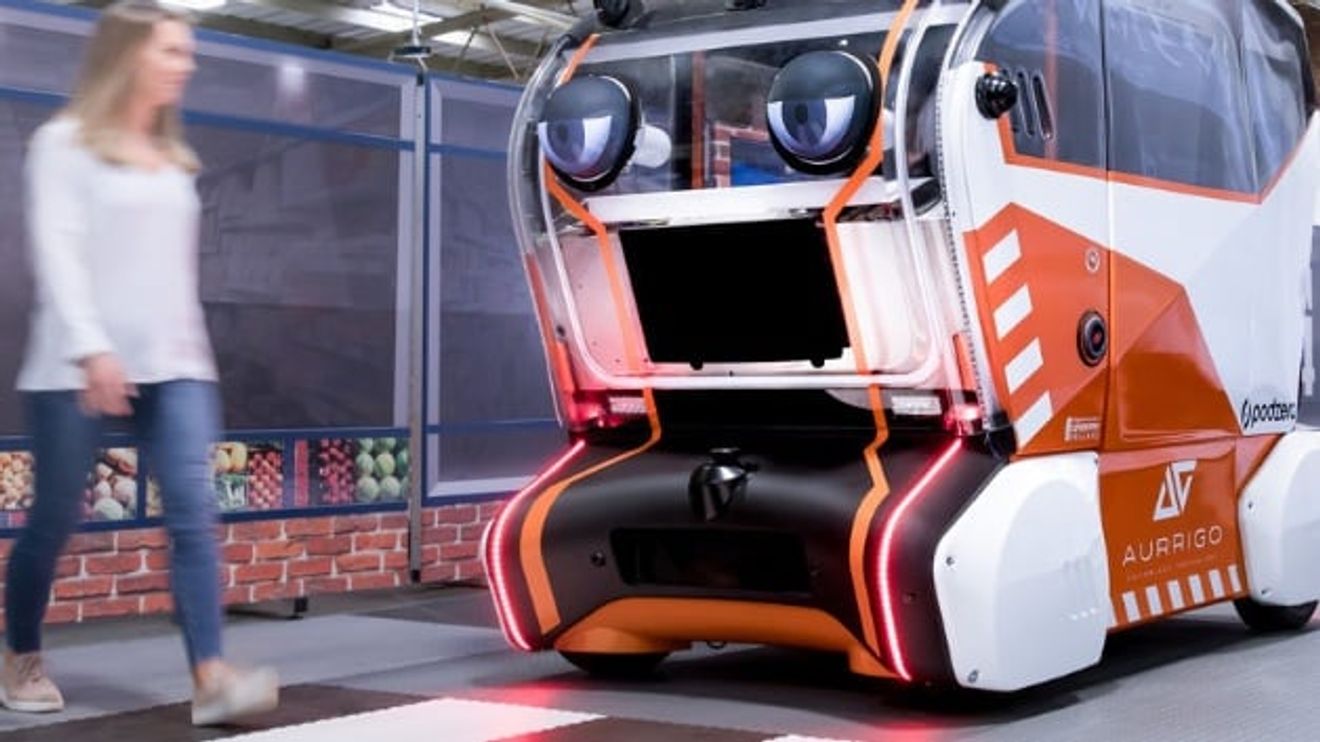
Studies have shown that 63% of pedestrians are concerned about whether they will be able to cross the road safely in the future. It is therefore important to research whether and how people's confidence in self-driving cars can be increased. Cognitive psychologists provide valuable insights into how the behavior of the vehicles influences the degree of human trust in the new technology.
One possible tool in this context is virtual eyes. They ensure that the self-driving pods have a kind of friendly face. This is because pedestrians usually make eye contact with the driver of an approaching car before entering the road. The virtual eyes can be used to find out how much information future autonomous vehicles will have to share with their users and pedestrians in order for people to trust the technology.
As part of a research project, the intelligent pods move autonomously within a scenery modeled on the streetscape of Coventry, so that the behavior of pedestrians crossing the street can be analyzed realistically. Development engineers from Jaguar Land Rover's Future Mobility department developed the virtual eyes. The pods use them to recognize pedestrians and then appear to look directly at them. This signals to the pedestrian that they have been registered by the vehicle and that the technology is responding accordingly.
The engineers measure the confidence level before and after the pod has made eye contact. This shows whether the vehicle has built up enough trust for the pedestrian to believe it will stop.
As part of the research project, the interaction with the self-driving pods, which were produced by Aurrigo, a Jaguar Land Rover partner in the UK Autodrive consortium, was examined in more than 500 test subjects.


You might also be interested in
Autonomous trucks in everyday operation on the A9
Autonomous trucks from DB subsidiary Schenker are currently on the A9 highway between Munich and Nuremberg with loads. Federal Transport Minister Andreas Scheuer is convinced that this will make transportation safer, more efficient and more...
 read more...
In-wheel drive for autonomous car 'Orbit'
The electric and autonomous shuttle 'Orbit' from car manufacturer Fisker Automotive will be equipped with the in-wheel eDrive technology 'ProteanDrive'. The drive technology can be easily integrated into the vehicle and allows for more space in the...
read more...Thermal images guide autonomous robot 'Anymal'
When autonomous robots such as 'Anymal' help to search for casualties in rough terrain, thermography is almost indispensable.
read more...California allows autonomous cars without a steering wheel
In California, self-driving cars without a steering wheel and pedals will be allowed on the road from April 2018. The US state's transportation authority has now overturned the previous requirement that a human safety driver must always be at the...
read more...MTCON and Sensor-Technik Wiedemann combine expertise
MTConnectivity power2pcb (MTCON) has a new shareholder: Sensor-Technik Wiedemann (STW) has held a stake in the power element manufacturer since the end of 2019.
read more...Electromobility / green electricity
Intelligent charging saves fossil fuels
Charging electric cars can overload the electricity grid and lead to fossil fuel power plants having to step in. This is unnecessary and leads to high costs for grid operators. BMW and Tennet want to change this.
read more...Service robotics at Conrad Electronic
Sales robots in use around the clock
To provide its customers with a 24/7 shopping experience in Berlin Schöneberg, Conrad Electronic has now deployed a sales robot. The robot 'Alex' is designed to provide a high-tech shopping experience. It comes from the manufacturer pi4_robotics.
read more...Ridesharing field test in Paris
Renault tests Zoe as a robo-taxi
Renault launches a ridesharing field trial in Paris with two autonomous Zoe robo-taxis. The two prototypes have been specially modified. In addition to the technology for automated driving, they have a modified interior with multimedia and on-board...
read more...Robots for the hospital of the future
ABB has opened its first global Health Care Hub dedicated specifically to healthcare research on the campus of the Texas Medical Center (TMC) in Houston, Texas. A number of technology concepts were presented at the opening, including a mobile YuMi...
read more...