
Cebit 2018 / Mixed reality solution
Walking naturally between worlds
In future, users of virtual reality (VR) will be able to interact with each other even more easily, naturally and in real time between real and virtual worlds. The Fraunhofer Heinrich Hertz Institute presented a new X-Reality technology that makes this possible at Cebit 2018.
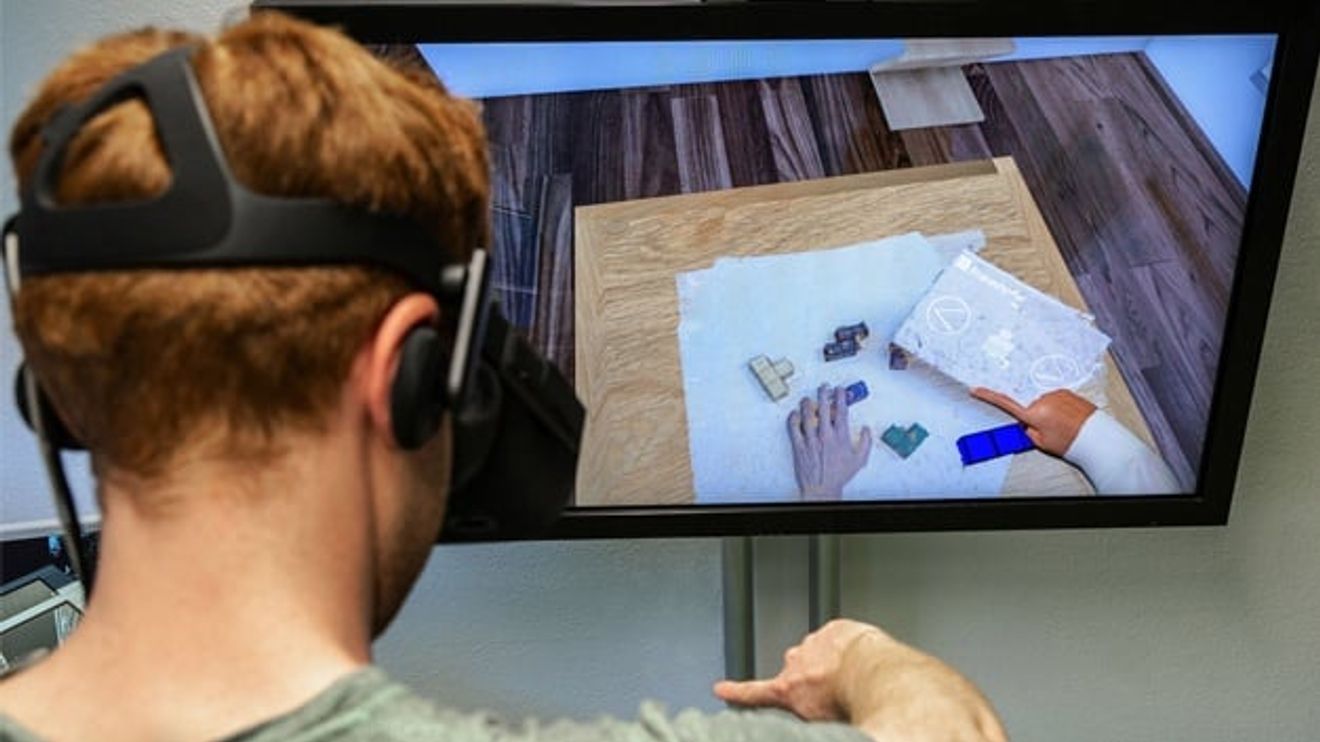
The mixed reality process presented is based on two technologies: in the real world, eight cameras, four pairs each, capture the scene from all sides and generate depth maps of it at up to 30 hertz. Gestures and dynamic movements are also recognized. This data is then summarized by algorithms, encoded and transmitted to the VR station in real time with the corresponding 3D textures.
In the virtual scenario, on the other hand, another 3D camera records the VR user. Thanks to the Fraunhofer HHI algorithms for 3D body detection and gesture interpretation, the user can interact naturally in the VR scene without any interfering controllers or markers. He is represented there as a moving full-body avatar, so to speak, and sees his own body and gestures in virtual space. "Only the combination of the two technologies enables a unique solution for new mixed reality interaction and collaboration scenarios," says Paul Chojecki, project manager at the Fraunhofer Heinrich Hertz Institute (HHI).
The feedback from the virtual world is displayed in the real scene by means of a projection. Special image processing algorithms, also from the Fraunhofer HHI, are used for this projected augmentation. These ensure that the information and control elements are displayed correctly, even if the surfaces onto which they are projected move or are tilted. The fields of application for the X-Reality solution are diverse: in addition to remote assistance, the process can be used in rapid prototyping, human-robot interaction and telecommunications or in telepresence and gaming sessions. For example, two physically separated people can play a board game together.
At the Fraunhofer stand at Cebit, visitors were able to try their hand at a 3D puzzle and get help from the virtual world. In the demo, the real object was projected live into the VR environment and explained to the VR user. They can then react to it virtually and mirror these reactions back to the real situation.


You might also be interested in
Professional data glasses with USB-C interface
Epson took the opinions of its test customers into account when developing the 'BT-35E' data glasses. In addition to adjustable temples and a nose pad for spectacle wearers, a USB-C and HDMI interface for importing external data has been integrated.
 read more...
Audi tests 'Virtual Reality Holodeck'
Audi wants to use virtual reality to assess the designs of new cars and thus reduce the number of time-consuming physical test models. The technology also offers potential in production.
read more...Facebook announces cheaper VR glasses
Facebook is planning to boost its virtual reality business with an aggressive pricing policy. The online network wants to launch a cheaper version of its Oculus VR glasses, which do not require a PC, at the beginning of 2018 - for 199 US dollars...
read more...HP presents new VR portfolio
Hewlett Packard (HP) presents its unified approach and commercial solutions for virtual reality, including the world's first professional wearable VR PC.
read more...Siemens cooperates with Sony
Together with Sony, Siemens presented a solution at the CES that redefines the workflow of engineers and designers.
read more...Securely networked - even in the Ex zone
Seamless communication and fast data transfer are the guarantors of success for digital workflows in the smart factory. In order to benefit from the digital transformation in potentially explosive areas, lone workers need suitable mobile devices.
read more...followed up! - with Rainer Brehm, Siemens
An All Automation Society?
Industrial automation has experienced an enormous upswing in the last 25 years. But where exactly is automation today and where should or must it be in the future? Rainer Brehm takes a stand in this interview.
read more..."Unnecessary uncertainty for companies"
The EU institutions have agreed on the "Data Act", which regulates the use of collected data. The VDMA takes a critical view of the agreement.
read more...Group companies merged under one brand
At automatica 2023, the Hahn Group will be appearing for the first time with a new brand design and under a new name. This step will unite more than ten individual brands into a globally positioned automation company under one brand.
read more...