
VDMA
The global market for machines in 2019
Sales of machines and systems rose by 2% worldwide last year. But how exactly did the industry enter the coronavirus period? And more importantly, how will it start the period afterwards? The VDMA provides a current outlook.
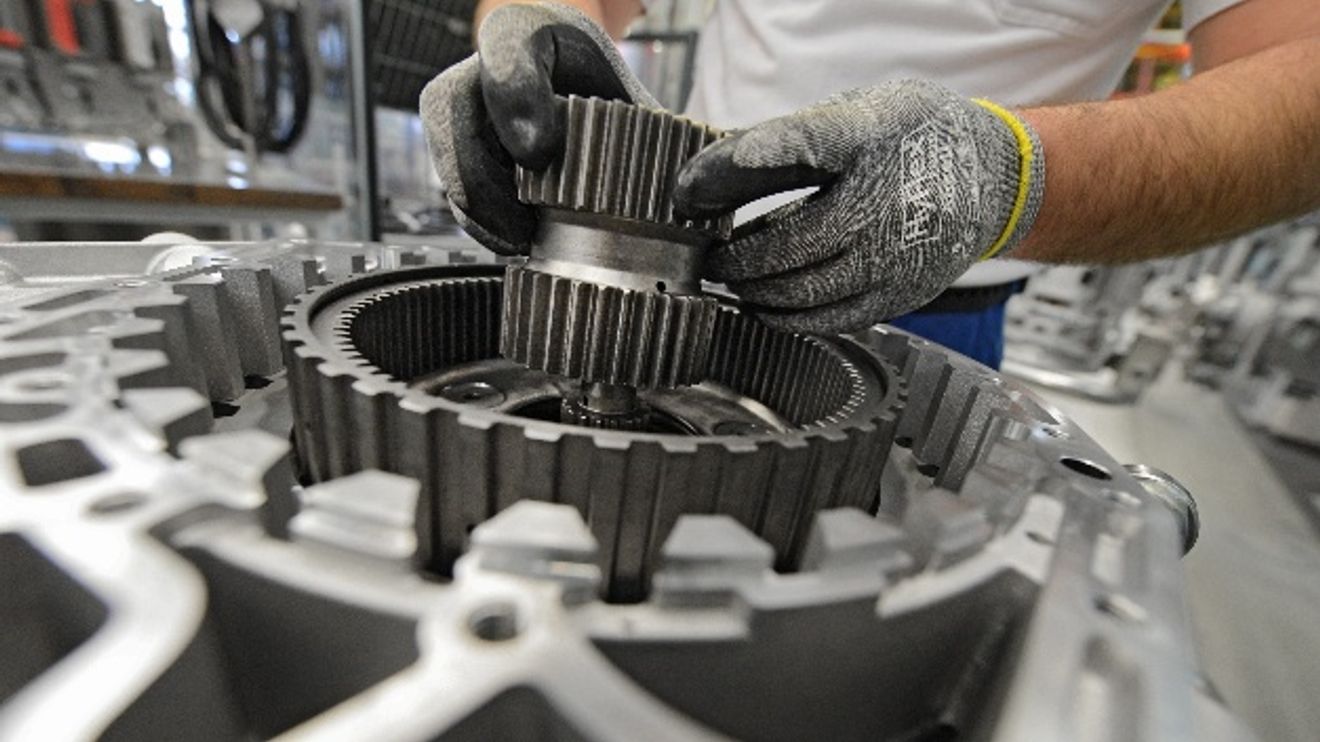
The changes in the automotive industry and the trade war between the USA and China already left their mark last year.
© Felix Kästle/dpaNew machines and systems were also in demand worldwide last year. However, business was already taking place under difficult conditions: The changes in the automotive industry, the trade war between the USA and China and the global rise in protectionism left their mark on the books. In some countries, machine sales already declined or stagnated last year. Where there were still comparatively high growth rates on a euro basis in 2019, major exchange rate changes were partly responsible. The coronavirus pandemic is now proving to be the next heavy burden for the mechanical and plant engineering sector. VDMA economists are assuming that there will be catch-up effects in the second half of 2020. "However, these will be nowhere near enough to compensate for the interim losses. Global machinery sales in 2020 will fall short of the previous year's result," predicts VDMA Chief Economist Dr. Ralph Wiechers.
Asia largest manufacturing region
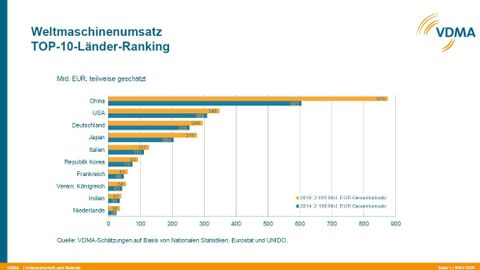
According to estimates by VDMA economists, sales of machinery rose by a nominal 2% overall in 2019 to almost EUR 2.67 trillion. At 1.37 trillion euros, Asia remained by far the largest manufacturing region in the machinery industry. The increase in turnover here also amounted to 2%, although this was a rather weak increase compared to previous years. The pace of growth in Europe and in the EU countries as a whole was lower than the global average, with growth of 1% in each case. Although the EU countries produced significantly fewer machines (768 billion euros) than Asia, they produced more than twice as many as the USA. However, the United States was able to increase its turnover significantly by almost 7 percent to 348 billion euros. "Last year was already challenging for many machine manufacturers. Now companies around the world are confronted with the coronavirus and the resulting burdens. 2020 will be a major challenge for everyone," commented VDMA Chief Economist Dr. Ralph Wiechers on the result.
Germany has held its position as the world's third-largest machine manufacturer since 2013. Last year, the sales volume of 296 billion euros fell 1 percent short of the previous year's record figure (300 billion euros). This means that Germany accounted for around 11 percent of global machinery sales.
China once again led the field by a clear margin. The country has held the title of the world's largest machine manufacturer since 2009, with total sales of 876 billion euros, an increase of 2 percent on the previous year in euro terms. In Japan (4th place), machine manufacturers were able to increase their turnover in euros by 5 percent to 264 billion euros. Italy, number 5 in global mechanical engineering, increased its turnover by 1 percent to 127 billion euros. As in the previous year, the top five countries in the ranking (China, USA, Germany, Japan, Italy) together account for 72 percent of global machinery sales. Exchange rate fluctuations had a significant impact on global sales figures. In 2019, the yen appreciated by an annual average of almost 7% against the euro and the US dollar by just over 5%. This means that the increase in turnover in both countries was lower in national currency than in the uniform euro perspective.


You might also be interested in
Interview with Hartmut Rauen, VDMA
"Germany remains the most important area for innovation and action"
Mechanical and plant engineering is Germany's job and innovation engine. In this interview, Hartmut Rauen talks about the VDMA's tasks in times of digitalization and which trends and technologies will provide a boost for the industry.
 read more...
The 'Subscription Economy'
The most significant economic trend of the current decade? Ownership is becoming a burden and more and more customers are paying for services on a subscription basis. The service subscription is thus becoming the central building block of the...
read more...Annual financial statements 2019 from...
Industrial IoT and charging infrastructure in focus
The Weidmüller Group recorded slight sales growth in the 2019 financial year. The connectivity company intends to increase its focus on the future markets of Industrial IoT and charging infrastructure for electric vehicles.
read more...Umati to become a global language
VDMA and VDW now want to promote the use and dissemination of OPC UA standards under the Umati brand for the entire mechanical engineering sector.
read more...Companies report supply chain disruptions
The VDMA used the spread of the coronavirus as an opportunity to conduct a flash survey. According to the survey, 60% of companies are experiencing initial supply chain disruptions. Production capacities are also being adjusted.
read more...VDMA calls for expanded package of measures
Structural change in the automotive industry, a weakening global economy, trade disputes and now the coronavirus pandemic are likely to lead to a 5% decline in production. The VDMA is therefore calling for swift action from politicians.
read more...Machinery exports continue to decline
German machinery exports are declining. According to the VDMA, exports fell by 1.5% in real terms. A further decline is likely in 2020.
read more...Robotics and automation slip into the red
The economy is now also having an impact on the robotics and automation industry: the VDMA expects sales to fall by 5% in 2019. The reasons can be found in the global economy, but also in saturation effects.
read more...Conrad continues Growth Course with new Management
Conrad Electronic is continuing its transformation from a traditional retailer to a B2B platform. The new managers Dr. Daniel Saga and Guy Dann strengthen the strategic focus on different customer segments.
read more...