

Endress+Hauser at the SPS 2024
Focus on decarbonization
For a climate-neutral future, the CCUS strategy (Carbon Capture, Utilization, and Storage) aims to capture and utilize or store CO₂ from fossil sources and industrial processes. Frederik Effenberger, Industry Manager for Decarbonization, explains the role of Endress+Hauser in this process.
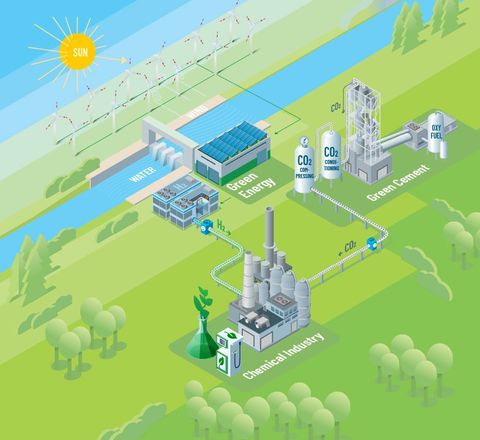
How does the first step of the CCUS strategy, direct CO₂ removal from the atmosphere, work, and what role does measurement technology play?
Two active technologies for CO₂ capture from industrial sources are relevant: Carbon Capture (CC) captures CO₂ before it‘s released into the atmosphere, preventing its harmful impact on the climate. Direct Air Capture (DAC) extracts CO₂ directly from the air. Once CO₂ is captured, it must be purified to remove impurities that could disrupt transport and storage, particularly to prevent corrosion in pipelines, which is caused by water, hydrogen sulfide, and oxygen. Regular analysis ensures CO₂ purity, avoiding corrosion and ice formation in pipelines. This is where precise measurement technology becomes crucial.
What solutions has Endress+Hauser developed for this process?
Their TDLAS and QF analyzers provide reliable real-time measurement and monitoring for CCUS applications. Additionally, their Netilion and Heartbeat Technology software solutions offer comprehensive monitoring and control capabilities.
What requirements must be considered during the transport of captured CO₂?
In pipelines, CO₂ behaves like a gas in viscosity but has the density of a liquid. Due to these unique thermophysical properties, controlling temperature and pressure in the pipeline is critical. Endress+Hauser has the expertise for complex CO₂ flow measurements, ensuring compliance with quantity and quality parameters. Their Coriolis mass flow meters are proven technologies for measuring dense-phase CO₂, and they also offer metering skids for precise measurement at transfer points.
Where is the CO₂ stored?
CO₂ is typically stored underground in deep, porous rock formations or beneath the sea, such as the sandstone layers in the North Sea. Frequently used storage sites include depleted oil and gas fields or saline aquifers. CO₂ is injected in a supercritical state, where it remains securely trapped under a dense caprock layer that prevents leaks. Continuous monitoring of storage sites is essential to minimize the risk of leaks.
How do you present this topic at the SPS?
At the SPS, Endress+Hauser showcases how their technologies reduce CO₂ emissions and advance renewable energy and emission-free processes. They present key technologies such as CCUS, Direct Air Capture (DAC), and hydrogen production and usage. The seamless integration of installed measurement devices is crucial for successful implementation.
Endress+Hauser at SPS 2024: Hall 7A, Booth 146


You might also be interested in
Philipp Gutmann takes over management
Since January 1, 2025, Philipp Gutmann has been the new Managing Director of the AMA Association for Sensors and Measurement, succeeding Thomas Simmons, who shaped the AMA Association for over 17 years.
 read more...
Strategic partnership begins
Sick and Endress+Hauser are putting their strategic partnership in the field of process automation into practice: Sick's gas analysis and flow measurement technology is now an integral part of Endress+Hauser's instrumentation portfolio.
read more...Simple torque and rotation angle measurement
The 'KiTorq 4552A' measuring flange from Kistler for applications in development and EOL test benches measures the efficiency of electric drives or pumps by recording not only the torque, but also the speed and angle of rotation of the motor to be...
read more...Change at the top of Endress+Hauser Level+Pressure
Dr. Helga Linnartz will take over as Managing Director of Endress+Hauser Level+Pressure on February 1, 2026, succeeding Dr. Dirk Mörmann, who died in an accident in 2025. The physicist brings many years of experience to the company.
read more...Nomination for sustainability award
Endress+Hauser is one of the three finalists for the German Sustainability Award (DNP) in the measurement and control technology sector.
read more...Keysight Expands Test Automation
Keysight is expanding its Eggplant test platform with the "Find by Description" feature. This feature identifies UI elements based on descriptions rather than screenshots, reducing the maintenance effort required for automated tests.
read more...Digital Panel-Mounted Instruments for Process Values
Optris is expanding its "CTi" series of infrared pyrometers to include EtherCAT and IO-Link communication interfaces.
read more...Higher Accuracy for Pressure Transmitter Series
Yokogawa introduces the "EJX S" series of pressure transmitters, featuring a silicon resonant sensor, ±0.025% accuracy, IP68 rating, SIL2 compliance, and support for HART and Profinet.
read more...EMC and radio testing in Germany and worldwide
In a world filled with smartphones, connected cars, medical devices and smart appliances, supporting optimal electromagnetic compatibility (EMC) and wireless performance to minimize interference between electronic products is critical.
read more...