

Kelvin/four-wire arrangement
Eliminate errors when determining the sensor resistance
A four-wire or Kelvin arrangement is used to eliminate the 'sensor lead' error variable when measuring the sensor resistance. This costs no more than two single conductors for reading the voltage via the sensor.
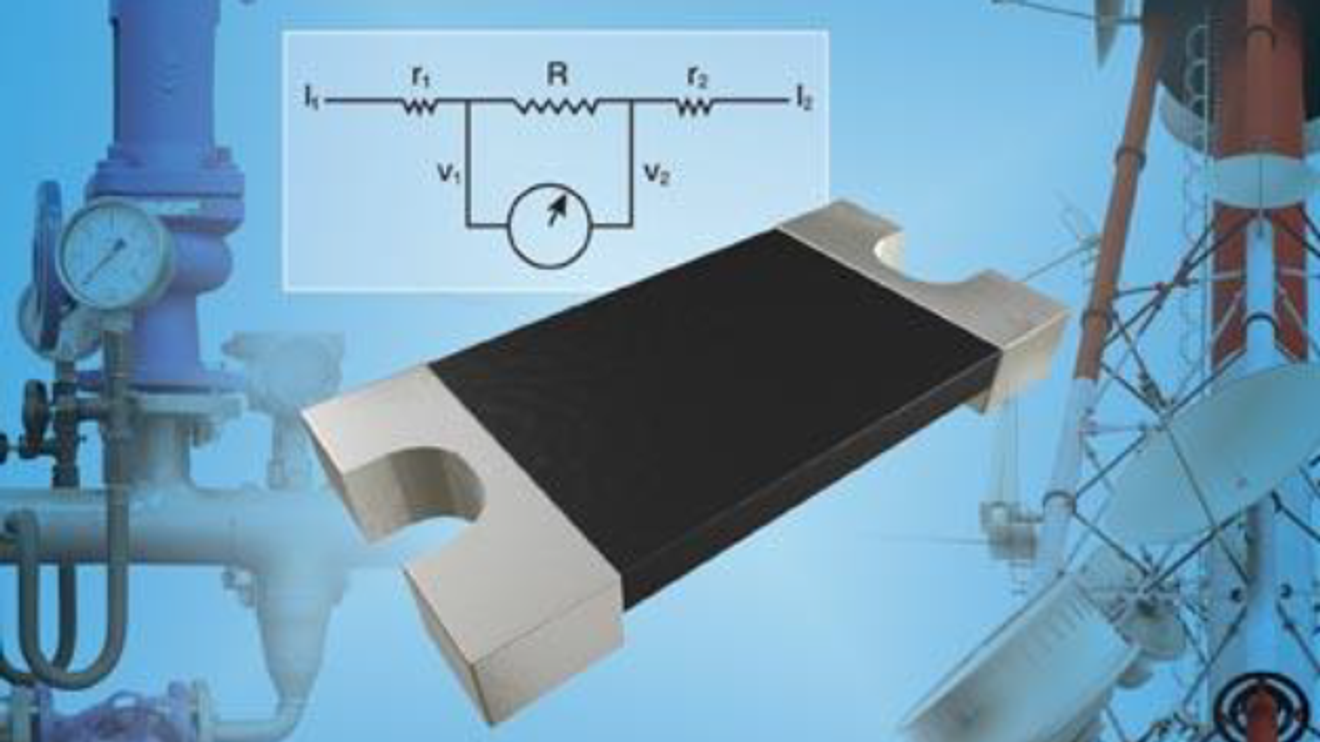
Chip resistor WSK1206R0100FEA with 0.01 Ω and 0.25 W in 3216 format for the connection of four conductors in current measurement applications
© VishayIf test devices are used to test products or calibrate systems, the change in resistance must often be determined by a low-resistance sensor many meters away. However, simply applying a known voltage across the thin-wire sensor cables, measuring the current and calculating the sensor resistance using Ohm's law (resistance = voltage/current (R = U/I)) does not work in this case. The nominal resistance and temperature coefficient of the sensor connections can distort the result considerably and cannot be calibrated out. However, the problem can be avoided.
Four-wire or Kelvin measurement as a solution

The falsification of the resistance measurement by the sensor leads can be prevented with a four-wire/Kelvin arrangement.
© Texas Components CorporationThe four-wire or Kelvin measurement is a widely used method for eliminating line-related errors when measuring the sensor resistance. For this purpose, the sensor is connected to a current source with a known current via the existing cable connections. Two additional conductors are then connected to the sensor to determine the voltage across the sensor using a high-impedance voltmeter or isolation amplifier. The known current and the measured voltage are inserted into Ohm's law - and that's it. With this four-wire arrangement and two additional simple voltage measurement wires, it is possible to avoid the resistance of the sensor connection wires being included in the equation.
Prevent self-heating of the sensor
In order to minimize the self-heating of the sensor and possible associated errors, the current should be as low as possible, but a sufficiently high voltage should be applied to the sensor. In most cases, the highest permissible voltage at the sensor is between 1 and 10 V.
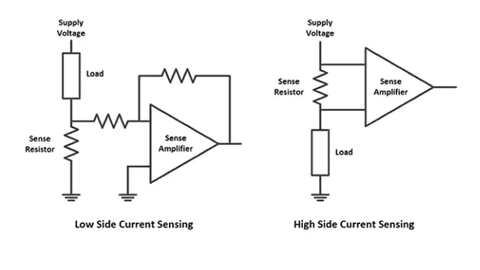
A variant of the Kelvin circuit is used to measure the current through a load, whereby a measuring resistor is connected between the load and earth (low-side) or the source and load (high-side).
© Digi-Key ElectronicsA variant of this technique is often used to measure the current of a load, for example a motor, where a 'low value' measuring resistor is connected in series with the load. A known resistor is used to measure load currents, usually in the order of 1 Ω or less, often in the mΩ range. Here, the voltage is measured using a differential isolation amplifier - which may need to be galvanically isolated from the rest of the circuit - and Ohm's law is applied again - this time in the version I = U/R.
Support components
During product testing or system calibration, the resistance value of a sensor often needs to be determined, so the tester needs to be aware of how the sensor's connecting leads can distort the measurements. This problem can be avoided with the four-wire/Kelvin method.

Chip resistor WSK1206R0100FEA with 0.01 Ω and 0.25 W in 3216 format for the connection of four conductors in current measurement applications
© VishaySometimes the challenge is simply to be able to connect all four conductors at all. This problem can be solved with special components, such as the Vishay WSK1206R0100FEA Dale chip resistor. The component in 3216 size with 0.01 Ω and 0.25 W is designed for the connection of four conductors in current measurement applications.
The author

Bill Schweber is an electrical engineer who has written three textbooks on electronic communication systems and hundreds of technical articles, commentaries and product descriptions.
Further information
Digi-Key: Fundamentals of Current Measurement: Part 3 - Funnel Amplifiers
Digi-Key: Reap the Benefits of RTD Temperature Sensors Without the Interface Complexity.


You might also be interested in
More than 340,000 new products
The distributor DigiKey added more than 340,000 new products to its product portfolio in the first half of the year. Around 90,000 of these are available for sale from stock.
 read more...
The e-paper of issue 1/2-2024
Distributors can help to master the three megatrends of electrification, automation and digitalization. The service providers explain how in this issue. Our new article series "ChatGPT in the industry" also starts in issue 1/2-2024.
read more...Interview with Eric Wendt, DigiKey
Everything on one platform
DigiKey continues to expand its offering in the field of automation technology. In this interview, Eric Wendt, Director Industrial Automation at DigiKey, talks about the background, the potential of the industry and the distributor's new services,...
read more...Interview with Eric Wendt, DigiKey
All on one platform
DigiKey continues to expand its offering in the field of automation technology. In this interview, Eric Wendt, Director Industrial Automation at DigiKey, talks about the background, the potential of automation industry and the distributor's new...
read more...DigiKey supports direct shipping within Europe
The distributor DigiKey now enables European suppliers to deliver directly to European customers via its marketplace program.
read more...DigiKey with a new brand identity
DigiKey has updated its brand system. The new logo and slogan are intended to reflect the evolution of the distributor, among other things.
read more...The e-paper of the January issue
Computer&Automation turns 25 this year! Throughout the year, we will be looking back at exciting aspects: What has happened in 25 years? What changes has the industry undergone? Until then, enjoy reading our first issue in 2023.
read more...New video series "Revolutionizing Automation"
Digi-Key presents "Revolutionizing Automation", a new video series about modern automation and control technologies.
read more...Energy supply for production lines
Developers of production lines are always on the lookout for reliable and energy-efficient power supplies. The aim is to meet all requirements without breaking the budget. This is where DIN rail power supply units come into play.
read more...