
Industrial Analytics
The will is there!
Industrial companies are aware of the relevance of data analysis - but there is a lack of implementation. This is the conclusion of a study conducted on behalf of the Digital Analytics Association.
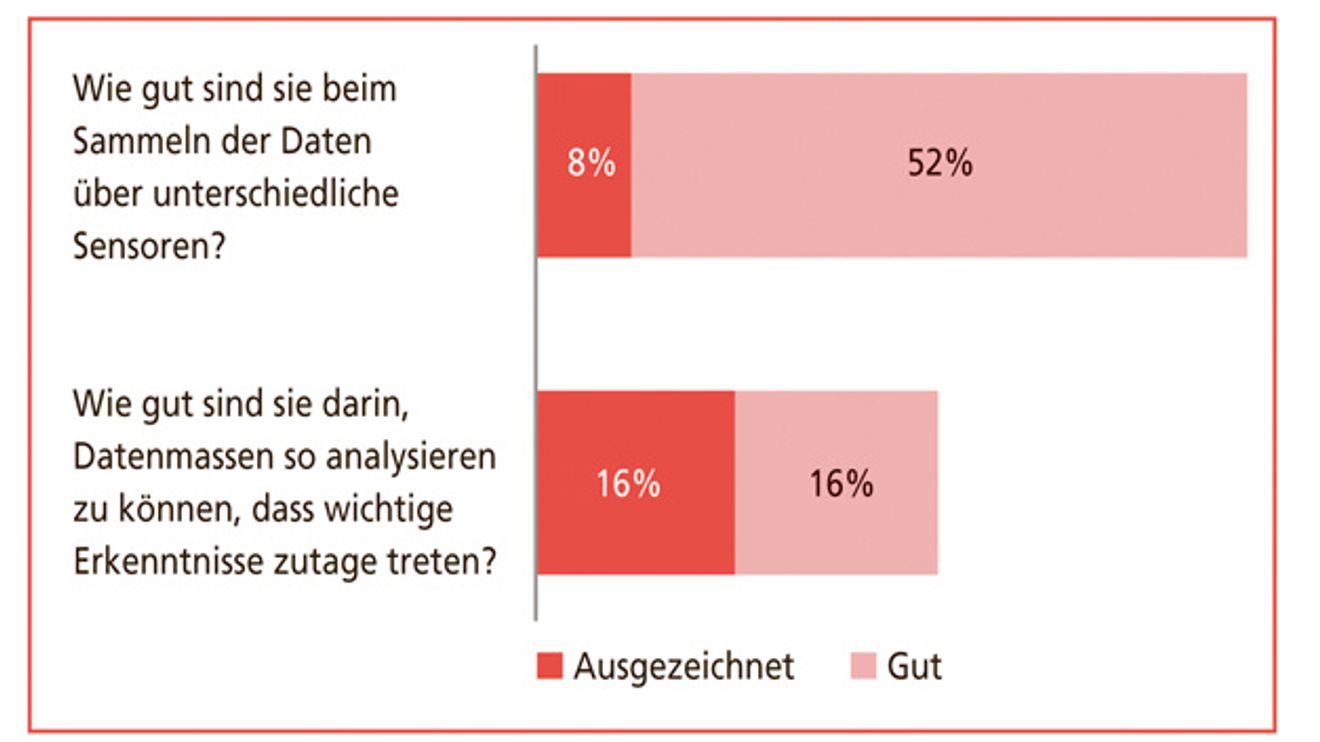
The Digital Analytics Association (DAA) commissioned the 'Industrial Analytics Report 2016/2017' study to determine the current situation. The market research company IoT-Analytics surveyed 151 analytics experts and decision-makers worldwide for this purpose - which revealed some interesting insights: almost 70% of the study participants assume that the ability to systematically analyze data will play an existential role in companies in the next five years. And yet: 15% already see this situation being reached today. More than half of the companies prefer to build up future-proof data expertise outside the core company and to cooperate with external service providers. Less than half of the study participants have already anchored the topic organizationally within the company structure.
The industry's commitment is not initially based on an attempt to reduce costs. Instead, companies are looking to increase their turnover. Predictive maintenance is just as much a focus as better sales through online analysis of customer and usage behavior.
Know-how is still in short supply
However, many companies are still struggling with considerable difficulties when it comes to implementing industrial analytics. The hurdles are not so much the collection of data via various sensors or online channels, but being able to analyze the masses of data in such a way that important insights are revealed. The study points to a significant lack of appropriately trained specialists.
The study reveals clear differences in how companies approach the topic of industrial analytics: around a third start with a clear idea of the goals to be pursued and the expected results. In contrast, a third of companies approach industrial analytics with an open mind and explore the possibilities before setting precise goals. This explorative approach is certainly justified: "The explorative approach seems to be the preferred method of entry for more and more companies. This makes sense insofar as the possibilities of industrial analytics can be approached more openly and potentials can be discovered that were not initially in view," comments Frank Pörschmann, member of the DAA Executive Board.
A look at the driving forces shows that industrial analytics has been recognized as a business-critical cross-sectional function: only 7% of the study participants have CIOs (heads of information technology) or CTOs (heads of technology) driving the relevant initiatives forward. In 58% of companies, top management is behind the commitment.
For Pörschmann, the study also shows that industry has certainly recognized the potential of industrial analytics: "Data only unfolds its benefits and value through analysis and ultimately only in a decision-making process. Most companies have therefore launched initiatives to explore the potential of industrial analytics. However, there is an urgent lack of competent specialists, overarching standards and the corresponding data expertise at management level."
Pörschmann also sees a current imbalance in terms of costs: "A look at the project cost structure shows the dilemma. Most of the work is involved in making the data available for analysis in the first place - i.e. access, preparation and qualification. And in many cases, this has to be repeated for every initiative. This is where there is potential to cut costs and speed up the process by using suitable technologies."


You might also be interested in
Intelligent measured value monitoring
AI project "NiMo 4.0" for clean water
The joint project NiMo 4.0 is developing software systems that combine AI processes with traditional methods in order to predict the spatial distribution of nitrate in groundwater more precisely. Disy presents the results at the networking meeting...
 read more...
Fraunhofer project determines properties of coatings virtually
In the "PaintVisco" project, researchers at Fraunhofer IPA are modeling the development and processing of paints. The bat was the model for the development of a new simulation program that can be used to virtually determine the exact properties of...
read more...Display testing and optical measurement technology strengthened
Instrument Systems, a manufacturer of spectroradiometers, cameras and display and light measurement systems, acquires Kimsoptec, a Korean supplier of display measurement systems, to strengthen its core business areas of display testing and optical...
read more...New Chairman of the GMA
Michael Weyrich took over the chairmanship of the VDI/VDE Society for Measurement and Automation Technology (GMA) from Atilla Bilgic on January 1.
read more...The new structure
Rohde & Schwarz closed the 2020/2021 financial year with an operating result on a par with the previous year. Investments are to be increased in technologies such as 6G, quantum computing, Industrial Internet of Things (IIoT), AI and cloud...
read more...Handheld vector network analyzer up to 26.5 GHz
With the ZNH, Rohde & Schwarz offers a two-port handheld vector network analyzer up to 26.5 GHz with cable and antenna analysis and complete S-parameter measurement.
read more...Modbus interface included
The Digalox series of measuring devices from TDE Instruments is now also available with a Modbus interface. According to the manufacturer, the graphical multifunction measuring devices with RGB backlighting offer extensive functions and display...
read more...Say goodbye to load peaks
Peak loads are expensive. Even one-off 'slips' cause additional costs in the five-figure range. However, the obvious solution of temporarily switching off large consumers such as heating systems must not compromise process reliability. Modern...
read more...Operation via touchscreen
Rigol Technologies is expanding its real-time spectrum analyzers with the RSA3000-E economic series. The devices are based on 'UltraReal' technology, which makes it possible to carry out real-time measurements, among other things.
read more...