
T-Systems and GFT
Partnership for manufacturing of the future
T-Systems and GFT are working together on the Industrial Internet of Things (IIoT). Together, they offer the manufacturing industry solutions for analyzing large-scale machine, production and planning data: End-to-end and directly on the production floor.
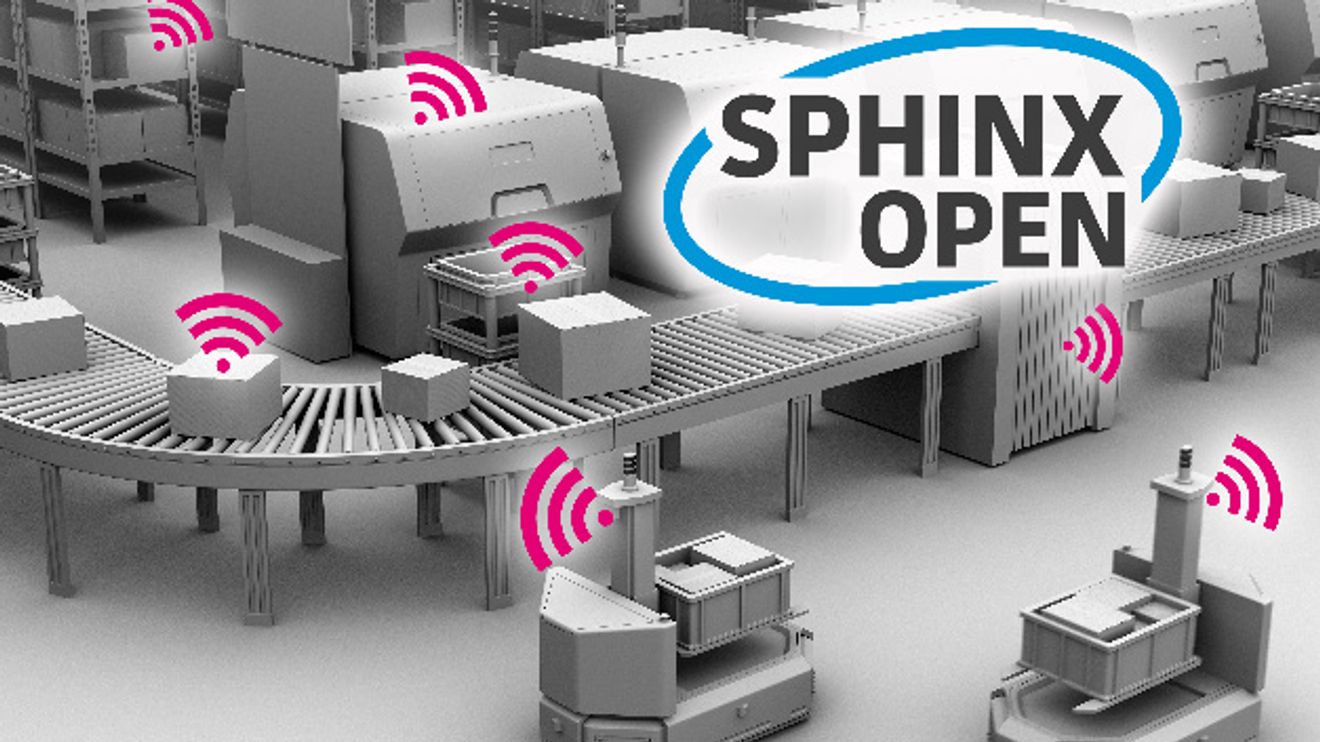
The partners combine the digital twin platform 'sphinx open online' from GFT with edge computing from T-Systems and artificial intelligence from the cloud. According to the company, errors in production are detected up to 300% faster.
Increasingly large amounts of data are being generated in a smart factory. Manufacturers can adapt and optimize processes based on the analysis results of this data. With predictive maintenance, they can prevent expensive unplanned downtime in production. In order for companies to evaluate this data in real time, they usually need high network capacities between the production hall and the central data center. There they are analyzed and the results are fed back into production. The integrated solution from T-Systems and GFT based on edge computing and IIoT offers new fields of application for smart production.
In the joint solution from GFT and T-Systems, sensors record status data locally and in real time at the individual systems. The data is sent in parallel, but not time-critical, via smaller bandwidths to a central data center or via 5G networks to the cloud. Due to the significantly lower bandwidth, data transfer costs are reduced by up to 70%. The solution analyses the data collected at the edge and uses artificial intelligence (AI) to identify optimization potential.
"Previously, manufacturers had to combine several services, software and hardware into a complete solution themselves. Thanks to our partnership with GFT, they can now get the whole package from a single source," says Frank Strecker, responsible for T-Systems' public cloud business. "Edge computing from us, data collection, digital twin and AI analysis from GFT - this is how we can connect the production hall with the data center. We also offer our own public and private cloud services. Or the customer can opt for the public cloud of our partners AWS, Microsoft Azure or Google."
With 'sphinx open online', companies can monitor their systems and control them fully automatically. For example, they receive information about operating states such as temperatures or pressure, as well as resource consumption or current output. To do this, data from all relevant sources is transferred to a common model ("model in the middle"). In 'sphinx open online', digital twins are created from this. These virtual images control systems automatically. The digital twins can also be used to create far-reaching simulations. Users can modify entire systems and production processes and check the effects without having to physically touch a single machine. The simulations reveal optimization potential. These optimizations can be implemented automatically by comparing them with defined parameters and rules. For example, to adapt specific processes or to plan necessary maintenance windows more precisely. Manual intervention is no longer necessary, as all measures are fed back into the industrial plant and applied in real time.


You might also be interested in
Industry 4.0 platform and CESMII cooperate
The Industrie 4.0 platform and the US institute CESMII - The Smart Manufacturing Institute will be working together in future to drive forward the digital transformation of manufacturing. They presented the first results of their collaboration at...
 read more...
Special issue Cloud & Edge & Embedded Computing
In our special issue Cloud & Edge & Embedded Computing, you can read about technologies that ensure efficient data acquisition and analysis as well as a secure flow of information from the edge to the cloud.
read more...What is behind the organization
The Edgecross Consortium
Decentralized data processing at the transition from production to the IT world - the Edgecross Consortium from Asia has been dedicated to this topic since the end of 2017. But what is behind this organization and what are its goals?
read more...A hybrid cloud initiative
Siemens, IBM and Red Hat are entering into a cooperation: Through a joint initiative, Siemens Digital Industries Software will use IBM's open hybrid cloud approach, which is based on Red Hat OpenShift.
read more...Virtual commissioning in mechanical engineering
Modern production machines are not only equipped with more computing power and store more measurement data than ever before, they are also becoming increasingly complex. This can lead to delays during commissioning and errors during operation....
read more...2021 will determine the success of the "moon mission"
The GAIA-X project, originally initiated by Germany and France, aims to create a powerful and secure data infrastructure for Europe. Marc Schieder, CIO of Dracoon, comments on the status quo of the project in his statement.
read more...Stirrups for automated machine learning?
In the "AutoQML" project, eight partners from research and industry are developing solutions that combine quantum computing and machine learning (ML).
read more...GFT takes over in-Integrierte Informationssysteme
GFT Technologies has announced the acquisition of software provider in-Integrierte Informationssysteme. The Constance-based company was acquired with effect from January 1, 2020.
read more...GFT takes over Axoom
With effect from July 1, 2019, GFT Technologies has acquired Axoom with its IT and industry expertise at the Karlsruhe site. In addition, the long-standing cooperation with Trumpf will be strengthened by a development partnership.
read more...