
TTTech
The PLC in the data center
What are the advantages of using an integrated, centralized control architecture on an edge server instead of a large number of individual controllers with their own electronics? Only used in isolated cases today, such an architecture could become increasingly important.

A look at the automotive industry illustrates what could be coming to the factory floor in the not too distant future: Since the late 1970s, engine control units have been installed in cars and soon after, various electronic control units for other functions. Since then, innovations in all areas from vehicle control and safety to comfort, driver assistance and automated vehicle functions have ensured that computers have taken on more and more tasks in cars. For each new function, a new control computer with its own I/O elements was initially used. The manufacturers of the control units explained that this was a prerequisite for guaranteeing high quality and operational safety.
As a result, however, the number of control units and I/O elements, including the necessary cabling, increased depending on the vehicle's equipment - and with it the power consumption, the total weight and the space required for the electronics.
In the 1990s, the concept of domain control units became established as part of an 'architecture revolution'. Instead of a separate control unit for each function, a larger and more powerful computer took over a large number of tasks of the same type - for example engine and transmission control or comfort functions. This integration and centralization saved costs because fewer individual control units had to be installed. The new architecture was also advantageous for maintenance and reliability because there were fewer individual electronic components, cables and connectors in the system.
In industrial automation, there are also dedicated control units - PLCs - and associated I/O elements with high reliability and availability requirements. The overall architecture often comprises a large number of individual controllers that are connected to each other. In contrast to the automotive industry, the functional connections between the controllers are often significantly smaller and there is sufficient space available for the installation and power supply of a large number of PLCs. The question now arises as to whether the integration and centralization of control systems in industrial automation can offer similar advantages to those in automotive electronics. Certainly, the comparison is much closer than with a data center, where virtualization and thus joint operation of web servers, databases and other applications of different types on powerful servers have long been state of the art.
The integrated, centralized architecture
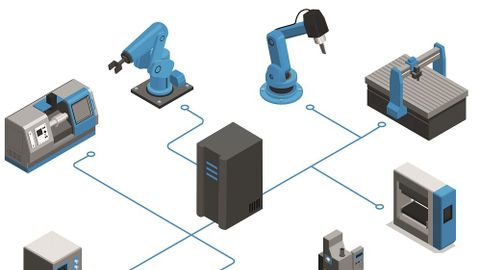
The following situation is quite conceivable: The PLCs are removed from the automation system and their control functions are hosted in the form of soft PLCs in an 'edge data center' with the appropriate computing capacity and network connection to the automation system on 'industrial edge servers'.
Today, servers already offer sufficient performance to process dozens of soft PLCs simultaneously, but conventional IT servers with technologies such as virtualization and shared resources for network and storage cannot adequately address the industry's requirements for reliability and real-time behavior. This requires 'industrial edge servers'.
In terms of networking, the data center must be closely connected to the automation in order to meet the necessary short communication cycles and latency requirements. The edge data center is therefore not just any cloud, but potentially an on-site server rack . The field level of the automation remains largely unchanged - however, analog and discrete I/Os must be replaced by Ethernet-based I/Os or supplemented by suitable gateways in order to be usable for the controller accessible via a network.
Advantages and disadvantages of the integrated architecture
Functionally, nothing changes in the control system. The capital expenditure (CAPEX) for integrated and centralized solutions differs depending on the use case. For example, it is relevant whether an edge infrastructure is already in place or not. A comparison of several hardware PLCs with a small number of edge servers shows that a clear CAPEX advantage for edge servers can only be identified with a large number of hardware PLCs. The two solutions also differ only slightly during operation.
However, there is a clear difference between the solutions in terms of flexibility and expandability: The ability to access data from the field level in the edge data center means that not only control systems but also analyses of process data can be carried out here in real time, which can be essential for diagnostics, maintenance, optimization and intelligent responses to changes in the automation system. These analyses do not run 'on', but 'parallel to' the controllers on the same edge servers. As the control functions are hosted on the same edge infrastructure, feedback loops from the analysis to the control system can also be implemented here, thus opening up new optimization possibilities with regard to Industry 4.0 suitability.
The implementation of centralized architectures
Why is the architecture described not (yet) in use to any significant extent? Three classes of arguments can be identified for this in surveys:
1. the current architecture is tried and tested: Reasons in favor of the integrated architecture, such as cost benefits, flexibility, optimization, are generally desirable, but the current model is not rated as deficient or inadequate in this respect.
2. technological risks: Reliability and determinism of integrated server platforms are not considered trustworthy enough to outsource mission-critical control functions to. The response time of control systems in an edge data center is considered unreliable due to the network.
3. organizational hurdles: Implementing an integrated platform of this type requires new skills among control specialists. The distribution of competencies within the company is often incompatible with an integrated architecture.
How relevant the advantages of centralizing control at the 'industrial edge' are can be assessed more on a case-by-case basis. In the area of real-time data acquisition and edge analytics, relevant advantages can be found particularly in those applications that rely more heavily on flexible production processes and reactive process changes as part of an Industry 4.0 strategy. The flexibility of an edge infrastructure therefore makes it particularly worthwhile for applications that place high demands on dynamic changes in automation.
The technological risks are certainly challenging, but some recent developments show what is already possible here:
- Hypervisor solutions already offer mechanisms for guaranteed robust partitioning of resources such as CPU cores and cache for current multi-core CPUs, so that real-time performance like on 'bare metal' can be achieved instead of virtualization and the associated runtime fluctuations. The more cores, the more real-time applications can be executed simultaneously and independently of each other.
- Hardware-supported network virtualization of the local Ethernet interface(s) enables multiple applications to use the network resources on the same server independently of each other and the required bandwidth is available in the network in real time. Time Sensitive Networking (TSN) in turn provides the mechanisms in the network to transport the real-time data of different applications independently and without interference with guaranteed latency through an Ethernet network.
- Specifications that define 'tunneling' via TSN are already available for various fieldbus protocols such as Ethercat and Profinet. This allows the I/Os at field level to communicate with the soft PLCs in the edge data center via a convergent network as if they were connected directly via the fieldbus.
- There is a strong trend towards manufacturer-independent interfaces for application and management. The ongoing specification work in the OPC Foundation's Motion Working Group aims to ensure manufacturer-independent interoperability between controllers and motion control devices (drives, I/Os) in real-time control on the basis of OPC UA PubSub. Similar standards for manufacturer-independent interoperability based on OPC UA and TSN have already been adopted by other industry consortia, such as Euromap and OPAF. Manufacturer-independent management interfaces such as DMTF Redfish also play an important role here.
Implementation of the centralized architecture
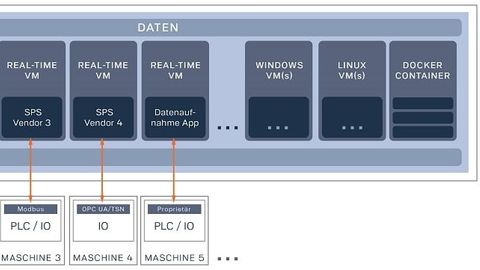
With the mechanisms, technologies and standards mentioned, the integrated and centralized architecture can not only be described hypothetically, but also implemented, as is already the case in various testbeds and demonstrators.
Finally, the organizational challenges are by no means negligible, but here too there are approaches to developing a solution perspective. On the one hand, the control system model remains unchanged in terms of programming and runtime behavior: the IEC 61131 programming model continues to be used, even if the resulting control application is executed as a soft PLC and communicates exclusively with the field level via fieldbus interfaces. Individual developments are already aiming to extend the centralized architecture in accordance with the requirements of IEC/EN 61499 for distributed control systems. However, even this does not change the basic model.
On the other hand, the configuration, commissioning and maintenance of a centralized edge platform for hosting control systems is a completely different task than programming and using a PLC. An approach that integrates the two system aspects - PLC and edge platform - inseparably and wants to manage them together would therefore not be very promising. Instead, it seems appropriate for the lifecycle of the control applications to remain the domain of the experts for these applications, while the IT department takes care of the installation and maintenance of the edge servers and the hosting infrastructure running on them. The essential interfaces that ensure robustness and determinism according to automation requirements must be included in an appropriately certified 'edge computing platform' product, as this competence is usually not found either in the control experts or in an IT department.
A look into the future

Georg Stöger is Director Technical Presales and Training Industrial at TTTech Industrial Automation
© TTTech Computer TechnologyA consistently centralized architecture for control systems in automation is not currently state of the art. The current architecture, in which almost every controller is implemented directly in its application as a hardware PLC, is well established. However, if the need for more flexibility and dynamic changes to a highly networked automation system suggests it, the methods and technologies for integrating and centralizing control systems in an edge computing architecture with edge servers and edge data centers can offer a good alternative.
Such solutions already exist: The industrial edge computing platform Nerve from 'TTTech Industrial Hypervisor', for example, integrates soft PLCs and centralized application management in an open solution. This ensures that when migrating to such a centralized architecture, openness and manufacturer independence are guaranteed as well as at present or even better.


You might also be interested in
Computing platform for the control cabinet?
In the age of digitalization and IIoT, closed systems are being replaced by open, freely programmable edge computing platforms. Solutions based on the Raspberry Pi ecosystem are becoming increasingly attractive for this.
 read more...
A commentary by Meinrad Happacher
The struggle for data
The news in mid-August should have woken up even the last German industry boss: Donald Trump tightens sanctions against Huawei. He decreed that no more chips manufactured using US software or technology could be supplied to the company.
read more...For direct machine integration
The C7015 ultra-compact industrial PC is a fully IP65/67 rated industrial PC for direct mounting on the machine or system.
read more...Edge computers for extreme environments
With the MC-1220 edge computer, Moxa enables AI calculations at the edge. In a fanless metal housing, they are used in harsh environments.
read more...The configuration
Time-Sensitive Networking must offer a standardized communication platform for machine builders and automation engineers alike - the TSN configuration must support both worlds without conflict. How and with which approach can this be achieved?
read more...3 questions for ... Edge Computing experts
Mastering the data flow
No one can avoid edge computing at the moment. What advantages does the technology bring to the manufacturing industry? What do users need to be aware of? We asked selected industry experts these questions, among others, and here are the answers.
read more..."Three questions for..." - in December
The company roadmap to TSN
Time Sensitive Networking - TSN for short - is in the process of establishing itself as a real-time Ethernet standard. What is the state of play in the industry? As part of the "3 questions for ..." series, we asked experts from companies about this.
read more...A TSN starter package
A starter package for setting up, configuring and testing TSN networks. TTTech is now launching it.
read more...The top articles in September
September was characterized by many trade fair cancellations. However, the fact that the industry is not standing still is demonstrated by exciting alliances of associations, initiatives and companies that are united by a common goal: the further...
read more...