

Phoenix Contact
PLCnext Technology - the 'ecosystem' becomes round
A new controller and a new software store: Phoenix Contact is further expanding the 'PLCnext Technology' ecosystem with these modules.
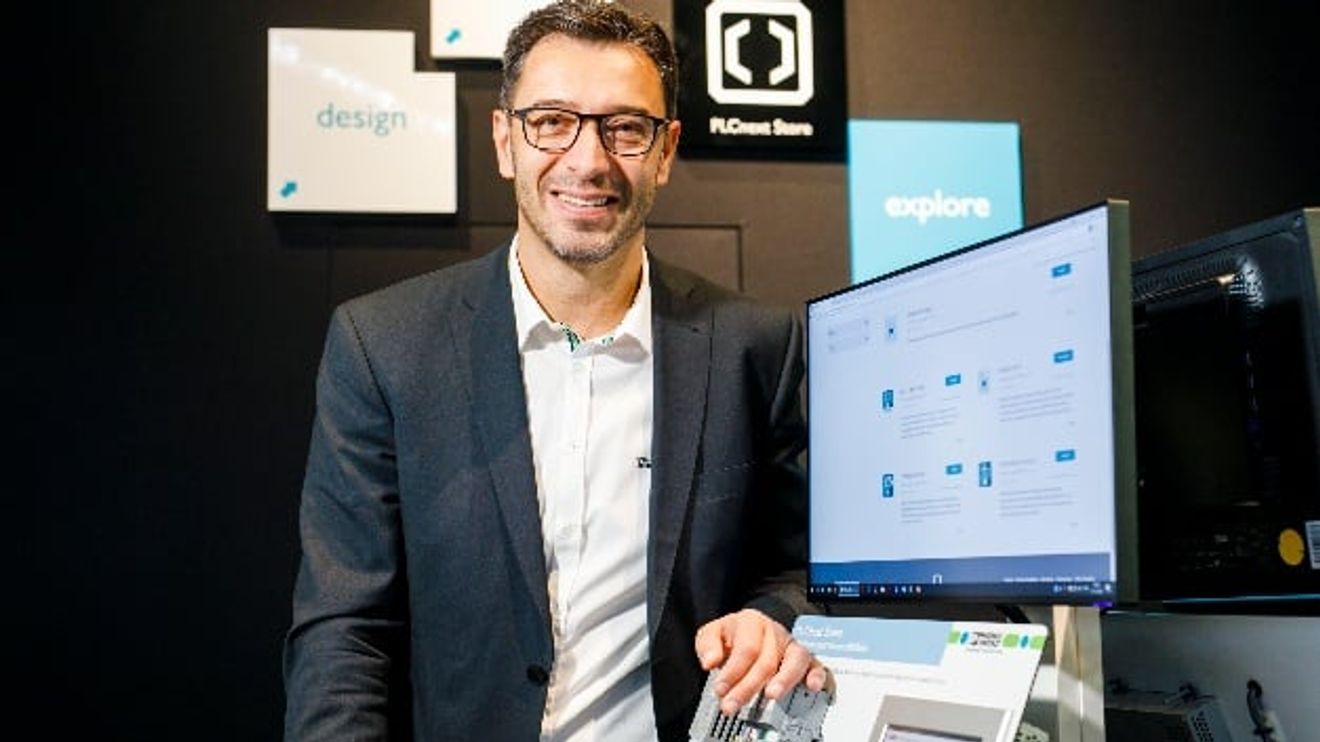
At SPS IPC Drives 2016, Phoenix Contact presented its vision of the control technology of the future to trade fair visitors for the first time. The new thing about 'PLCnext Technology': openness and a platform concept instead of a closed, classic PLC. This means, among other things: Functions according to IEC 61131-3, routines from C/C++, C# or Matlab Simulink can be combined flexibly and at will with this control concept, whereby the exchanged data is always synchronized and available to the different applications. Open source software and apps can also be integrated. All programs running on the control platform exchange information with each other and with the communication interfaces via a common application layer.
The PLCnext Control 'AXC F 2152', the first industrial controller based on PLCnext technology, followed at the 2017 trade fair: this is a controller that can be modularly expanded using I/O modules from Phoenix Contact's Axioline family. With its 2 x 800 MHz ARM processor, the PLC was initially aimed primarily at the market for decentralized, modular controllers for small and medium-sized applications. For users who require more computing power, the Blomberg-based company is now following up with the 'RFC 4072S', a high-performance controller with integrated safety PLC, which is based on an Intel i5 dual-core processor and provides 4 GB of RAM. The safety-relevant calculations are carried out by two independent CPUs based on different architectures. The RFC 4072S can be used in Profinet and Profisafe systems. It uses the current Profisafe profile 2.61. The safety-related controller acts as an F-Host in the Profisafe network and can put up to 300 subordinate F-Devices into operation.
As safety is an integral part of RFC 4072S, Phoenix Contact is initially aiming this controller primarily at safety-related applications. But what if safety is not required? "For these customers, we will be introducing another PLCnext Control PLC next year - again in the modular Axioline form factor - which is slightly below the RFC 4072S in terms of performance and in which safety can be modularly added or supplemented as required," says Ulrich Leidecker, Managing Director Business Area IMA at Phoenix Contact.
A software marketplace for everyone!
However, the real highlight for the Blomberg-based company at this year's SPS IPC Drives is the 'PLCnext Store', which went live just in time for the trade fair. In future, this will be the central platform for software modules and solutions relating to PLCnext technology - and not just for software from Phoenix Contact itself. Leidecker comments: "We want to open up the store just as much as the technology behind PLCnext itself! In other words: We are creating a trading platform through which other companies can also make their software available for PLCnext Technology." This could be IEC 61131 libraries, for example, which can be integrated into the PLCnext Engineer engineering system from Phoenix Contact. Or ready-programmed software solutions - for a pump application, for example - that the user can download directly to the controller via the store.
The fact that Phoenix Contact is serious about openness is underlined by another announcement: In the future, the company will work together with 3S-Smart Software Solutions, among others - in other words, in addition to its own IEC 61131 runtime environment, the Codesys runtime from 3S will also be included in the store. This runtime can then simply be installed as an app on a PLCnext Control. Other runtimes - for example Java - are to follow.
When asked on what terms third-party providers can place their software in the marketplace, Leidecker replies: "We will gradually offer various business models here. Initially, users will have to purchase a license for the corresponding software app for each device. The software provider will be charged a share of the revenue for providing and using the platform. The price of the respective app is determined by the app provider. We have also decoupled the downloading of the app from the purchase of the license. This means that the user can first download the app and test it in demo mode and then initiate the purchase process downstream - in the first step, for example, by credit card." Further payment models are to follow successively.
There is one final aspect that rounds off the PLCnext Technology ecosystem: cloud connectivity. Every PLCnext controller has connectivity to the 'Proficloud' on board as standard. However, openness also applies here: "It will be possible to install various 'cloud agents' on the controller, which can then also establish a connection to Siemens MindSphere, Microsoft Azure or AWS, for example," says Leidecker.


You might also be interested in
Efficient administration of distributed control systems
With a large number of control systems in the field, it is often difficult to maintain an overview. This is where the 'Codesys Automation Server' comes in: It enables convenient administration of all controllers via the digital image of each PLC in...
 read more...
Schneider Electric - the background to the Aveva takeover
In September 2017, Schneider Electric acquired a majority stake in Aveva and at the same time contributed its own software business to the British company. Jürgen Siefert, Vice President Industry DACH, explains the strategy behind this.
read more...Safety in sensor technology
What do sensor manufacturers currently offer in terms of safety? At SPS IPC Drives, there were a number of clever concepts on show - including from Sick, Pepperl+Fuchs and Leuze electronic.
read more...Video flashback of the three days of the fair
New hall, new topics and a new name in 2019 - the SPS IPC Drives 2018 in seven minutes.
read more...The review in the movie
New hall, new topics and a new name - that was SPS IPC Drives 2018 in seven minutes.
read more...OPC UA and TSN - a major trade fair topic
The OPC UA and TSN communication standards are major topics of discussion in the industry. This could not be overlooked at SPS IPC Drives 2018.
read more...Smart transport - three approaches in the video
How can material and product transport in machines and systems be reorganized in the age of Industry 4.0? Beckhoff, B&R and Bosch Rexroth presented interesting approaches in this regard at SPS IPC Drives 2018.
read more...'Software & IT' in focus
Last year, SPS IPC Drives bundled the topic of 'Software & IT in manufacturing' in Hall 6. In response to high demand, this concept was extended to Hall 5 in 2018.
read more...The 'Automation Hackathon'
At the 'Automation Hackathon' at SPS IPC Drives 2018, seven start-ups had the chance to develop new business models for selected companies in the automation industry in 48 hours. Winner: the start-up Othermo in collaboration with Wago.
read more...