
Sigmatek
Object-oriented into the future
Sigmatek presented the LASAL software platform with object-oriented programming (OOP) in 2002. The company was the first automation solution provider to move away from strictly sequential programming and has been using object-oriented programming ever since.
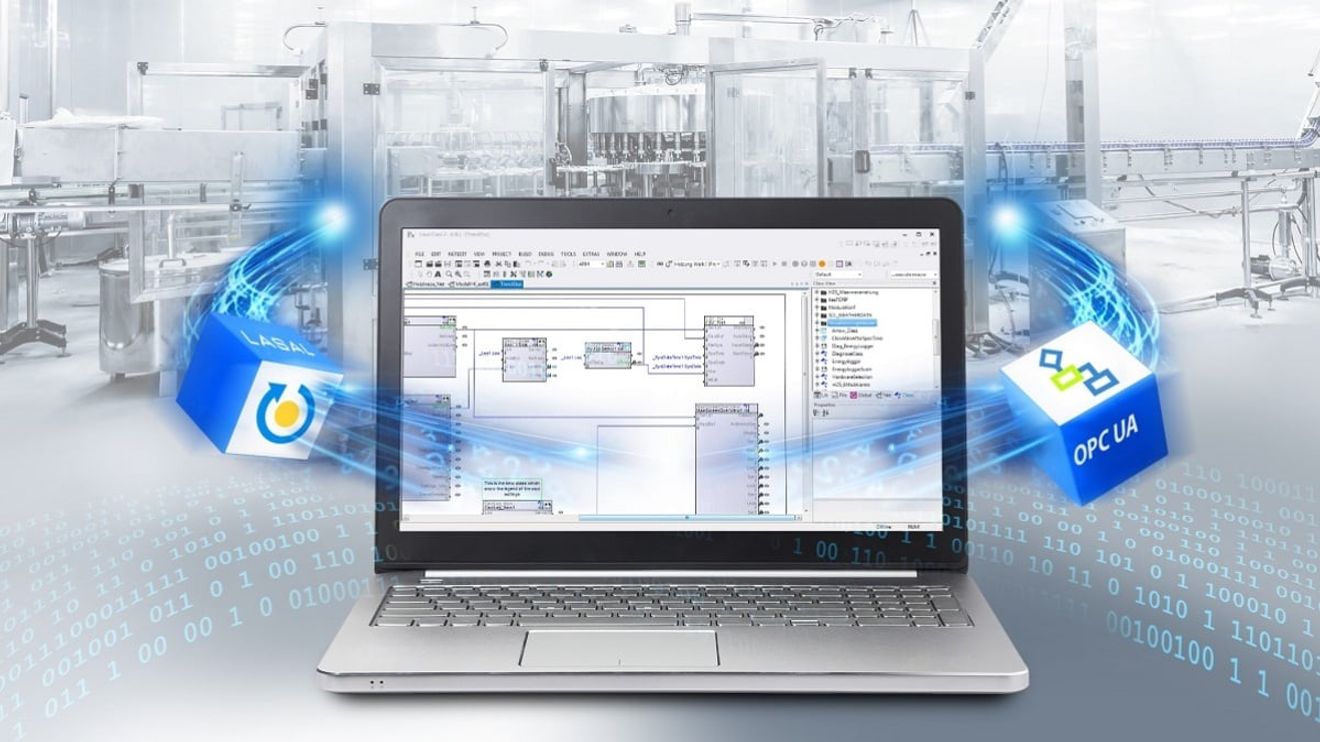
Modern tools and approaches such as object-oriented programming (OOP) are essential for the development of future-proof machine concepts in order to make the application software as universal as possible and at the same time easy to maintain and expand. With an object-oriented approach, machine builders achieve maximum hardware independence. The software is also very clear and structured. Object-oriented programming with LASAL was introduced to the market by Sigmatek 21 years ago. The idea was to create a single software tool which, designed as a modular system, would take on all engineering tasks in automation technology - from control programming to project planning for visualization, drive and safety technology.
Sigmatek was the first manufacturer in the industry to transfer object orientation from PC programming technology to control technology. "The idea of object-oriented programming (OOP) is to combine code and data into logical units called 'objects'. These objects represent the various parts of a machine or system0171, explains Franz Aschl, Technology Management at Sigmatek. Behind each 'object' is a 'class'. It is the blueprint of the object, contains the program code and the associated data elements. Each class can take on a specific 'task', such as measuring and evaluating a temperature, controlling a valve or activating a conveyor belt. As each individual function is encapsulated, unwanted external influence can be ruled out. As soon as the class is provided with parameters and interfaces, it is referred to as an object.
"The advantage of this development method is its consistent modularity from the lowest level of the individual function right up to the overall project. This ensures clarity and forces structured software development. The dreaded 'spaghetti code' cannot arise at all,0171 says Aschl. The classes contain the familiar programming via Structured Text (ST), Sequential Function Chart (SFC) or Ladder Diagram (LD) according to IEC 61131-3 as well as ANSI-C and interpreters.
A key feature of LASAL is the object-oriented programming with client-server technology as well as graphical display, graphical project planning and graphical debugging. A complete overview of the project, the functionalities, the data traffic and the interfaces is available at a glance. Complex relationships are therefore much easier to recognize, change and control.
The classes are stored in 'libraries'. Individual functions can be put together in the software in a modular system and simply "wired up "0171. As in mechanics, where a tried and tested design is reused, the modular structure of OOP means that application parts that have already been created can be easily reused and adapted. This ensures a high degree of flexibility, as changes can be implemented quickly with little code and little effort. This increased reusability significantly reduces the development time and therefore the time-to-market cycles.

Continuous development - from concept to detail
"One advantage of object-oriented programming is that it forces you to formulate definitions carefully," says Aschl. Based on the overall project, the software architects consider which functions are required in the machine and how they are connected to each other. In top-down design, tasks and functions are broken down and visualized: Which machine parts talk to others, which exchange data. "No line of code is required to understand how the application works in a LASAL network. Once the functions and communication interfaces have been defined, development starts from the bottom up," explains Aschl.
Development tasks can thus be distributed to developers or groups. These tasks can be completed independently. Instead of programming, the user models standard machine functions on the graphical user interface using drag & drop from the extensive libraries. This reduces the development effort enormously and increases software quality at the same time. Only at a certain point is it necessary to merge and coordinate individual software packages in a release. Interface problems are a thing of the past.

The object-oriented engineering tool LASAL combines all automation tasks on a modern low-code platform and ensures simple handling of machine and system concepts.
© SigmatekAnother advantage of object-oriented development is that the hardware does not yet have to be available or defined. The software is decoupled from the hardware. This is very helpful for the machine builder, as it is often only during development that it becomes clear which computing power, drive type, visualization power and display size are ultimately optimal. Speaking of visualization: HTML5 visualizations, which can be flexibly adapted to the HMI used, offer maximum freedom when selecting the target device.
Machine Manager: Flexible task distribution
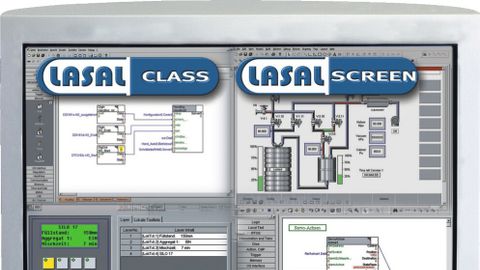
Looking back: The object-oriented, all-in-one automation software LASAL was presented at the Hanover Trade Fair in 2002.
© SigmatekIn today's world, production systems must be adaptable and able to react quickly and easily to market changes. On the road to the smart factory, Sigmatek has therefore been relying on modular, decentralized automation solutions for many years. Multi-CPU solutions provide machine builders with a great deal of flexibility: The system configuration can be put together individually and, if required, can also be subsequently expanded with optional functional units and computing power. The 'LASAL Machine Manager' ensures that this intelligent modularity is also reflected in the software. Machine software consists of many sub-projects, which in turn are divided into sub-groups such as sequence and visualization. The Machine Manager provides the user with an overview of the individual projects in the machine or system and makes it easy to see or define: Who is allowed to exchange which data with whom?
| You can get a comprehensive overview of LASAL's range of functions here |
As a software layer, the Machine Manager lies above the actual machine programming and assigns the various subtasks to the existing hardware control units. This can be defined once during commissioning or changed during the service life of a machine. The communication paths between control units and HMIs can be defined in the Machine Manager. The variables are automatically requested and sent during runtime via cross-project client/server connections. The Machine Manager thus ensures maximum clarity in software projects for multi-CPU applications and a great deal of flexibility in the distribution of tasks.
Engineering with a future

The author: Ingrid Traintinger is Head of Marketing at Sigmatek in Lamprechtshausen, Austria.
© Sigmatek"Every mechanical engineer knows that the software and the knowledge about it is their greatest asset," Aschl is convinced. In combination with modern hardware, the decisive added value is created for users With a flexible, structured and user-friendly engineering tool, code remains legible and easy to adapt even after years. Code thus becomes sustainable and can be passed on clearly. Even technology changes, which will inevitably occur more and more frequently in today's world, can be handled with minimal effort and risk.
Interview with Franz Aschl

What prompted the switch to an object-oriented approach in 2000?
Franz Aschl: We are always in close contact with our customers and when there was an increasing call for simple engineering for machines with different variants and options, we looked for the right solution. A solution that makes software maintenance easier, ensures transparency and supports variant diversity, i.e. that the addition of options has no effect on the rest of the program. Object-oriented programming with LASAL offers all this and much more - namely client-server technology, mechatronic engineering and low code.
Looking back, what are you proud of?
That we recognized the signs of the times back then and were the first company to transfer OOP to automation technology. Of course, we also had to convince experienced programmers, who were used to ladder diagrams and instruction lists, to use object-oriented programming. You could say it was a generation break. The younger software engineers were already familiar with object orientation, structured text and C from their training or studies.
To what extent has LASAL changed over the last 20 years?
LASAL was developed as an all-in-one tool: Control, visualization and motion were there right from the start. Over the years, many convenient functions have been added, such as version management, Matlab, hardware editor and scripting. In 2009, the LASAL SAFETYDesigner was added as a seamlessly integrated tool that allows users to conveniently configure safety-relevant applications. And since 2015, the LASAL Machine Manager has simplified the handling of multi-CPU solutions. It provides a clear overview of the individual software projects in a machine or system and controls communication between the distributed intelligences. At its heart are our extensive libraries, which have grown enormously over the last 20 years and provide templates, add-ons and theme-specific packages for a wide range of machine functions. Of course, we have also integrated HTML5 visualization into LASAL. A new feature is the integration of model-based development with Digital Twin.


You might also be interested in
Manage and secure assets
In today's fast-paced industrial environment, it is essential that production processes run smoothly and efficiently. However, one critical aspect that is often overlooked is the importance of PLC backup and restore procedures.
 read more...
Update brings support for TIA V19
Delta Logic has updated the 'Accon OPC UA Server' software to version 1.4.0.0. The new features include support for TIA Portal projects of version V19 and for the latest firmware for CPUs of the Siemens S7-1200 and S7-1500 controllers.
read more...Branch office opened in Norway
The Austrian company Bachmann electronic, which specializes in automation technology for maritime applications, renewable energies and industry, is opening a branch in Norway.
read more...Raquel Torres is the new President
Raquel Torres succeeds John Conway as President of UniversalAutomation.Org.
read more...Subsidiary founded in Vietnam
The Schmersal Group has founded a new subsidiary in Ho Chi Minh City, Schmersal Vietnam Co. Ltd.
read more...Safe programming of PLCs
In collaboration with Codesys, Fraunhofer IEM has integrated static code analysis development methods into the Codesys development environment commonly used for PLCs.
read more...RoboDK and Keba work together
RoboDK and Keba Industrial Automation have announced their collaboration. Together, they want to simplify the life cycle of a process solution with integrated robotics - from quotation preparation to after-sales support.
read more...Frank Stührenberg hands over to Dirk Görlitzer
At the end of the year, Frank Stührenberg will hand over the position of CEO of Phoenix Contact to Dirk Görlitzer. Until then, there will be dual leadership.
read more...SPS - Smart Production Solutions
SPS from 2025 again at the end of November
From next year, the SPS will return to the familiar dates and will take place in Nuremberg from November 25 to 27, 2025. The subsequent dates until 2027 will also be at the end of November.
read more...