
Artificial intelligence
Neuromorphic hardware saves energy
A newly published study shows that neuromorphic technology for large deep learning networks is up to sixteen times more energy efficient than other AI systems.
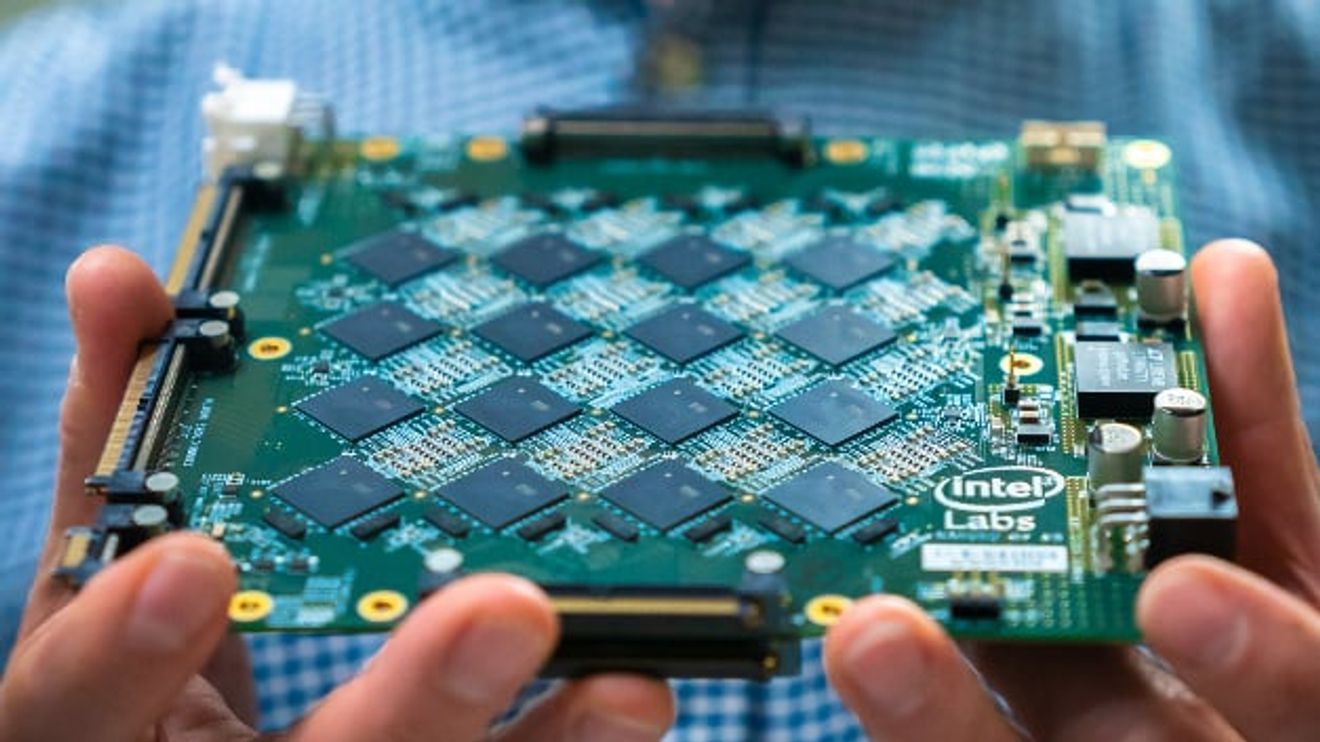
The Institute for Fundamentals of Information Processing at TU Graz and Intel Labs have experimentally demonstrated for the first time that a large neural network can process sequences (such as sentences) four to sixteen times more efficiently on neuromorphic hardware than on conventional hardware. The new research results are based on the neuromorphic research chip Loihi (1st generation) from Intel Labs. Loihi uses findings from neuroscience to create chips modeled on the biological brain. The research results have now been published in Nature Machine Intelligence.
The human brain as a model
Smart machines and intelligent computers that can independently recognize and deduce objects and relationships between different objects are the subject of global artificial intelligence (AI) research. Energy consumption is a major obstacle on the way to a broader application of such AI methods. It is hoped that neuromorphic technology will provide a boost in the right direction. It is modeled on the human brain, which is the world champion when it comes to energy efficiency: its hundred billion neurons only consume around 20 watts to process information, which is not much more energy than an average energy-saving light bulb.
In its work, the team from TU Graz and Intel Labs focused on algorithms that work with temporal processes. For example, the system had to answer questions about a previously told story and identify the relationships between objects or people from the context. The hardware tested consisted of 32 Loihi chips.
Loihi chip: up to sixteen times more energy efficient
"Our system is four to sixteen times more energy efficient than other AI models on conventional hardware," says Philipp Plank, PhD student at the TU Graz Institute for Information Processing Fundamentals. Plank expects further efficiency gains when these models are migrated to the next generation of Loihi hardware, which significantly improves the performance of chip-to-chip communication.
"Intel's Loihi research chips promise advances in AI, particularly by reducing high energy costs," said Mike Davies, Director of the Intel Neuromorphic Computing Lab. "Our work with TU Graz provides further evidence that neuromorphic technology can improve the energy efficiency of today's deep learning workloads by rethinking their implementation from a biology perspective."
Imitation of human short-term memory
In their concept, the group reproduced a presumed method of the human brain, as Wolfgang Maass, doctoral supervisor of Philipp Plank and professor emeritus at the Institute for the Foundations of Information Processing, explains: "Simulations suggest that a fatigue mechanism of a subset of neurons is essential for short-term memory."
The network only needs to test which neurons are currently fatigued in order to reconstruct what information it has previously processed. In other words, previous information is stored in non-activity of neurons, and non-activity consumes the least energy.


You might also be interested in
First TSN certification program
AVNU's TSN certification program is the first of its kind to certify Time Sensitive Networking (TSN) capabilities, specifically the 802.1 TSN standards developed by IEEE SA.
 read more...
Sonja Pierer heads the German business
In addition to her position as Country Manager of the Sales and Marketing Group (SMG), Intel has appointed Sonja Pierer as the new Managing Director in Germany.
read more...Sonja Pierer manages the German business
In addition to her role as Country Manager of the Sales and Marketing Group (SMG), Intel has appointed Sonja Pierer as the new Managing Director in Germany.
read more...Sysgo at the embedded world 2024
Cooperation for safe cobot solution
Sysgo, Nexcobot and Vectioneer are working together with Intel to develop a platform that serves as the basis for cobots. The platform will be presented at the upcoming embedded world.
read more...The Ultra Ethernet Consortium
The Ultra Ethernet Consortium (UEC), which has now been launched, aims to establish a new Ethernet-based communication stack architecture to meet the growing demands on networks for AI & High Performance Computing.
read more...Real-time behavior with dynamic cycle changes
A trend towards consolidating various applications on industrial PCs has been observed for years. This trend is supported by modern processors that can regulate the clock rate per core and are characterized by low-latency switching behavior.
read more...With a focus on edge & cloud computing
The e-paper of issue 03/23
Sustainability is at the top of the embedded community's agenda. Prof. Dr. Peter Fromm from Darmstadt University of Applied Sciences explains in an interview why embedded technologies are becoming the key to a sustainable future - in cars, in...
read more...The top articles in August
The question of what role artificial intelligence already plays in predictive maintenance was of great interest in the most-read articles in August. And last but not least, the question: What are Google and Tesla planning in terms of robots?
read more...Intel stops development of smart cameras
Intel abandons the development of high-tech cameras for use in robot technology and 3D scanners, which it has been driving forward for years.
read more...