
Automation
From ERP directly to production
Around 1000 customized and pre-packaged roller shutters leave the ConDoor factory in Zeewolde, the Netherlands, every week - in countless variations. Behind this is an extremely complex manufacturing process that cannot function without sophisticated full automation.

ConDoor is one of the leading manufacturers of industrial and garage doors in Europe. Since 1997, ConDoor's production sites in Zeewolde and Emmen (NL) have been manufacturing fully customized roller shutters based on a fully automated ordering system. The specialist dealer network passes on the individual requirements of each project electronically directly to the Dutch specialist, who uses this information to manufacture the corresponding custom-made doors.

"We got in touch with Weber Maschinenbau from Zwaag back in 2007 when we purchased our first profile processing line. We needed a special punching machine with which we could produce curved shapes for garage doors. After a short time, we invested again - in an extremely fast, 90-degree bending machine with which we could produce curved pieces with special connecting holes," says Jaap Kwant, founder and managing partner at ConDoor, recounting his first experiences with automated systems. When the decision for a new state-of-the-art production line was made in 2014, the company once again brought on board the special systems manufacturer Weber Maschinenbau and with it the experienced system integrator Sigmacontrol from Barendrecht (NL), which - as with the first line - was once again responsible for the complete automation based on components from the Austrian system manufacturer Sigmatek.

The 40 mm thick sandwich panels have a thin steel or aluminum shell and a fire-retardant CFC-free polyurethane foam core in between.
© CondoorOn an area of 150 × 60 m², a system with a production capacity of 1000 roller shutters per week in the day shift was ultimately created. A total of 178 servo axes are used for sawing, milling and drilling units as well as for pick & place logistics and 60 frequency-controlled drives. The application software for the fully automated production line was created using the all-in-one engineering tool Lasal. For Weber itself - a 35-man company from Zwaag specializing in manipulators, cutting, punching and milling machines - the project also marked the largest order in the company's almost 60-year history.
In detail, the production of the roller shutters begins with the cutting and sawing of the panels. Around 40 different types are processed. Immediately after sawing, special pick & place grippers transfer the panels to the milling and drilling units with millimeter precision. In order to achieve the required precision and speed, a total of seven servo-controlled gantry drive units are operated, with two fast units gripping 12-metre-long panels weighing 900 kg and working at a lifting speed of up to 120 m/min. A further five gantry drives manipulate complete stacks of packages weighing up to 1700 kg.
How the production process works
Weber Maschinenbau was able to draw on Sigmatek's motion library to create the application. The object-oriented engineering tool 'Lasal Class' provides sophisticated templates for controlling complex kinematics or coordinated motion systems with up to nine axes each. There is practically no limit to the total number of servo axes that can be controlled. The 178 drives and 60 frequency-controlled motors are connected to the controllers via Varan, a deterministic real-time bus system based on Ethernet technology.
After drilling and milling, the panels are transferred to a buffer system, which ensures that the subsequent processing steps are carried out as efficiently as possible. The panels are stacked into packs, which are already assigned to the individual orders, and fed to the assembly area. This is where the assembly assemblies, known at ConDoor as 'hamburger' packages, are added. Once the panels have been fully assembled, they are transferred to the packaging line. Kees Geelhoed, Managing Director of Weber Maschinenbau, explains the challenges in the process: "There are also panels that have to be provided with color. These are given a unique code and are fed back into the process at a later stage. Not to mention the countless variants with window frames, access doors and small steps; these options make the entire production process extremely complex."
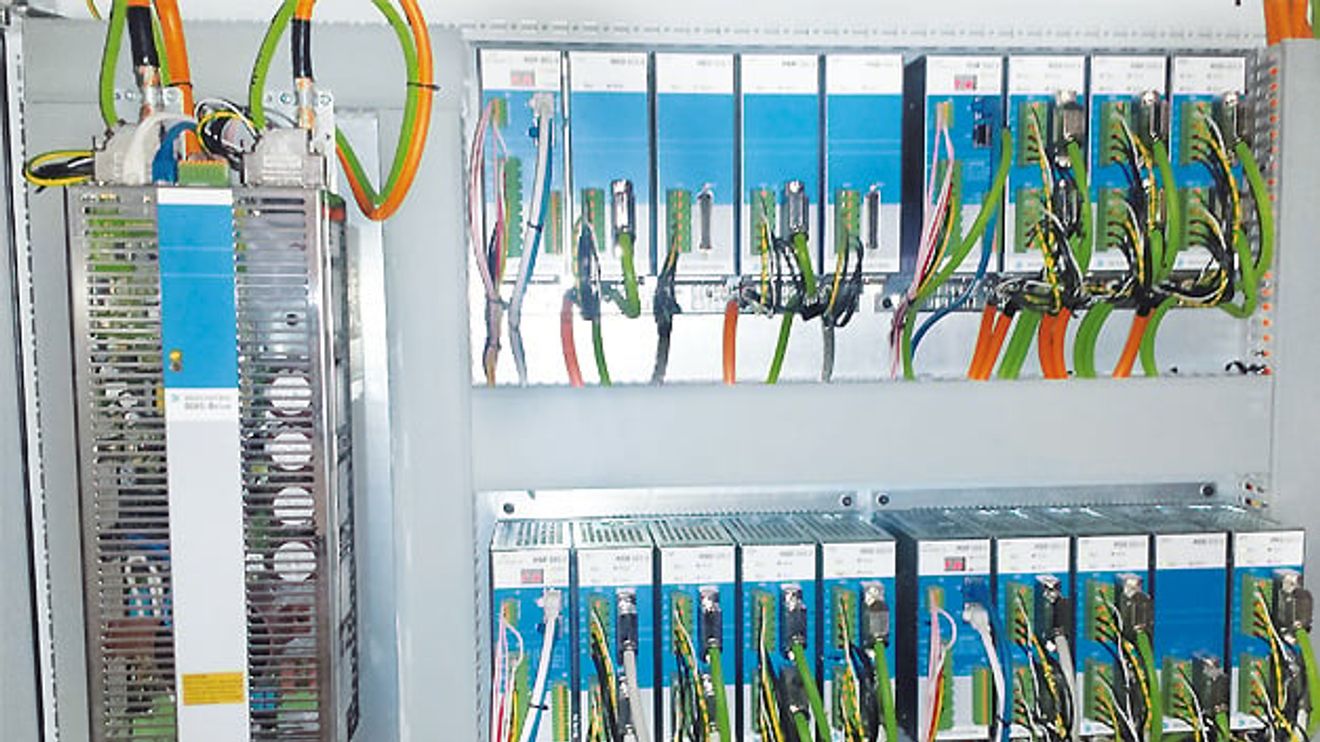
When it comes to drives, Weber Maschinenbau has opted for the compact SDD 300 and MDD 100 multi-axis systems from Sigmatek. The drives can operate servo, linear, high-torque and asynchronous motors.
© SigmacontrolAgainst this background, Sig-matek's multi-CPU strategy fitted perfectly into ConDoor's concept. This involves dividing the entire line into smaller, manageable functional units, each with a separate processor module. "This means that the units can be tested independently of each other and commissioned individually, which is a considerable simplification for a system of this complexity and saves a lot of time," explains Niels Joosten, responsible for programming this project at Weber.

The extremely slim control system saves valuable space in the control cabinet and can be expanded with a modular safety controller as required.
© SigmacontrolWith the slimline S-Dias series, the space required for the control solution is extremely small - even the CPU modules measure just 12.5 mm in width. The units can be easily and completely modularly expanded with safety control units. Accordingly, all emergency stop circuits at ConDoor, including the numerous installed solenoid interlocks for the safe monitoring of the protected areas, are covered by the control concept.
From Weber Maschinenbau's point of view, the ConDoor requirement to optimize the use of materials was a key aspect of the project. The aim was to produce as many segments as possible from the available standard panel lengths with the least amount of waste. In order to achieve this, however, a solution first had to be found with which the panels could be optimized and cut to size across all orders. Kees Geelhoed explains the solution.
System optimization reduces waste

The 'fathers' of the new production line: ConDoor founder Jaap Kwant (left) and Kees Geelhoed, Managing Director of Weber Maschinenbau.
© Sigmacontrol"We use a special software application that allows us to divide the production volume very evenly over an entire working week. The daily production is divided into batches, each comprising up to 20 gates. The product mix within a batch ultimately gives us the flexibility we need to optimize the use of the individual machines. After cutting, the panels are returned to the assembly line in batches. We have been working on this for a long time: Sigmatek's so-called de-nesting software continuously arranges and tracks the orders. All parts of an ordered door are brought together in a buffer zone and then transported onwards. For delivery, all parts must be stacked in such a way that the customer can always remove the components in the correct order on the construction site to install the door."
The production line is connected to the plant-wide ERP system via FTP. The ERP first creates a job list for each batch. This is forwarded to the machine control systems involved via Ethernet TCP/IP. In addition, the ERP provides an associated file for each panel, which contains information about its specific options. The HMIs from the ETV series, also from Sigmatek, with their 12.1-inch and 19-inch touchscreens, ensure that the order details of a batch can be clearly displayed for the operator alongside important and time-critical system information.
From ERP directly to production
The entire production process is structured and organized in such a way that the shift supervisor only has to confirm the start of production of the batches. However, he can change their sequence manually if necessary. Niels Joosten explains the solution in the software application: "Even before a single panel enters the production line for a new batch, the status messages of the individual controllers are queried using around 200 different telegrams. On this basis, the use of the system is planned for each individual batch."
The so-called 'Machine Manager' is used to set up the data transfer between the compact CPUs of the functional units. With the graphical software interface, the required data connections can be set up very easily using drag & drop. The Machine Manager also clearly displays all CPUs in the machine network and the Lasal applications for control, visualization and safety can be opened directly with a single mouse click.
Company founder Jaap Kwant attributes ConDoor's continued strong order situation and ongoing success to a large extent to the investment in the system described above and the perfectly designed automation system, which makes fast and efficient production possible in the first place.


You might also be interested in
Embedded AI agent integrated
Grossenbacher is expanding the 'Universal Controller' to include an embedded AI agent that can be executed directly in a container.
 read more...
Dual leadership in Shanghai
Stefan Becker has been appointed Managing Director of Eckelmann Automation Technology in Shanghai and will manage the subsidiary together with Zhongwei Huang.
read more...Complete solution for industry-specific control systems
The 'iCube Control' automation platform from Yaskawa is officially launched at the SPS: The first controllers from the control portfolio are available with the 'iC9226' series.
read more...Control multi-layered applications
Wago is launching the 'PFC300' controller on the market. According to the manufacturer, it enables universal and cross-industry programming, control and visualization. This is made possible by the Linux operating system, a dual-core 64-bit CPU and 2...
read more...Grossenbacher Systeme at the SPS 2024
Scalable 'Embedded AI' for Automation
The Universal Controller from Grossenbacher Systeme is based on the high-performance ARM-Yocto architecture and is scalable for AI applications through interchangeable System-on-Modules (SoMs).
read more...Controller, gate driver and communication in one IC
Microchip Technology offers a new series of integrated motor drivers based on the 'dsPIC' digital signal controllers (DSCs) to enable efficient embedded real-time motor control systems in space-constrained applications.
read more...Efficiently to the bus controller
Systemtechnik Leber and E-T-A have developed a space-saving and price-sensitive bus controller for monitoring electronic circuit breakers. A practical development example.
read more...Nearby controller with Powerlink interface
The 'SN4D' product line developed and produced by Ever Elettronica consists of nearby controllers that are suitable for applications where decentralization of the installation on the machine makes sense.
read more...Miniature servo controller for small spaces
Actronic-Solutions introduces the 'Nano' series of digital servo drives from Copley Controls. The miniature servo controllers can be integrated into autonomous driverless transportation systems, autonomous mobile robots, robot joints and other...
read more...