

Artificial intelligence in production
BMWi project 'OPAK' completed
Software that largely programs itself - this is the goal that Lemgo scientists have been pursuing together with companies from the automation industry as part of the 'OPAK' project. After three years of research, the project has now been completed.
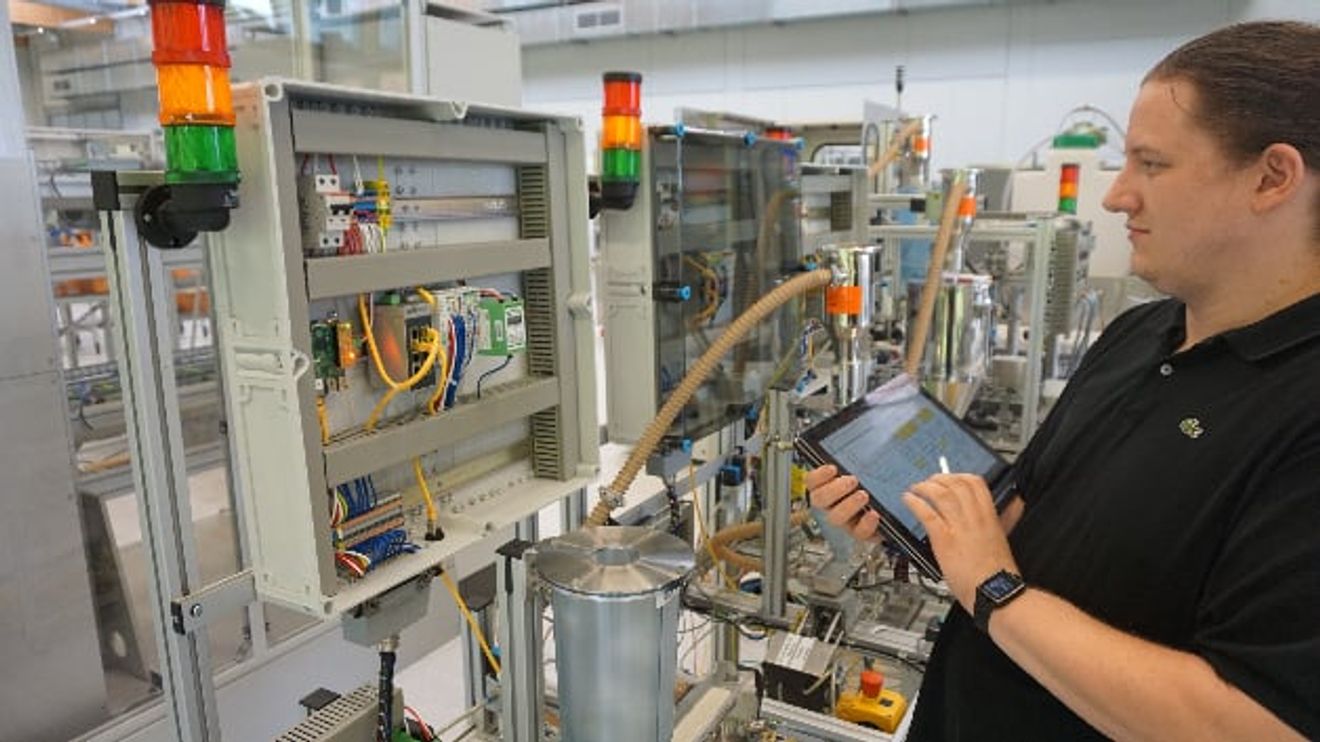
The goal of OPAK: The modern automation system "programs" without program code.
© Centrum Industrial IT (CITT)OPAK stands for "Open engineering platform for autonomous, mechatronic automation components in function-oriented architecture". With this project, the partners involved want to set new standards in the control architecture and engineering processes of production systems. Professor Oliver Niggemann, Director of the Institute for Industrial Information Technology (inIT) at OWL University of Applied Sciences, explains the motivation for this: "The main bottleneck in the adaptation and reconfiguration of production systems today is the programming of the automation software. De facto, however, there are not enough programmers on the market to constantly write or reprogram new software for a modularized plant model." OPAK's declared aim was therefore to create software that generates itself largely automatically.
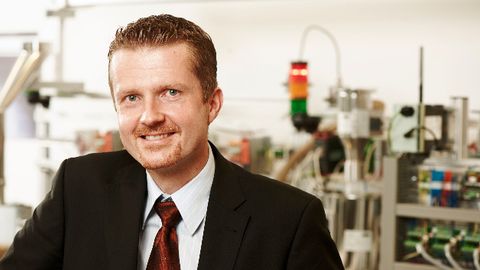
Professor Oliver Niggemann: "Our solution increases the adaptability of technical systems and reduces the engineering effort involved in planning the automation solution."
© Centrum Industrial IT (CITT)Modular, intelligent mechatronic components developed as part of the research project are intended to simplify the design and assembly of a production system. In addition, an algorithm generates large parts of the control code of a system automatically; only the mechatronic components involved and their capabilities are required.
Among other things, the researchers at inIT worked on the development of software that can control the complete commissioning and conversion of large factories itself. The research results were implemented in a demonstrator in the SmartFactoryOWL - a joint research and demonstration factory of Fraunhofer IOSB-INA and the OWL University of Applied Sciences. This multi-vendor system has a modular structure: Each module has its own decentralized control system and consists of automation components in a heterogeneous environment from different manufacturers. For example, a Raspberry PI with Codesys runtime environment is used as a small controller to control the modules. The entire system is fully networked on the basis of standards such as Ethernet, WLAN or OPC-UA.
The OPAK approach offers a visual interface with which an application can be implemented from predefined component descriptions and by calling up component skills. The writing of source code or function blocks and program code has been replaced by a graphical editor, the Codesys Application Composer. This development environment for creating/configuring application applications enables a completely new type of function-oriented engineering approach: in future, it will free the automation engineer from non-value-adding activities such as programming at signal level, thus placing the planning, design and optimization of automation processes back in the foreground.
The OPAK project was funded by the German Federal Ministry for Economic Affairs and Energy (BMWi) over a period of three years as part of the German government's largest Industry 4.0 research program "Autonomik für Industrie 4.0". The project partners inIT, Asys, 3S, Elrest, Festo, Fortiss and Intracom came from different areas - from research to component manufacturers and system integrators - and thus covered the entire value chain. The work at inIT alone was funded with almost half a million euros.


You might also be interested in
The Industry 4.0 case
Fraunhofer IOSB-INA has developed a new type of mobile sensor system. What looks like luggage is actually a mobile 'Industry 4.0 analysis case' for machines and systems.
 read more...
A separate brand for artificial intelligence
Artificial intelligence is becoming an important topic in more and more areas of industry and life. Mitsubishi Electric is now bundling its technology activities in this area under the new "Maisart" brand.
read more...Artificial intelligence in USB format
Intel presents a USB stick that accelerates deep learning algorithms with the help of a VLIW processor. It processes the data locally in real time and is therefore particularly suitable for systems without a connection to the cloud.
read more...Schneider Electric takes over nxtControl
The Schneider Electric Group, which operates in the field of energy management and automation, has acquired nxtControl. The Austrian company specializes in real-time control software for distributed systems based on the IEC 61499 standard.
read more...DFKI / TU Kaiserslautern / SmartFactory
Martin Ruskowski succeeds Detlef Zühlke
On June 1, Dr. Martin Ruskowski will take over from Dr. Detlef Zühlke as head of the "Innovative Factory Systems" research department at DFKI in Kaiserslautern and the former Chair of Production Automation (PAK) at TU Kaiserslautern.
read more...OPC UA is set!
OPC UA is regarded as the established standard for Industry 4.0, so you couldn't miss it at Hannover Messe 2017 - as demonstrated by three short videos.
read more...Voith drives digitalization forward
The mechanical engineering group Voith has acquired a 60% stake in the digital service provider Ray Sono. Together, the two companies want to establish a new business area for industry-related digitalization solutions.
read more...The new possibilities with Grafcet
Grafcet is a standard that has so far been used to describe the control function of a machine or represent a sequence control. New software now makes it possible to transfer the created Grafcet directly to any PLC platform.
read more...More intelligent together
ABB has entered into a strategic partnership with IBM. The aim is to combine the ABB Ability digital offering with the cognitive capabilities of IBM's Watson IoT.
read more...