
Embedded Computing
With ARM into the industry
Integrated in the standard SMARC 2.0 and Qseven modules, the new ARM-based processors of the 'i.MX 8' family from NXP are predestined for a wide range of applications. But which models are suitable for industrial use?

As processors from the 'i.MX8' processor family are available in a wide range of configurations and performance classes (i.MX 8, i.MX 8M, i.MX 8X), the areas of application are also very diverse. They range from smaller industrial control and automation systems such as PLCs, I/O controllers, robotics and handling systems to building management systems as well as IoT and M2M applications with distributed devices of various designs, automotive and intralogistics cockpits or distributed smart video surveillance systems.
At the same time, the new 'i.MX-8X' processors - which integrate the most efficient Cortex cores that ARM has ever developed - can also be used in the extended temperature range between -40 and +85 °C, making the new processor class ideal for outdoor and mobile vehicle applications. With a power consumption of between 3 and 12 W in normal operation, the i.MX-8 processor family is also suitable for completely fanless and solar-powered applications and, with its high degree of integration of graphics, video, audio and voice functions, it can also be used to implement HMIs, rugged tablets and handhelds. Even if these devices are equipped with the most economical 3-watt processors, they already offer a performance that is significantly higher than what was considered high-performance for tablets just a few years ago. The integrated image processing functions also predestine the new processors for video analytics and the use of neural network technology for object recognition and situational awareness applications, for example in collaborative robotics. But which processors are recommended for industrial use?
Initially, Congatec focused on two processor classes in the family, as both the 'i.MX 8' in the QuadMax, QuadPlus and Dual variants and the 'i.MX 8X' were developed for industrial applications throughout and therefore support the important - because cost-effective - LVDS connection for integrated displays, among other things. However, the company does not currently support the 'i.MX 8M', which is already available in series production, for precisely this reason, as it lacks LVDS support. But what are the differences between 'i.MX 8' and 'i.MX 8X'?

What is the difference?
As the flagship, the new 'i.MX-8' processor (Quadmax) has been in the sights of embedded system developers for some time. It is the most powerful of the entire family and extends into the application field of previous low-power x86 processors, so that it can also replace existing designs in this category, which can offer TPD and price advantages when purchasing processors. The new 'i.MX 8X' series is also available these days. It extends the scalable range of the 'i.MX-8' series with a particularly energy-saving and robust processor variant, opening up additional application fields for very small smart devices with full application flexibility thanks to open operating system support.
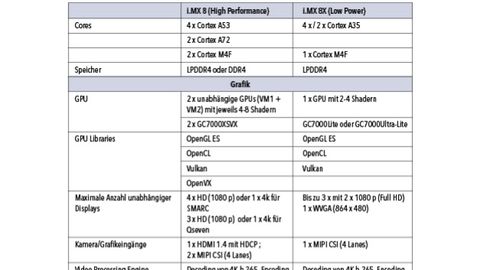
The 'i.MX 8X' differs from the 'i.MX 8' (Quadmax) primarily through the use of ARM Cortex A35 cores instead of the up to four ARM Cortex A53 cores in the 'i.MX 8' (Quadmax) and the omission of the ARM Cortex A72 cores. In addition, the 8X series has one instead of two Cortex M4F with an integrated floating point unit and DSP for processing critical tasks such as fallback camera, system monitoring and system wake-up. It therefore offers a more economical and energy-efficient feature set overall. This reduces power consumption to 3 to 4 watts.
For video-based applications, the 'i.MX 8X' supports a 4-lane MIPI CSI interface, among other things. The GPU with 2 to 4 'Vec4 shaders' (1x GC7000Lite or 1x GC7000UltraLite) also supports OpenGL ES, OpenCL, OpenVG and Vulkan for parallel data processing outside of graphics output. The focus is on situational awareness applications through image recognition as well as AI applications and deep learning applications for machine learning. If you are still missing something from this extensive feature set of the 'i.MX 8X', you can assume that the 'i.MX 8' as a larger variant can certainly go one better in almost every feature category.
The i.MX 8 offers a total of up to eight cores (4x A53, 2x A72, 2x M4F) with a power requirement of up to 12 watts. The 'i.MX 8' also supports up to three independent displays as well as 1x SPDIF and 2x ASRC sound including comprehensive codecs for speech recognition and touchless interaction.
All variants can connect at least two displays in full HD (1080p) and another in WVGA (864x480). The integrated video processing engine supports de- and encoding of 1080p videos in h.264 as well as decoding of even higher resolution 4K videos in h.265.
Another important feature is the hardware-based resource partitioning, with which both the processor and graphics cores can be separated, allowing the operation of several independent applications on a single chip. In combination with hypervisor support, this makes it possible to develop highly flexible, fail-safe systems - essential for autonomous robotic vehicles, for example: if the 3D camera system fails, for example, a camera still remains available in fail-safe B/W mode. The same principle can be applied to other vision-based control systems in automation technology.
Many interfaces - including real-time Ethernet
The core also features a PCIe 3.0 interface for flexible expansion options as well as 1x USB 3.0, 2x USB 2.0, 3x CAN, 4x UART, 4x SPI and 1x 12-bit AD converter. The two Gigabit Ethernet interfaces are also ideal for horizontal and vertical networking in automation. The 1588-compliant support of real-time communication via the TSN protocol for Industry 4.0 and IoT suitability is also supported as an option, so that several welding robots/arms in a production cell can be synchronized in real time via Ethernet. This support can be realized with the 'i.MX 8X' by using an additional Qualcomm Atheros module, as optionally implemented with the modules from Congatec. AVB (Audio Video Bridging) is also supported for video streaming via Ethernet, which can be of interest for cameras that use GbE for monitoring and quality control, as a point-to-point connection is no longer required and numerous video channels can be transmitted in duplex mode.
In addition, both processor variants offer very high reliability thanks to the so-called FD-SOI manufacturing technology (FD-SOI: Fully Depleted Silicon on Insulator) used, with which the application processors manufactured in the 28 nm process drastically improve the MTBF compared to previous technologies and reduce latch-ups - due to the high immunity of FD-SOI to soft errors. All these functions together with the sophisticated security features, such as high assurance boot, TPM timer, comprehensive encryption functions and up to ten active and passive tamper pins, make the new processors an ideal basis for the development of energy-saving and reliable embedded computing platforms for automation.
High investment protection thanks to Computer-on-Modules

Which solution is right for my application? Users need to ask themselves these questions.
© CongatecCongatec offers all these processors on SMARC 2.0 and Qseven modules in application-ready and immediately production-ready versions. The advantage here is not only the fact that the modules are application-ready - which saves NRE (non-recurring engineering) costs - but also that companies such as Congatec offer other suitable hardware-related software services, which makes integration even easier. At the same time, they ensure a long-term availability roadmap that is not even limited by the processor architecture, as all low-power x86 processors are available on these module standards. And that is a good thing, because thanks to increasing processing performance, it is no longer a question of whether the ARM or x86 instruction set is more efficient or not. There is so much glue logic in modern programmed and therefore hardware-independent application codes that the actual application functions are becoming increasingly independent of the pure hardware - even in soft PLCs or Java-based GUI software, for example. Today, more and more development frameworks and runtime tools also support both architectures. Linux too, of course. Even an Android-x86 is available.
Nevertheless, you can't just install software on one platform or the other and have everything work 'like clockwork'. The crux is often in the detail. Not least because there are hardware experts for either ARM or x86. Depending on the supplier, the API is then designed differently for specific board configurations. The situation is completely different with standardized SMARC 2.0 and Qseven modules. They have - at least with Congatec - functionally identical APIs and come with a homogeneous set of drivers and libraries in accordance with the form factor and embedded API specifications according to PICMG. They also enable an extremely simple physical platform change. Only the appropriate module needs to be changed on existing carrier boards.
Consequently, anyone setting up industrial computer designs in the low-power segment should consider implementing them on the basis of the leading Computer-on-Module standards. This puts developers on the safe side in terms of processors, and what is hosted on the carrier board of these modules can always be precisely attributed to the needs of the application.
Authors:
Martin Danzer is Director of Product Management at Congatec;
Daniel Gunter is Head of the Technical Solution Center (TSC) at Congatec.


You might also be interested in
SMARC modules with up to eight cores
Congatec is launching robust SMARC modules based on the Intel Atom x7000RE processor series (codenamed Amston Lake) and Intel Core i3 processor, which have been specially developed for industrial requirements.
 read more...
Next-generation AI computing for the edge
Congatec introduces COM Express Compact modules based on Intel Core Ultra processors. The new modules combine heterogeneous computing units such as CPU, GPU and NPU and are therefore particularly suitable for executing demanding AI workloads at the...
read more...New man in the management team
Congatec, a provider of embedded and edge computing technology, has appointed Dominik Reßing as its new CEO.
read more...The decisive factor is the performance class
It is not easy for developers to correctly evaluate the different form factors of the standardization bodies. Depending on the performance class, only a single standard is usually recommended for new system designs. However, there are also...
read more...Choose your cover photo favorite of the year 2022
Which cover picture did you like best this year? Take part in a short survey and optionally in the prize draw for great prizes.
read more...The top articles in October 2022
The top articles in October are outside the norm, showing the advantages of scalability, intelligent robots and the role of AI in control. In addition, the top article from September remains a perennial favorite. Read for yourself.
read more...Functionally secure with x86 multicore
Power-hungry sensor technology in applications with functional safety (FuSi) means that embedded computing platforms must also increase their performance - multicore processors are therefore increasingly coming into focus.
read more...Five new COM-HPC Server Size D modules
Congatec is expanding its portfolio with five new COM-HPC Server Size D modules with Intel Xeon D-2700 processors.
read more...Congatec tackles the safety market
At embedded world, Congatec announced that it was investing heavily in functional safety. The motivation behind this is that functionally secure embedded computing platforms are needed in many new applications.
read more...